Introduction
The adoption of disc brakes on road bikes was not a smooth journey—from the UCI’s experimental approval in 2015 to full permission for professional racing in 2018, disc-brake road bikes finally secured mainstream status after much controversy. Taiwan’s riding environment—from the 3,275-meter long descents of Wuling to the wet surfaces of northern mountain roads—actually demands the reliable braking power of disc brakes more than the flat European race circuits. This article will help Taiwanese cyclists fully understand this technology, from the principles of physics to everyday maintenance.
How Hydraulic Disc Brakes Work
The core of hydraulic disc brakes is Pascal’s principle of fluid mechanics: a liquid in a closed container transmits pressure completely, and the pressure is equal in all directions.
System components:
- Master Cylinder: Controlled by the lever at the handlebar end, it pushes a piston to compress the brake fluid
- Hydraulic Line: A sealed channel that transmits pressure, typically a stainless steel braided hose
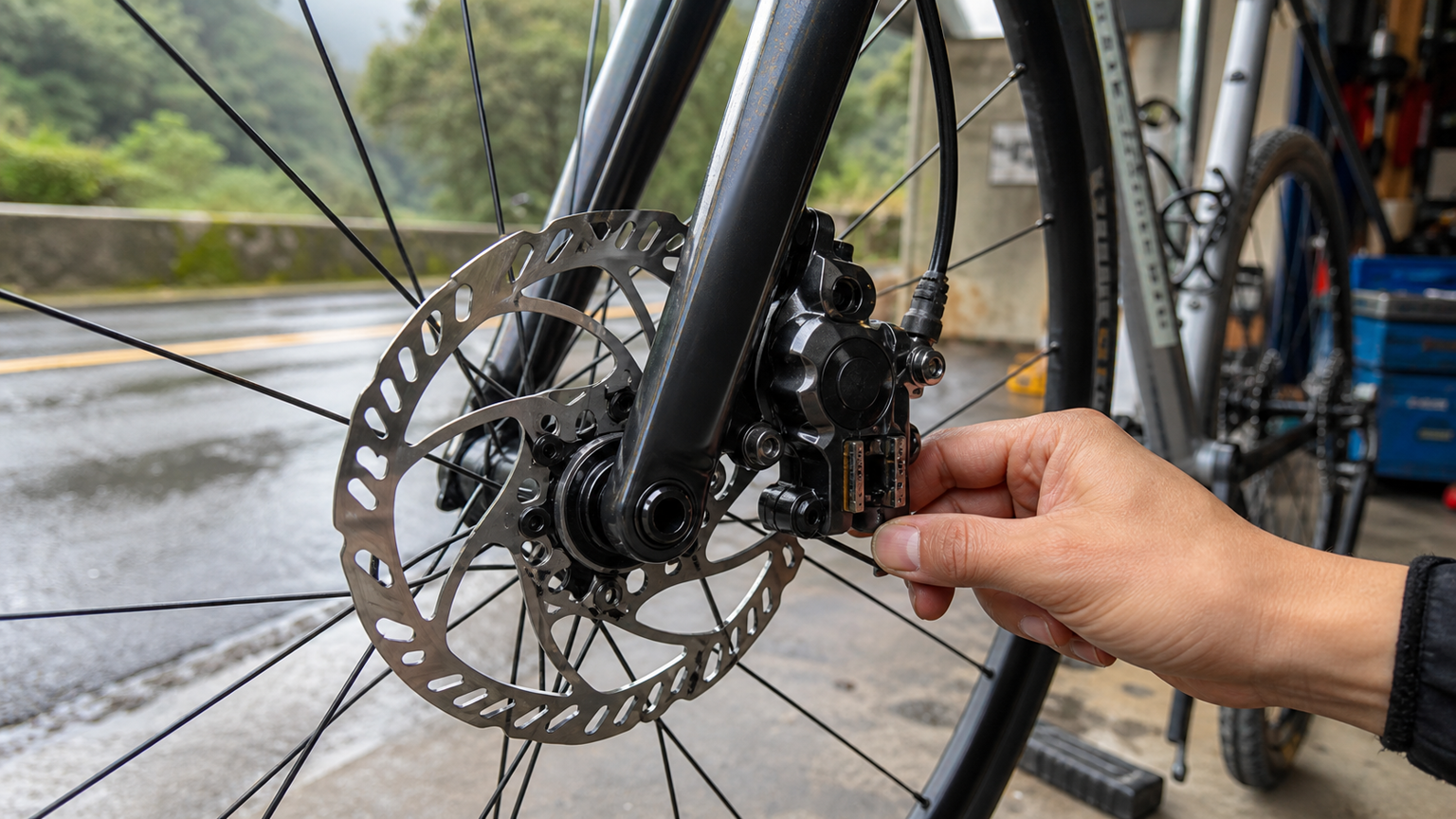
- Caliper: Mounted to the frame/fork, containing one or more pistons
- Rotor: Mounted to the hub, rotating with the wheel
- Brake Pad: Pushed by the piston to clamp the rotor and generate friction for braking
The force multiplication principle of hydraulics: the master cylinder piston has a small surface area while the caliper piston has a large surface area. According to the relationship pressure = force/area, under the same pressure the caliper outputs greater clamping force. This is precisely why hydraulic disc brakes feel light at the lever yet deliver powerful braking.
Rotor Size and Material Selection
| Rotor Size | Heat Dissipation Area | Braking Power | Weight | Suitable Scenarios |
|---|---|---|---|---|
| 140mm | Standard | Standard | Light | Flat-road commuting, lightweight climbing |
| 160mm | Good | Excellent | Medium | Rolling hills, mixed routes |
| 180mm | Excellent | Strong | Heavier | Long mountain descents, mountain bikes |
| 203mm | Best | Strongest | Heavy | Heavy-duty mountain bikes, Enduro |
The mainstream choice for Taiwanese road bike users is 160mm front / 140mm rear. This combination strikes a good balance between braking power and weight. For riders who frequently tackle long descents such as Wuling or Guanyinshan, upgrading both front and rear to 160mm is an option worth considering.
Rotor materials:
- Stainless steel (SUS): Most common, good durability, but heavier
- Aluminum core + stainless steel braking surface: Reduces weight; designs like the Shimano RT-MT800 use this construction
- Floating rotors: The braking surface is separated from the aluminum core, reducing heat transfer and minimizing brake pad heat fade
Brake Pad Selection: Resin vs. Metallic
This is the most common choice faced when using disc brakes:
Resin/Organic Pads:
- Linear feel, more progressive braking sensation
- Low noise at low temperatures
- Prone to heat fade at high temperatures (long descents)
- Ideal choice for flat-road commuting and light mountain riding in Taiwan
Metallic/Sintered Pads:
- Heat-resistant, stable performance on long descents
- More consistent braking power in all weather conditions (wet surfaces)
- Require a longer break-in period initially
- May require a rotor with higher heat dissipation
- Recommended choice for long descents such as Wuling and Hehuanshan
The Impact of Taiwan’s Climate on Disc Brakes
Taiwan’s hot and humid environment has specific effects on hydraulic disc brakes:
Brake Fluid Management:
The fluid used in hydraulic systems falls into two categories: mineral oil (used by Shimano, Magura) and DOT fluid (used by SRAM, Tektro). Mineral oil is relatively stable and does not readily absorb moisture from the air; DOT fluid is more hygroscopic. In Taiwan’s high-humidity environment, it is recommended to replace DOT fluid every 1-2 years to prevent a drop in boiling point that could lead to braking failure.
Noise Issues:
Disc brake squeal is the most commonly complained-about issue among Taiwanese cyclists. Common causes:
- Brake pads or rotors contaminated with oil (chain lube, anti-rust spray)
- Warped rotor (rapid cooling after high heat)
- Uneven brake pad wear
- Misaligned caliper mounting
Cleaners (disc-brake-specific sprays) are the first step in resolving oil contamination; a warped rotor requires a truing tool or replacement.
Recommended Maintenance Schedule
- After every ride: Confirm braking power is normal and check for any unusual noises
- Every 500-1,000 km: Check brake pad thickness (replace when it reaches ≥1.5mm)
- Every 2,000-3,000 km: Clean the rotor and brake pads, check that caliper pistons retract properly
- Every 2 years: Replace DOT system fluid (mineral oil every 3 years or as needed)
- After a crash: Immediately check rotor trueness and caliper position
Practical Advice
- Have bleeding done by a professional: Bleeding a hydraulic system requires specialized tools; it is recommended to have it handled by an authorized shop
- Never let oil/grease touch the system: If brake pads or rotors become contaminated with grease, the result ranges from noise to complete braking failure. Residue may remain even after cleaning, and replacement may be necessary in severe cases
- Test before and after long descents: Before descending on Taiwan’s mountain roads, lightly squeeze the brakes a few times to verify the braking feel is normal
- The rotor is very hot after stopping: This is normal; avoid touching it and do not immediately wash the bike with water (thermal shock can warp the rotor)
Conclusion
Hydraulic disc brakes are one of the most significantly advanced systems in road bike technology in recent years. Understanding how they work and mastering proper maintenance knowledge not only ensures safety on every ride but also extends system lifespan and reduces long-term costs. Taiwan’s mountainous terrain allows disc brakes to fully demonstrate their advantages. Investing in a reliable hydraulic disc brake system is the most worthwhile safety upgrade for Taiwan’s mountain road riders.
Related Reading
- Evolution of Road Bike Braking Systems: Mechanical Disc vs. Hydraulic Disc vs. Rim Brake Comparison
- Complete Road Bike Brake System Comparison: Rim Brakes vs. Disc Brakes—Which Suits Riding in Taiwan?
- MTB Brake Systems: Hydraulic Disc Brake Adjustment and Prevention of High-Temperature Fade
- Bicycle Brake Systems: Performance Differences Between Disc Brakes and Rim Brakes on Taiwan’s Mountain Roads
碟煞公路車 銑面器 !? 原來銑完差這麼多! 降低蹭碟機率! | TIME 公路車 保養小記錄 | CT Yeh
3 年前
碟煞公路車 優缺點?換車一年半實際經驗分享 / 公路車 / CT Yeh
2 年前
再一組! 全碳幅條 碟煞/無內胎輪組 開箱! 到底好騎嗎? UNAAS X40 | 公路車 | CT Yeh
4 年前
公路車 BB培林大升級! / 備戰海鷗繞圈賽 Canyon Aerod & TIME 一起改 / MIT大廠 CEMA對鎖式陶瓷培林BB & 導輪 / 公路車 / CT Yeh
2 年前
鉅齒紋輪組!? ControlTech MEG-T50 EVO 碳纖維幅條輪組/ 功率對比實驗 / 公路車 / CT Yeh
2 年前
換車囉! TIME ADH 2023 全內線碟煞公路車 開箱實錄!/ Dyneema 碳纖維真的太猛了 / 曜越單車 / CT Yeh
3 年前
公路車 爬坡 破PR 紀錄 小技巧 分享
6 年前
西進武嶺 自製新版AI配速表產生器 x 賽前攻略 抱佛腳! 沒有功率計也可以產生配速表嗎?有什麼其他眉角賽前要注意的呢? | 西進武嶺 / 東進武嶺 KOM 攻略 | 公路車 | CT Yeh
4 年前