Introduction
The width, shape, and material of a road bike’s handlebar are perhaps the most overlooked components, yet they have one of the most direct effects on comfort. An ill-fitting handlebar width can lead to chronic neck and shoulder tension; a poorly designed drop curve can cause wrist fatigue during long rides in the drops. In recent years, aero bars with fully integrated cable routing have introduced an entirely new riding experience — sleek, low-drag, but significantly more complex to service. This article gives a comprehensive breakdown of handlebar system options.
The Science Behind Handlebar Width
The traditional rule of thumb is “handlebar width should match shoulder (acromion) width,” but modern research and trends among professional riders are shifting toward narrower bars. On the UCI professional circuit, handlebar widths that once centered around 44–46cm have, in recent years, given way to riders adopting 38–40cm narrow bars, paired with optimized aero tuck positions.
Factors to consider when choosing width:
- Handling: Wider bars provide better leverage for control on technical mountain descents
- Comfort: Overly narrow bars can compress the chest and restrict breathing
- Aerodynamics: Narrow bars combined with tucked-in arms can significantly reduce frontal area
- Taiwan riding scenarios: On mountain roads, prioritize handling; on long flat routes, prioritize aerodynamics
Recommendation: Use your own shoulder (acromion) width as a baseline (±2cm). For your first setup, choose a standard width, then adjust based on riding needs once you’ve built up experience.
Breaking Down the Three Main Handlebar Types
Traditional Drop Bars
Traditional drop bars are the most common design on road bikes, with these basic geometric parameters:
| Parameter | Description | Effect |
|---|---|---|
| Reach | Horizontal distance from the top of the bend to the end of the drops | Degree of forward lean when riding in the drops |
| Drop | Vertical distance from the top of the bar to the bottom of the drops | Difference in riding position height |
| Flare | The angle at which the drops flare outward | Handling stability; comfort on gravel/long rides |
Short reach/short drop design (Reach ≤70mm, Drop ≤120mm): Suited to riders with lower flexibility or a preference for a more upright position, prioritizing comfort.
Standard design (Reach 73–80mm, Drop 125–128mm): The choice of most competitive riders, balancing aggressiveness and comfort.
Flared design (drops flared 8–16° outward): A recent trend, offering more stable handling on technical terrain — particularly beneficial for riding Taiwan’s mountain roads.
Aero Flat Bars
Aero flat bars generally come in two forms:
Static aero bars: The top section of the bar is reshaped into a flattened cross-section, improving aerodynamics while retaining traditional handling characteristics. Representative examples include the Zipp SL-70 Aero and 3T Superergo series.
Time trial extension bars (TT Bar/Tri Bar): Extension arms and elbow pads are mounted in front of a standard drop bar, allowing the rider to adopt a prone-like position that minimizes frontal area. This is the standard setup for time trials and triathlons, and is widely used by Taiwanese IRONMAN athletes.
Integrated Handlebar/Stem Systems
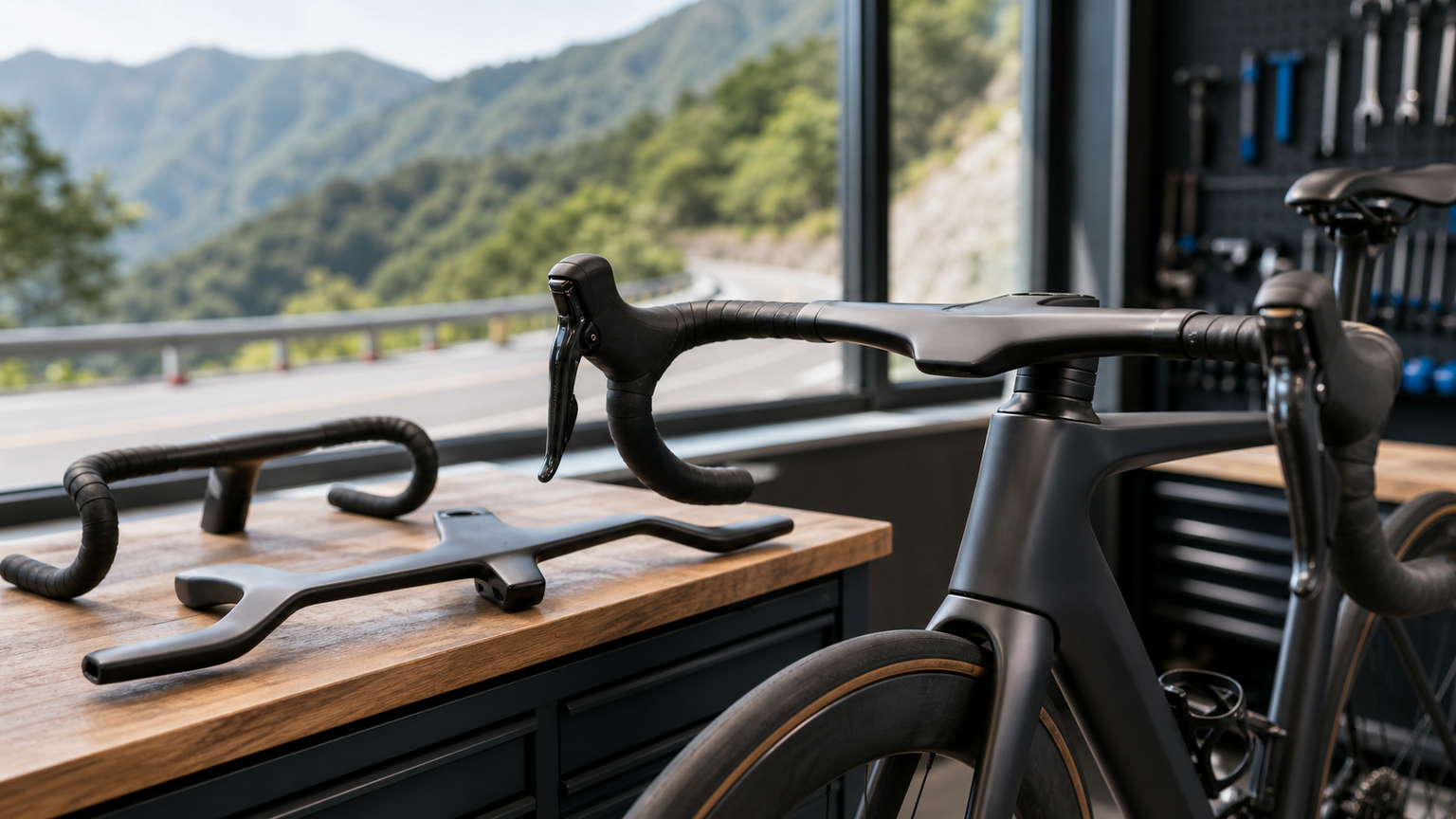
Integrated cockpits are one of the most eye-catching design trends among high-end road bikes in recent years. Representative products include:
- Specialized S-Works Future Toupe (stock on the Venge/Tarmac SL7)
- Canyon Aerocockpit
- Cervelo Smartfit
- Pinarello Dogma series integrated cockpits
Core advantages of integrated cockpits:
- Optimized aerodynamics: Cables are fully internally routed, eliminating the turbulence caused by traditional exposed cables
- Stiffness: The one-piece construction delivers higher system stiffness
- Aesthetics: An extremely clean look at the front of the bike
Notable limitations of integrated cockpits:
- Difficult fit adjustment: Bar height is fixed at the design value and cannot be adjusted with spacers like a traditional setup; some designs don’t even allow horizontal position adjustment
- Complex maintenance: Operations like brake pad replacement or derailleur adjustment require the cables to be disconnected first, significantly increasing labor costs
- Compatibility issues: Certain frame brands are only compatible with their own proprietary integrated cockpits
For Taiwanese riders who are still exploring their optimal fit position, the limited adjustability of integrated handlebars is the biggest concern. It’s recommended to have a professional bike fit done to confirm your position before considering an integrated cockpit installation.
Materials: Aluminum vs. Carbon Fiber
The impact of handlebar material on ride quality is often underestimated:
Aluminum handlebars: Durable and low maintenance cost. In the event of a crash, if there’s no visible deformation, the bar is usually still usable, though it’s advisable to carefully check for cracks. On Taiwan’s gravelly mountain roads, aluminum bars offer relatively greater peace of mind in the event of a mishap.
Carbon fiber handlebars: Lightweight, with excellent vibration damping (especially for high-frequency road vibration). However, damage assessment is more difficult with carbon bars — after any crash impact, even if there’s no visible external damage, it’s important to carefully evaluate whether internal delamination has occurred. It’s recommended to purchase from a brand that offers a warranty policy.
The Importance of Bar Tape
Bar tape is a frequently overlooked key to comfort. EVA or gel composite bar tape with a thickness of 2.5–3.5mm provides significant protection for the hands and wrists on long rides. Given Taiwan’s hot, humid summer riding conditions, it’s recommended to choose bar tape made of silicone or cork with good breathability and anti-slip performance.
Practical Recommendations
- Get a bike fit first: Confirm the appropriate reach/drop specifications before upgrading your handlebar, to avoid buying something that doesn’t fit
- Beginners should choose traditional drop bars: Flexible to adjust and easy to service — the best foundation for building riding habits
- Time trial riders: Check UCI regulations (extension bar length limits) and pair with a bike fit to dial in your TT position
- When to consider an integrated cockpit: For advanced riders who have already confirmed a stable fit and are prioritizing optimal aerodynamics
- Regular inspection: Visually inspect carbon fiber handlebars annually, and have them evaluated by a shop immediately after any crash
Conclusion
Choosing a handlebar system is a balance between functionality and engineering aesthetics. For most Taiwanese riders, a traditional drop bar with an appropriate width and a reach/drop that suits their body, paired with quality bar tape, will already satisfy 95% of riding needs. The pursuit of an integrated aero cockpit is best left to competition-oriented riders who have already found their perfect fit and prioritize speed above all. Regardless of your choice, correct installation and regular inspection of the handlebar should always remain the top safety priority.
Related Reading
多到選擇障礙... 換個單車把帶想一個小時 / BTP / 編織&軟木特有材質超吸睛! / 公路車 / CT Yeh
1 年前
Canyon 公路車斷把手 五年老車特規還能修嗎? 維修保養全記錄 feat. 501單車監理站 | 公路車 | CT Yeh
4 年前
公路車 BB培林大升級! / 備戰海鷗繞圈賽 Canyon Aerod & TIME 一起改 / MIT大廠 CEMA對鎖式陶瓷培林BB & 導輪 / 公路車 / CT Yeh
2 年前
再一組! 全碳幅條 碟煞/無內胎輪組 開箱! 到底好騎嗎? UNAAS X40 | 公路車 | CT Yeh
4 年前
碟煞公路車 銑面器 !? 原來銑完差這麼多! 降低蹭碟機率! | TIME 公路車 保養小記錄 | CT Yeh
3 年前
3D 列印車褲墊 / 舒適改善? / 無痕 x 分區壓縮 / ATK & Decider系列 / JE22黑科技 / #公路車 #CTYEH
11 個月前
CT 喇低賽) 武嶺牽車 才是王道 西進牽車四小時內秘訣 攝手位置 如何判斷 防抽筋小秘訣
7 年前
碟煞公路車 優缺點?換車一年半實際經驗分享 / 公路車 / CT Yeh
2 年前