Introduction
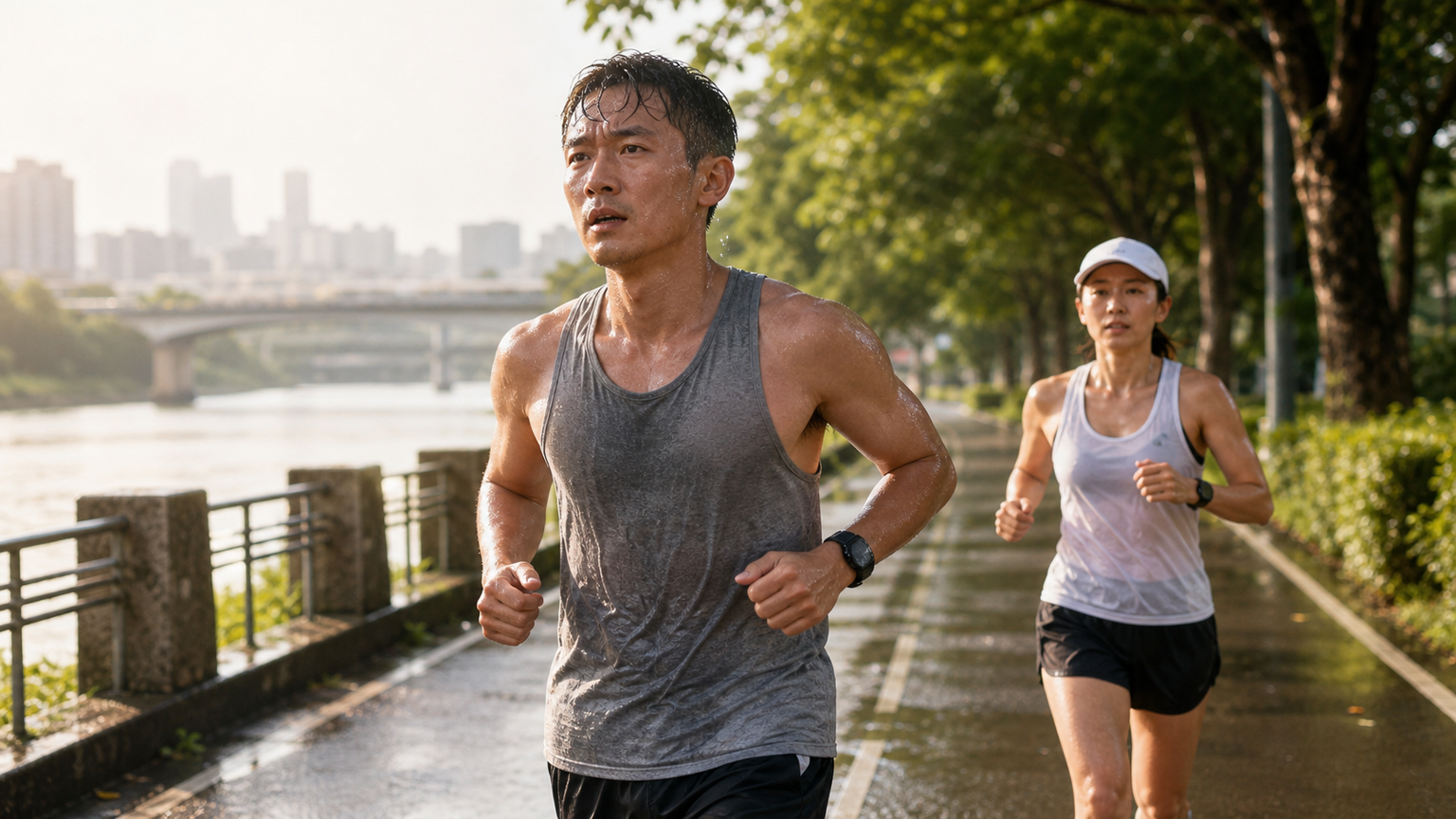
From May to September each year, runners in Taiwan face the same challenge: even just heading out for an easy jog at 6 a.m., within 20 minutes they are drenched in sweat with their heart rate soaring. Many runners completely abandon outdoor training in the summer, while those who persist risk a higher incidence of sports injuries and heatstroke.
At the core of this issue is thermoregulation—how the body maintains a stable core temperature during exercise, and what challenges Taiwan’s hot, humid environment poses to this mechanism.
Heat Production During Running
Running is an extremely inefficient energy conversion process. Of all the energy expended:
- Only about 25% is converted into mechanical energy (actually propelling the body forward)
- About 75% is converted into heat (becoming the source of rising body temperature)
Take a 70kg runner running at a 5:30/km pace as an example: hourly heat production is approximately 600–700 kcal, equivalent to the thermal output of a space heater. If heat cannot be dissipated effectively, core temperature will exceed safe limits within minutes.
The Body’s Heat Dissipation Mechanisms
The human body has four ways to dissipate heat:
| Dissipation Method | Mechanism | Importance in Running | Efficiency in Taiwan’s Summer |
|---|---|---|---|
| Radiation | Emitting infrared radiation to the environment | Low (small proportion during exercise) | Poor (high ambient temperature) |
| Convection | Airflow carrying heat away | Moderate (wind while running) | Moderate |
| Conduction | Direct contact with cool objects | Low (minimal contact while running) | Low |
| Evaporation | Sweat evaporation carrying heat away | Most important (accounts for 70–80%) | Severely affected by humidity |
In Taiwan’s summer, evaporative cooling is the most important heat dissipation mechanism, but relative humidity in Taiwan’s summer often reaches 80–95%, severely limiting sweat evaporation efficiency. This is why “37°C Taiwan summer” is harder to endure than “37°C Xinjiang desert.”
Physiological Stress of Exercising in Heat
When running in a hot environment, the body faces a dual challenge:
Increased Cardiovascular Strain
- Skin blood vessels dilate to enhance heat dissipation, but this reduces blood flow to working muscles
- Heart rate increases at the same pace (for every 1°C rise in ambient temperature, heart rate increases by approximately 2–4 beats per minute)
- Plasma volume decreases due to sweating, further reducing cardiac output
Core Temperature Critical Thresholds
- When core temperature reaches 38.5–39°C, athletic performance begins to decline noticeably
- At 40°C, central nervous system function is impaired, with reduced judgment and loss of coordination
- Above 41°C, the risk of heat stroke rises sharply, constituting a medical emergency
In Taiwan’s summer road races (such as certain evening events or summer challenge races), with temperatures exceeding 30°C, reaching a core temperature of 39°C during a race is not uncommon.
Heat Acclimatization: Getting the Body Used to the Heat
The good news is that heat acclimatization can significantly improve the body’s exercise capacity in hot environments:
- Increased sweating rate: After acclimatization, sweat secretion speeds up, and the core temperature threshold for starting to sweat lowers
- Increased plasma volume: After heat acclimatization, water content in the blood increases, better coping with the blood volume reduction caused by sweating
- Lower heart rate: At the same pace and environment, heart rate is 5–10 beats per minute lower than before acclimatization
- Lower sweat salt concentration: After acclimatization, sodium ion concentration in sweat decreases, reducing electrolyte loss
Heat Acclimatization Training Plan
- Duration: 10–14 consecutive days of exposure training yields significant adaptation
- Method: 30–60 minutes of moderate-intensity running in a hot environment daily
- Intensity: Zone 2–3 is sufficient; high intensity is not needed
- Retention period: Heat acclimatization effects last approximately 2–4 weeks; re-acclimatization is needed during the winter-to-summer transition
Practical Strategies for Summer Running in Taiwan
Timing Selection
- Best times: 5–6 a.m. (before sunrise) or after 10 p.m., when temperatures are relatively lower
- Avoid: 10 a.m. to 4 p.m., when the UV index and temperatures are highest
- Watch the “heat index”: Don’t just look at temperature—the heat index combining temperature and humidity is the true indicator of exercise risk
| Heat Index (°C) | Risk Level | Running Recommendations |
|---|---|---|
| <27 | Low | Normal training |
| 27–32 | Moderate | Reduce pace, increase hydration |
| 32–39 | High | Shorten duration, closely monitor body signals |
| >39 | Extreme | Switch to indoor training or rest completely |
Clothing and Gear
- Choose light-colored, breathable, moisture-wicking fabrics
- A hat can block direct sunlight, but don’t let it impede heat dissipation from the head
- Splashing cool water on the back of the neck, wrists, and other areas rich in blood vessels can accelerate core temperature reduction
Hydration Strategy
- 30 minutes before running: drink 400–600mL of water
- During running: replenish 150–250mL every 15–20 minutes (don’t wait until you’re thirsty)
- After running: replenish 125–150% of sweat loss (approximately 1500mL needed for every 1kg of body weight lost)
- For long summer runs (>60 minutes), consume sports drinks containing sodium to prevent hyponatremia
Recognizing Heat Exhaustion and Heat Stroke
Every summer road runner in Taiwan should know the difference between these two emergency conditions:
- Heat exhaustion: Heavy sweating, dizziness, nausea, weakness, with cool and clammy skin. Move to a shaded area immediately and replenish with electrolyte fluids; recovery is usually spontaneous.
- Heat stroke: Body temperature exceeds 40°C, skin is hot and dry (sweating mechanism has failed), and consciousness is altered. This is a medical emergency requiring an immediate call to 119.
Practical Advice
- Adjust the “definition of success” for summer running in Taiwan: define training intensity by heart rate rather than pace
- Allow the body to naturally heat-acclimatize over 7–10 consecutive days of running; don’t force yourself to maintain winter training volume and pace right away
- Training in Taiwan’s tropical regions (such as Tainan or Kaohsiung) before a race is one way to acclimatize to heat in advance
- Training partner system: running long distances alone in summer carries risks; running with a partner allows mutual observation of heat exhaustion symptoms
Conclusion
Taiwan’s summer climate poses a major challenge to road runners, but it is also an opportunity to develop heat acclimatization capacity. By scientifically understanding thermoregulation mechanisms, adjusting training strategies, and properly managing hydration and heat prevention, Taiwanese runners can not only continue training safely in summer but also enter the autumn racing season with stronger cardiorespiratory function and a heat-acclimatization advantage to smash their PBs.
Related Reading
- Thermoregulation in Road Running: The Science of Sweating Mechanisms and Heat Acclimatization Training
- Core Temperature Regulation in Running: Heat Balance Mechanisms Under Taiwan’s Summer High Temperatures
- Heat-Tolerant Runners: The Physiological Mechanisms of Heat Acclimatization for Summer Road Running in Taiwan
- Running in Taiwan’s Summer Heat: Training Strategies for 33°C Hot Environments
CT暗黑廚房) 車友必備 宇宙無敵鮮蚵湯 幫助訓練恢復 天然食補 好市多 超肥鮮蚵 破PR
7 年前
一日北高前的高裝檢 | 北高 360 | 挑戰11小時的裝備 | 一日雙塔 | 補給
6 年前
2019 夏季KOM 5小 完賽心得 準備攻略 東進武嶺 夏季登山王之路 Taiwan KOM Challenge
7 年前
台灣旅行團參加 第7回まえばし赤城山ヒルクライム大会 雙視點
8 年前
單車 一日北高 ( 雙城 ) 肥宅雙人瘋狂行 紀錄片 REACTO
10 年前
#東進武嶺 全程實況錄影 5小時半 #夏季KOM #太魯閣 Taiwan KOM Challenge Reality Video Taroko scenery
7 年前
水金九不厭五分 10度寒流冷到不願停!feat. 卡卡 / 公路車 / CT Yeh
6 個月前
實景訓練台) 彰化經典百K 高強度喵團 90分鐘 跟著一起練功 2019 Indoor workout Changhua Classic 100 Taiwan
7 年前