Team Strategy in the Medley Relay: Competitive Considerations in Order Arrangement and Baton-Handoff Technique
Introduction
The medley relay is the event in competitive swimming that most tests team coordination—the 4 × 100-meter medley relay requires four swimmers in backstroke, breaststroke, butterfly, and freestyle to combine in the most effective order, seamlessly connecting at each exchange to maximize individual speed into a total team result. In relay events at the National High School Athletic Games or the University Sports Cup, a team whose “individual events are not particularly outstanding” can often surpass opponents who are “strong individually but lack coordination” if they excel in strategy and relay exchange technique.
The Fixed Order and Restrictions of the Medley Relay
World Aquatics regulations stipulate that the stroke order for the medley relay is fixed as:
- Backstroke
- Breaststroke
- Butterfly
- Freestyle
This order is determined by the technical rules and cannot be changed. Therefore, the coach’s strategic focus lies in: which swimmer swims which leg, and how to maximize the time benefit of each exchange.
Swimmer Assignment Strategy
Basic Principle: Which Leg Should the Strongest Swimmer Take?
Traditional thinking holds that the strongest swimmer should be placed on the final leg (freestyle) for a powerful finish. However, modern competitive analysis shows that this strategy is not always optimal in every situation:
| Scenario | Recommended Assignment Strategy |
|---|---|
| Team is generally balanced | Place the strongest swimmer on the fourth leg (freestyle), using a strong finish |
| Butterfly or breaststroke swimmers are particularly outstanding | Consider building an advantage in the middle legs, allowing the fourth leg to swim from a leading position |
| Backstroke swimmer is the strongest | Build a psychological advantage on the first leg, putting pressure on opponents |
| Opponent’s breaststroke is especially strong | Build enough advantage on the first leg so that the deficit in the breaststroke leg can be recovered |
Considerations of Psychological Advantage
In highly competitive races, the psychological factor in relays is very important:
- Swimmers who start with a lead (butterfly and freestyle) typically perform with lower anxiety because the previous leg has already established an advantage.
- Swimmers who are chasing from behind have the opportunity to unlock their potential, but also face a higher risk of errors (such as disrupted stroke mechanics).
Research suggests: assign the swimmers with the strongest mental resilience to the legs most likely to involve chasing from behind, rather than considering pure speed alone.
The Time Benefit of Relay Exchange Technique
The Rules of Starting Timing
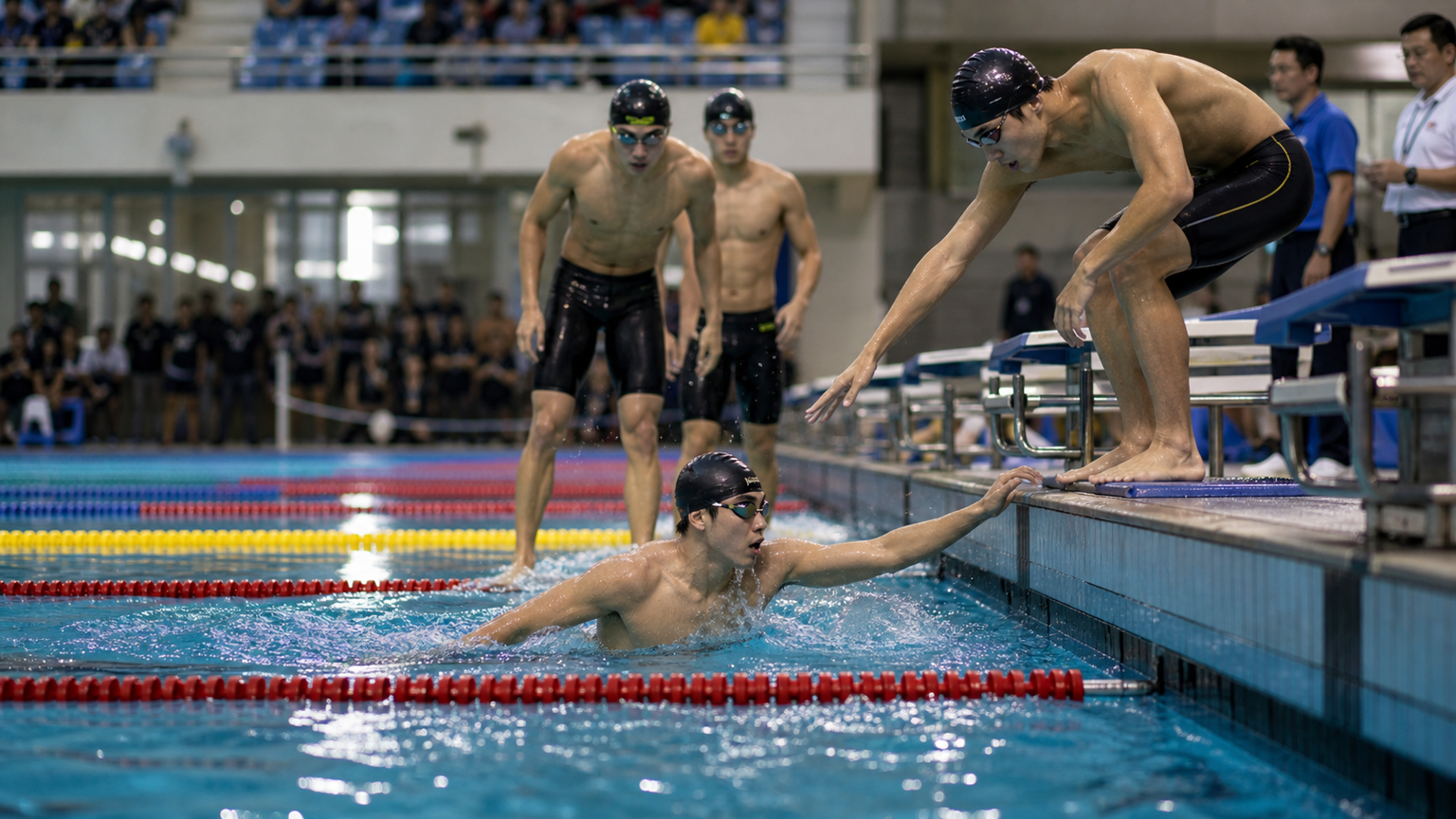
The relay exchange rule: the next swimmer may not leave the block before the previous swimmer touches the wall with any part of their body (an early start results in team disqualification). Therefore, the precision of exchange timing is the technical core of the relay.
Optimal exchange timing: the next swimmer initiates their dive at the moment the previous swimmer touches the wall, so that the start and the touch occur almost simultaneously.
Research shows that the average exchange reaction time (from the previous swimmer’s touch to the next swimmer leaving the block) for elite relay teams is approximately -0.03 to 0.05 seconds (i.e., starting almost exactly at the moment of touch or immediately after). In comparison, amateur teams often have exchange delays of 0.3–0.5 seconds, and across four exchanges, the total loss can exceed 1 second.
Relay Exchange Training Methods
| Training Method | Description | Frequency |
|---|---|---|
| Timed exchange practice | Two swimmers per group—one swims, one practices precise starting timing on the block | 1–2 times per week |
| Video analysis | Record exchange movements and review in slow motion to analyze the time difference between the previous swimmer’s touch and the next swimmer’s start | Monthly |
| Full-team relay simulation | Complete a full 4 × 100m rehearsal at race intensity, recording the time difference of each exchange | 2–4 weeks before competition |
The Ready Stance of the Next Swimmer
- When standing on the starting block, the next swimmer’s eyes should be locked on the spot where the previous swimmer will touch the wall (rather than the entire lane), using the smallest visual range to improve reaction speed.
- Keep knees slightly bent and maintain muscle pre-tension so that the “ignition” reaction for the dive is as fast as possible.
- Avoid excessive tension leading to muscle stiffness while waiting; light ankle movements can be performed during the wait.
Common Problems of Taiwanese Relay Teams
- Assembling a team at the last minute: Taiwanese school swim teams sometimes finalize their relay lineup only shortly before competition, leaving insufficient time for joint practice. It is recommended to confirm the lineup at least 2 weeks before competition and conduct 3–5 full joint practices.
- Neglecting relay exchange training: Many teams never practice exchanges during regular training and rely solely on combining individual results. Relay performance = sum of individual results − time saved through exchange optimization, and the latter can amount to as much as 1–2 seconds.
- Lack of pre-race communication: Before the start, the team should confirm each swimmer’s race pacing plan to avoid one leg starting too fast and collapsing in the latter half, which would affect speed before the exchange.
Practical Recommendations
- Establish dedicated relay training sessions: At least one relay practice per week, including exchange simulations and full-team timing.
- Analyze opponents’ relay lineups: Before major competitions, understand the relay order arrangements of key opponents and adjust your own strategy accordingly (e.g., placing your strongest breaststroke swimmer after the leg where the opponent’s breaststroke is weakest to create a catching-up advantage).
- Track exchange timing: Use video to record the exchange time differences in each relay practice, establish a baseline, and progressively reduce it.
- Build team cohesion: Relay success is not just a technical matter—it is a matter of trust. Building emotional connections among team members outside of training, so that everyone believes their teammates can perform under pressure, is the core of the relay spirit.
Conclusion
The medley relay is the competitive format in swimming that best embodies the spirit of “team over individual.” Taiwanese swim teams have enormous room for strategic optimization in relay events—through scientific swimmer assignment, precise relay exchange technique training, and good team communication, overall relay performance can improve significantly even without improvements in individual results. The relay is the most beautiful team performance in the sport of swimming.
Related Reading
- Swimming Relay Leg Assignment Strategy: Order Arrangement and Exchange Technique
- Swimming Relay: Split Strategy and Exchange Technique for Four-Swimmer Relays
- Key Technical Points of Swimming Relays: Exchange Timing and Teammate Coordination
- Complete Analysis of Relay Exchange Technique: The Art of 0.03 Seconds
CT 喇低賽) 武嶺牽車 才是王道 西進牽車四小時內秘訣 攝手位置 如何判斷 防抽筋小秘訣
7 年前
新屋團體繞圈賽 | 眾多菁英好手賽道奔馳 | 千瓦女子軍團 | 無敵交管狂獲好評 明年你一定不能錯過 | #公路車
5 年前
2024桃園團體自由車邀請賽!4K環台賽等級拍攝 全賽事精華!/ 集團大摔車 / 60隊菁英好手衝線 / 公路車 CT Yeh
1 年前
2025 海鷗團體繞圈賽 網路直播 超激烈裁判長視角 / EIPC 李廷威、Waypoint 等眾多高手競爭 / feat. 卡密兒主持 / 海鷗繞圈賽
9 個月前
Live) 備戰2019彰化經典百K 賽前攻略 (已完賽請看新影片
7 年前
Zwift跨國線上追逐賽 第二站 台灣 TTR vs. 日本 JETT 第二場 (台灣追日本) | 數百位國內外公路車高手,同場較勁 | 多視角賽事直播
4 年前
2025 海鷗團體繞圈賽 / 前八強賽事精華!/ 環台賽等級拍攝 / 國手菁英隊伍較勁 / CT Yeh #公路車
8 個月前
2023桃園團體繞圈賽/環台賽等級拍攝/賽事精華/ 10人一隊缺一不可!50隊廝殺大場面 / 第三屆 海鷗繞圈賽 /公路車/CT Yeh
2 年前