Competitive Considerations in Swimsuit Selection: Analysis of Drag and Pressure Benefits of Tech Suits
Introduction
The 2008 Beijing Olympics was a watershed moment in swimming history. The debut of the Speedo LZR Racer, an ultra-high-tech full-body swimsuit, led to 25 world records being rewritten at that Olympics, drawing global attention. Although World Aquatics banned polyurethane-based full-coverage buoyancy suits in 2010, the development of tech suits has never ceased since. Today, high-end competitive swimsuits still provide athletes with performance advantages measured in hundredths of a second through material engineering, seam technology, and compression design.
When Taiwanese swimmers choose competition swimsuits, they face product lines from multiple brands such as Speedo, Arena, TYR, MIZUNO, and DESCENTE, often lacking a basis for judgment. This article takes a scientific approach to help athletes understand the core benefits of tech suits and make the best choice.
Three Mechanisms by Which Swimsuits Affect Performance
Mechanism One: Reduction of Hydrodynamic Drag
Drag in water includes:
- Form Drag: Resistance generated by body shape, accounting for approximately 60–70% of total drag.
- Friction Drag: Friction between body hair, skin texture, and the water surface, accounting for approximately 25–35%.
- Wave Drag: Waves created by the body at the water surface at high speeds, accounting for approximately 5–10%.
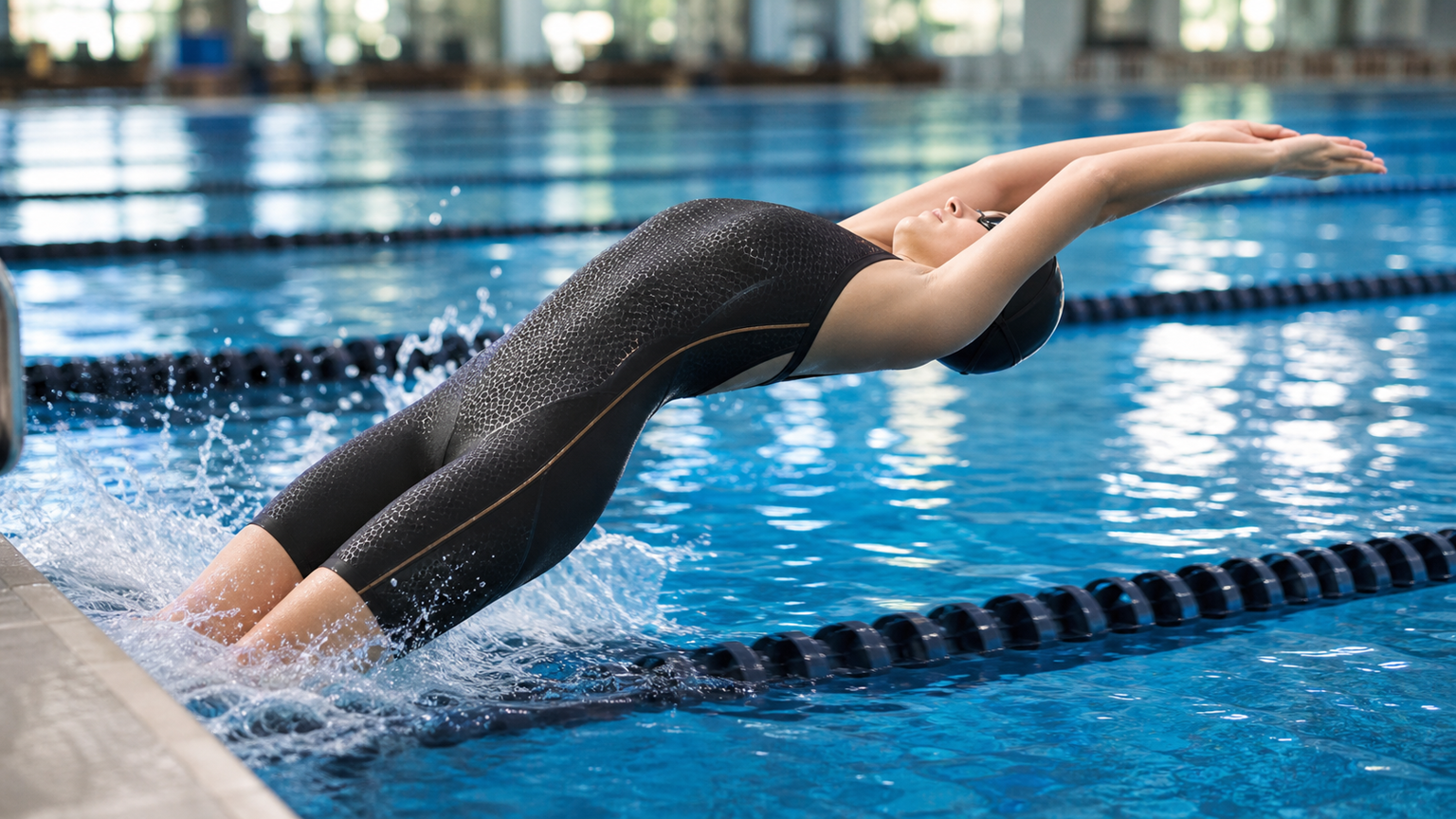
Tech suits are primarily optimized for friction drag: special surface textures (such as the fine diamond-shaped patterns mimicking shark skin) guide water flow direction, reduce turbulence, and allow water to pass over the body more smoothly.
Mechanism Two: Muscle Compression and Vibration Damping
High-compression swimsuits can:
- Reduce lateral muscle oscillation during swimming, lowering the energy expenditure caused by vibration (studies show energy savings of 2–3%).
- Hold muscles in the optimal position for force generation, reducing efficiency losses from unnecessary movement.
- Suppress postural breakdown under fatigue, helping athletes maintain technical quality in the latter half of a race.
Mechanism Three: Psychological Effects
Wearing a top-tier competitive swimsuit can itself boost an athlete’s confidence, and this psychological effect (placebo-like effect) has been quantified multiple times in sports science research. For some athletes, this confidence boost may lead to more significant performance improvements than the physical characteristics alone.
Main Types of Competitive Swimsuits
| Type | Coverage | Material Characteristics | Suitable Context |
|---|---|---|---|
| Racing briefs (men) | Waist to mid-thigh | High-elasticity fabric, ultra-low drag | Daily training and regular competitions |
| Racing swimsuit (women) | Full-body or half-body | Special textured fabric | Important competitions |
| High-end tech suit (FINA-approved) | Waist to knee (men) / full-body (women) | Multi-layer materials, low-friction coating | Major events |
| Training swimsuit | Various styles | Chlorine-resistant, durable materials | Daily training |
How to Choose a Competition Swimsuit
Consideration One: FINA/World Aquatics Approval
Ensure the swimsuit is on the approved list; otherwise, it may not be permitted in official competitions. Domestic events in Taiwan generally follow World Aquatics rules, so confirm the swimsuit’s compliance before competition.
Consideration Two: Size Selection
Size selection for competitive swimsuits differs from regular swimwear—a competitive swimsuit should feel tight enough to be slightly uncomfortable to deliver its compression benefits. A general recommendation is to go 1–2 sizes smaller than everyday wear, but it should not be so tight as to affect deep breathing or leg range of motion.
When wearing a high-end tech suit, the donning and doffing process can take 10–20 minutes, so allow extra time on race day.
Consideration Three: Material Lifespan
High-end tech suits use water-soluble materials that gradually degrade with each use in chlorinated water. It is generally recommended to reserve tech suits for important competitions only, limiting total annual use to 5–10 times to avoid consuming material performance during training.
Consideration Four: Budget Allocation
In the Taiwanese market, high-end tech suits (such as the Speedo Fastskin and Arena Carbon Air²) retail for approximately NT$7,000–15,000 per suit, a significant expense for student athletes. Recommended strategy:
- Use chlorine-resistant training swimsuits (NT$1,000–2,500) for daily training to preserve tech suit performance.
- Use high-end tech suits for major events (National High School Athletic Games, National Intercollegiate Athletic Games).
- Use mid-tier competitive swimsuits (NT$3,000–5,000) for medium-level events (city and county championships).
Practical Recommendations
- Try on new swimsuits before major competitions: Wearing a new swimsuit for the first time on race day without prior testing may cause distraction due to unfamiliarity. It is recommended to complete 1–2 full training sessions in the tech suit at least 1–2 weeks before the competition.
- Maintain to extend lifespan: Rinse the swimsuit immediately after racing with fresh water (not chlorinated water), then lay it flat to air dry. Avoid folding or compressing the suit to prevent material damage.
- Do not over-rely on equipment: Tech suits can provide marginal advantages, but an equipment boost of 0.1–0.5% can never replace a 5–10% improvement in technique. Training comes first; equipment comes second.
- Know your priority races: After establishing your annual competition schedule, plan in advance which events will use high-end tech suits and budget your equipment investment accordingly.
Conclusion
Tech suits are an important component of modern competitive swimming equipment, but they are a tool for “icing on the cake” rather than “fuel in the snow.” Taiwanese swimmers should establish a clear priority order in equipment selection: technique > training volume and intensity > recovery and nutrition > equipment optimization. Building on this order, scientifically selecting and using competitive swimsuits is the true way to maximize the competitive benefit of your gear.
Related Reading
- The Impact of Swimsuit Choice on Performance: The Second Difference Between Racing Suits and Training Suits
- The Science of Water Drag in Swimming: Streamlining Technique and Energy Expenditure
- The Full Record of the Super Suit Controversy: Swimming’s Technological Revolution and Rule Rebuilding, 2008–2009
- The Technology of Racing Swimsuits: A Guide to Compression Levels, Materials, and Fit Selection
3D 列印車褲墊 / 舒適改善? / 無痕 x 分區壓縮 / ATK & Decider系列 / JE22黑科技 / #公路車 #CTYEH
11 個月前
鉅齒紋輪組!? ControlTech MEG-T50 EVO 碳纖維幅條輪組/ 功率對比實驗 / 公路車 / CT Yeh
2 年前
2025 台北自行車展 逛展VLOG / 新奇商品探索 居然有這些神奇小物 / TT表演賽對戰德國91 / 巧遇 EVA 廷威 AYA 小D 四爺 夏美 松哥 .. / CT Yeh
1 年前
多到選擇障礙... 換個單車把帶想一個小時 / BTP / 編織&軟木特有材質超吸睛! / 公路車 / CT Yeh
1 年前
一日北高前的西濱集訓 | 跟著11小時軍團 | 300W踩不動的大逆風 | 輪車破風差幾瓦?
6 年前
[防寒衣體驗] 鐵人魂 三鐵 防寒衣試穿會 於松運 深水游泳池 鯨魚池
8 年前
Unaas X50 全碳纖幅條輪 數據實測對比PK | Lun Hyper 的高階版 | 板輪爬坡也可以很厲害? ! 武嶺2小時大師一起親測! CP值超高 | 公路車 | CT Yeh
4 年前
訓練台體驗) 2019台北自行車展 三大家 訓練台體驗 Tacx Neo Flux 2 Xepdo Apx Wahoo Kickr
7 年前