Introduction
The Alishan Highway (Provincial Highway 18), starting from Chiayi City, passes through Zhuqi, Ruili, and Shizhuo, before finally reaching the Alishan National Forest Recreation Area at an elevation of 2,216 meters. Covering approximately 75 kilometers with a cumulative climb of about 2,200 meters, it is one of the most challenging and renowned road cycling climbs in western Taiwan.
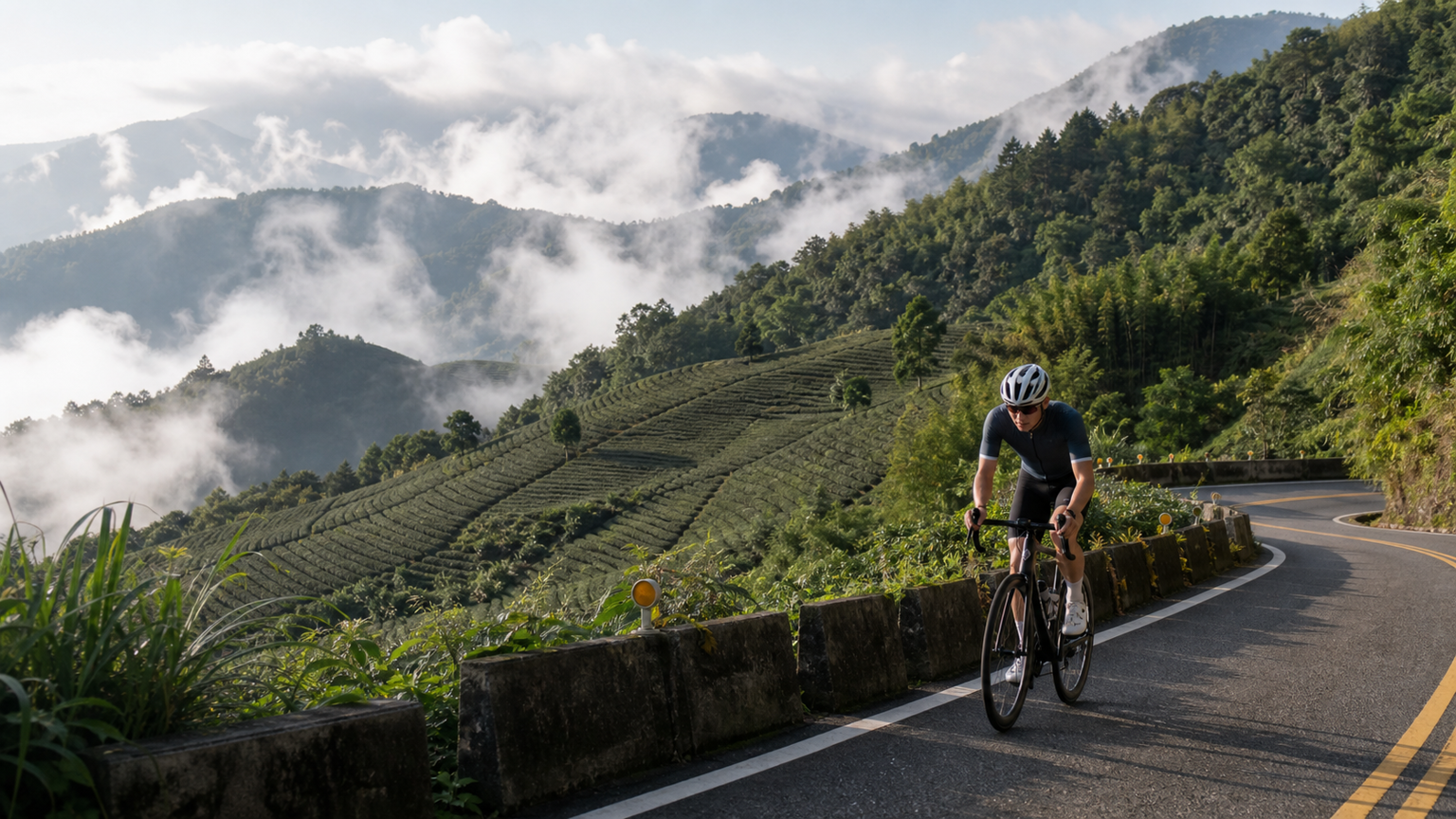
Unlike Wuling, which is famous for its high altitude, the allure of the Alishan Highway lies in its rich “ecological layering”: from the tropical agricultural landscapes of the Chiayi plains, gradually transitioning to the tea terrace fields of Meishan, the green bamboo forests of Zhuqi, and then entering the mist-shrouded sacred tree forest trails. Each change in elevation feels like stepping into a different world.
Route Segment Analysis
The Alishan Highway can be divided into four distinct segments:
| Segment | Elevation Range | Distance | Average Gradient | Landscape Features |
|---|---|---|---|---|
| Chiayi City → Zhuqi | 30m→300m | Approx. 20km | Approx. 1.5% | Gentle agricultural zone |
| Zhuqi → Meishan | 300m→900m | Approx. 22km | Approx. 2.7% | Bamboo forests, camellia oil farms |
| Meishan → Shizhuo | 900m→1600m | Approx. 15km | Approx. 4.6% | Alishan tea terraces |
| Shizhuo → Alishan | 1600m→2216m | Approx. 18km | Approx. 3.4% | Sacred tree forest trails, clouds and mist |
The most challenging segment is from Meishan to Shizhuo, where some sections reach gradients of 8-12%. Combined with the switchback climbs through the tea terraces, this section is the most physically demanding. It is recommended to stock up thoroughly in Meishan before tackling this segment.
The Cycling Aesthetics of Alishan Tea Plantations
The Alishan region of Taiwan (including Meishan, Zhuqi, and Alishan Township) is the most important high-mountain oolong tea producing area in Taiwan. When cycling through the terraced tea plantation sections near Shizhuo, rows upon rows of neatly aligned tea bushes cascade up the hillsides, appearing and disappearing through the morning mist.
Your pace naturally slows on this stretch—not because of tired legs, but because the scenery is so beautiful you cannot help but stop. It is recommended to purchase a pack of local high-mountain oolong tea from Shizhuo Old Street to bring home. Not only is it the best souvenir, but it is also the most representative memento of this journey.
Tea Farmer Culture Experience: Some tea farmers along the way offer tourist tea-picking experiences. If time permits, consider stopping by to learn about the growing environment of Alishan high-mountain tea and the tea-making process.
Resupply and Accommodation Planning
Resupply points along the Alishan Highway are sparser than those on Wuling, so advance planning is essential:
- Zhuqi: Convenience stores and local eateries; the first reliable resupply point (approx. 20km from the start)
- Meishan Old Street: Abundant local snacks (plum chicken, crispy fried tofu); the best lunch stop (approx. 42km from the start)
- Shizhuo: Tea shops and general stores; the last high-mountain resupply point (approx. 57km from the start)
- Alishan Recreation Area: Hotels and restaurants; the recharging station before descending
Recommended Accommodation Strategy: For a two-day cycling plan, stay overnight in Meishan on the first day, then set off early the next morning to tackle the upper half to Alishan. This allows you to fully appreciate the morning mountain mists and sea of clouds.
Descent Precautions
The descent on the Alishan Highway is another aspect that requires serious attention:
- Numerous sharp turns throughout, with some sections’ sightlines obstructed by tea plantations
- Temperatures are low on the mountain; your body cools rapidly during the descent, so be sure to wear a jacket before heading down
- Dense fog is common weather on Alishan; visibility in fog can drop to less than 10 meters, so be sure to turn on your lights and ride slowly
- Before descending, check the cooling condition of your disc brakes (or rim brakes); on long descents, intermittent braking is recommended
Practical Tips
- Best cycling seasons: March-May (stable sunny spring weather) and October-November (most beautiful autumn sea of clouds)
- The Alishan Forest Railway (Alishan小火車) is cyclists’ favorite way to descend the mountain; bicycles can be shipped (advance reservation required)
- Before departure, check whether the Alishan Highway has road construction or rockfall closures (on the Directorate General of Highways website)
- Chiayi City has several bicycle specialty shops where you can do a final bike check before setting off
Conclusion
The climbing challenge of the Alishan Highway offers cyclists a way to “slowly experience Taiwan’s mountain forests.” It is not the highest, nor the steepest, but it possesses the richest ecological and cultural layers of any road cycling route in Taiwan. The fragrance of tea, bamboo forests, sacred trees, and seas of clouds—these are not just roadside scenery; they are the natural accumulation of thousands of years on Alishan, worthy of cyclists slowing down to pay tribute to each one.
Related Reading
- Chiayi Alishan Highway (Provincial Highway 18): A Climbing Challenge from the Plains to the Clouds
- Alishan Highway Cycling Challenge: A Magnificent Climb from Chiayi to Alishan
- Chiayi Alishan Highway: A Tea-Scented Journey from the Plains to 2,200 Meters on Provincial Highway 18
- Chiayi Alishan Highway: The Complete Guide to the Long-Distance Climb from Zhuqi to Alishan
那瑪夏x茶山 阿里山系深山單車行 Day2 累積爬升6000M | 🥶超陡連續下坡 整路看隊友刷 | 爬升一座西進武嶺 | JJSC | 公路車 | CT Yeh
3 年前
一定要騎一次!阿里山最深處:里佳部落!單車旅行 | 2800m爬升 | 深度部落體驗:嗨翻晚會、螢火蟲、銀河 | feat. JJSC & 廢物伙伴 | 公路車 CT Yeh
10 個月前
梅山36彎 奮起湖 單車挑戰 下集 #公路車
6 年前
阿里山塔塔加 兩倍特濃版!全新隧道開通! 進喔!公路車 | CT Yeh
3 年前
里佳部落 阿里山單車深度旅遊! | 竹山/草嶺/來吉/奮起湖 | 無敵銀河絕景 全新路線探索! 驚險狀況百出! | 4K沉浸式畫質 | 公路車 | CT Yeh
3 年前
4K單車實境) 嘉義 梅山36灣 訓練台 爬坡 輕鬆騎
6 年前
嘉義大埔、阿婆灣挑戰賽,美到以為在日本!ft. 環騎5 Cool 西拉雅188 / 公路車 / CT Yeh
7 個月前
半日 小台灣 極限單車路線挑戰實錄
7 年前