Running Knee Braces and Kinesio Tape: A Scientific Analysis of Assistive Gear for Preventing Knee Injuries
Introduction
According to sports medicine surveys in Taiwan, pain around the knee (including patellofemoral pain syndrome, iliotibial band syndrome, runner’s knee, etc.) is the leading reason road runners seek medical attention. When faced with knee discomfort, many runners instinctively purchase knee braces or kinesio tape, but the mechanisms of action and appropriate applications of these assistive devices differ greatly. Using them incorrectly is not only ineffective but may even delay proper treatment.
Common Types of Running-Related Knee Injuries
Before introducing assistive gear, let’s first understand the most common knee problems among Taiwanese runners:
- Patellofemoral Pain Syndrome (Runner’s Knee): Pain in the front of the knee, aggravated by climbing stairs or prolonged knee flexion, commonly seen in runners who increase training volume too quickly
- Iliotibial Band Syndrome (IT Band Syndrome): Pain on the outside of the knee, typically appearing 20–30 minutes into a run and particularly noticeable on downhill sections—an occupational hazard for Taiwan’s mountain trail runners
- Patellar Tendinitis (Jumper’s Knee): Pain in the patellar tendon below the kneecap, commonly seen in runners with high training frequency
Types and Mechanisms of Knee Braces
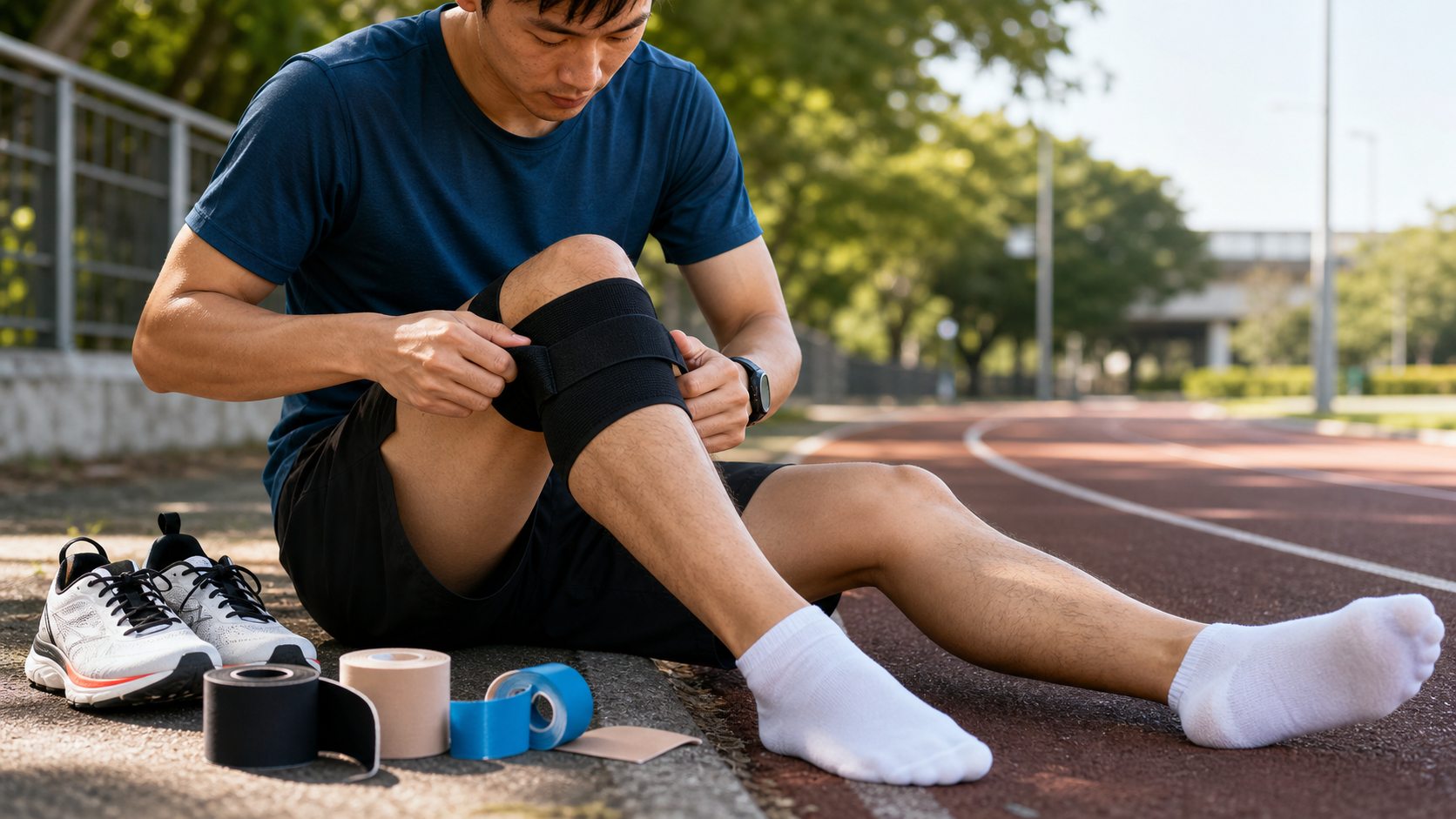
Compression Knee Sleeves
Full-coverage compression knee sleeves provide benefits through uniform pressure:
- Enhanced proprioception (same principle as compression clothing)
- Mild warming effect that promotes local blood circulation
- Psychological comfort effect (not to be underestimated—its impact on confidence helps maintain running rhythm)
Appropriate Use Cases: Mild knee instability, preventive use during downhill running, light exercise during post-surgical recovery
Caution: If compression sleeves apply excessive pressure, they may restrict the knee’s normal range of motion; long-term use may create dependency, further weakening the surrounding musculature
Patellar Straps
A narrow strap design worn below the kneecap. The mechanism works by altering the tension distribution of the patellar tendon, reducing pressure concentration at specific points. Research support for its effectiveness is moderate, but subjective improvement is more pronounced in patients with patellar tendinitis.
Functional Knee Braces (with Lateral Support Stays)
Knee braces embedded with metal or plastic side stays provide additional lateral stability, suitable for runners with knee instability symptoms or those recovering from mild ligament injuries. They are heavier and not suitable for racing.
| Brace Type | Primary Benefit | Target Condition | Racing Usability |
|---|---|---|---|
| Compression Sleeve | Proprioception, warmth | General prevention | Yes |
| Patellar Strap | Tendon tension adjustment | Patellar tendinitis | Yes |
| Functional Lateral Support | Lateral stability | Knee instability | Limited |
Kinesio Tape
Kinesio tape (commonly referred to as “kinesio tape” or “肌貼” in Taiwan) rapidly gained popularity in Taiwan’s road running community after the 2008 Beijing Olympics, and is now widely used from athletic trainers to everyday runners.
Theoretical Mechanism of Action
The design concept of kinesio tape is to gently lift the skin, increasing subdermal space to improve lymphatic drainage and local microcirculation, while influencing muscle activation patterns through cutaneous sensory feedback.
Current State of Research
To be frank, scientific findings on kinesio tape are quite mixed:
- Some studies show moderate short-term pain relief effects for acute-phase pain
- Most studies on athletic performance improvement show insignificant effects or that placebo effects dominate
- A 2019 systematic review (Cochrane-level) concluded that “there is a lack of high-quality evidence supporting kinesio tape as an effective means of preventing running injuries”
Practical Advice: If you have experienced subjective benefit from kinesio tape in the past, there is no harm in continuing to use it; however, kinesio tape should not replace physical therapy or functional training.
Common Knee Taping Techniques
- Patellar Stabilization Taping: Y-shaped tape applied around the patella to reduce patellar tracking deviation
- Quadriceps Support Taping: Tape applied along the anterior thigh muscles to provide auxiliary support
- IT Band Relief Taping: Applied along the lateral thigh, theoretically reducing iliotibial band tension
Correct application technique is critical to effectiveness; it is recommended to have an athletic trainer or physical therapist demonstrate proper technique before first use.
The Real Foundation for Preventing Knee Injuries
Assistive gear ultimately addresses symptoms rather than root causes. The following strategies prevent knee injuries at the source:
- Strengthen the Gluteal Muscles: Gluteus medius weakness is the most common root cause of iliotibial band syndrome. Targeted gluteal training 2–3 times per week far exceeds the benefit of any knee brace
- The 10% Rule for Training Volume: Increasing weekly mileage by no more than 10% over the previous week is the most effective injury prevention principle
- Running Form Optimization: Increasing cadence to 170–180 steps/minute can significantly reduce knee loading; many running coaches in Taiwan offer cadence analysis services
- Complete Post-Run Stretching: Particularly stretching the posterior thigh (hamstrings) and lateral thigh (iliotibial band)—the most commonly neglected component among Taiwanese runners
Conclusion
Knee braces and kinesio tape are reasonable assistive tools that do hold value in appropriate situations; however, they cannot replace proper training planning, strong supporting musculature, and the wisdom to rest when your body sends signals. The knee is every runner’s most precious asset, deserving of protection through correct knowledge and attitude.
Related Reading
- Choosing Running Knee Braces: When to Use IT Band Taping vs. Knee Support Sleeves
- Knee Braces and Ankle Supports for Road Running: When to Use Supportive Gear
- A Guide to Choosing Knee and Ankle Supports for Road Running: Timing for Preventive vs. Therapeutic Bracing
- The Complete Knee Protection Manual: Runner’s Knee, IT Band Syndrome, and Meniscus
摔車後補裝備: 好市多新款單車安全帽& Specialized Romin 北高整路屁股都不痛的坐墊 | 一千元居然有MIPS | CT Yeh | 公路車
4 年前
一日北高/長距離團騎 常見問題補充篇 / 組團或跟團的眉角 / 壯車友容易被瘦車友慢性拉爆 / 原來屁股痛可能是這個原因...? / 風場配速法 / 公路車 / CT Yeh
2 年前
一日北高常見問題大集合 | 攻略 | 路線 | 訓練 | 補給 | 自行車 單車 | 一日雙城 | 雙塔 | TWB北高360 | 屁股痛
6 年前
#公路車 #Fitting 靠人工智慧APP 幫你調整單車
6 年前
3D 列印車褲墊 / 舒適改善? / 無痕 x 分區壓縮 / ATK & Decider系列 / JE22黑科技 / #公路車 #CTYEH
11 個月前
一日北高前的高裝檢 | 北高 360 | 挑戰11小時的裝備 | 一日雙塔 | 補給
6 年前
單車 一日北高 ( 雙城 ) 肥宅雙人瘋狂行 紀錄片 REACTO
10 年前
大家都在開箱的...單車用藍芽對講耳機真的有幫助嗎? SENA BiKom 20 長距離旅遊 & 海鷗繞圈賽 實際體驗心得 / 公路車 / CT Yeh
9 個月前