Bicycle Helmet Aerodynamics: The Design Trade-off Between Ventilation, Heat Dissipation, and Low Drag
Introduction
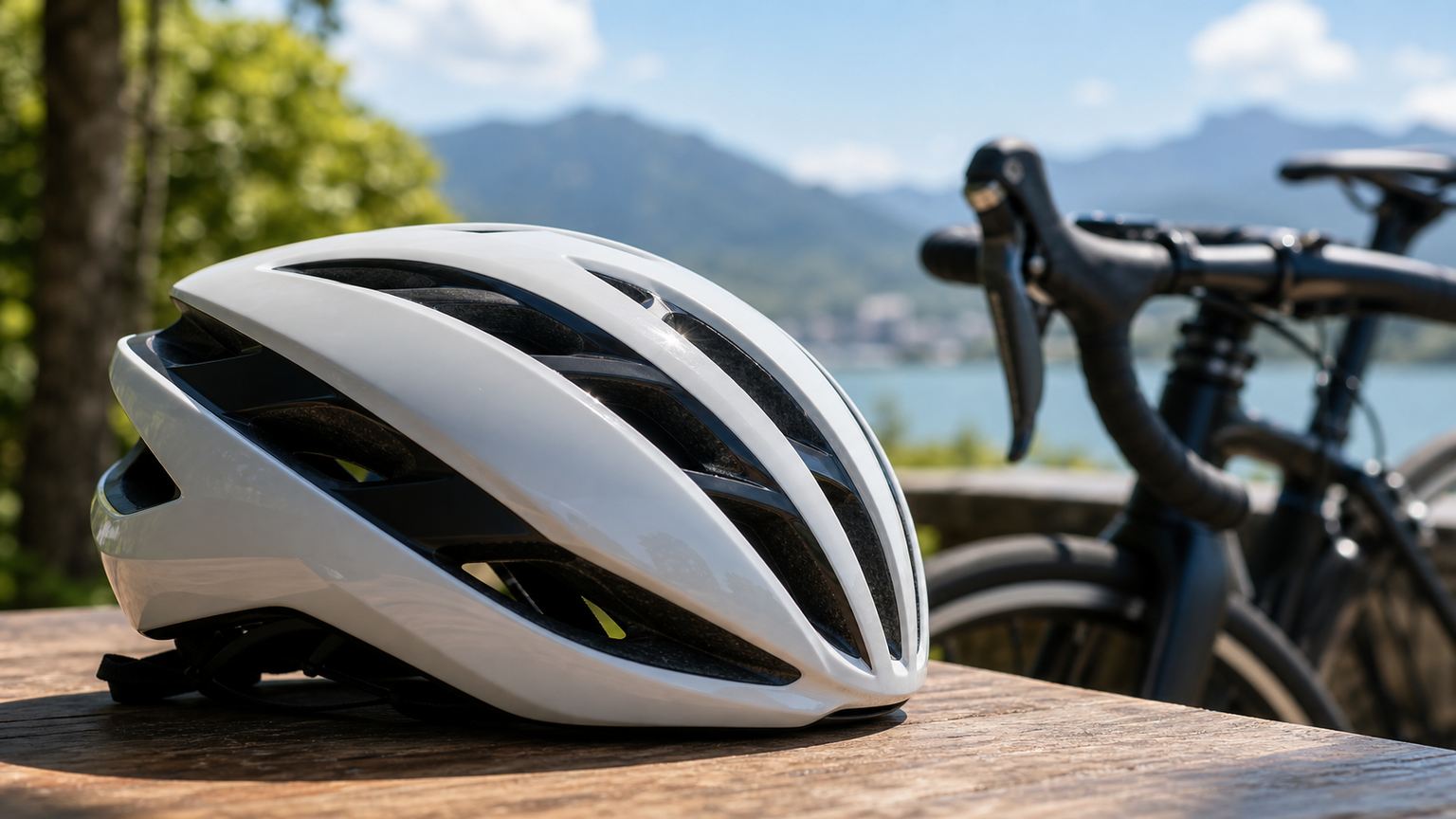
“Always wear a helmet” is the first lesson in all bicycle safety education. However, for competition-oriented cyclists, helmet selection goes far beyond safety protection, involving aerodynamic differences of tens of watts and comfort management of perceived temperature. Taiwan’s average summer temperature easily exceeds 35°C. Whether commuting in Taipei City or climbing Wuling, a helmet’s cooling ability is often valued more than its aerodynamic performance. This article systematically analyzes the core technologies of helmet design to help you find the most suitable choice for Taiwan’s environment.
Helmet Certification Standards
Helmets sold on the market must pass relevant safety certifications to be legally sold. Common certification standards in the Taiwan market:
| Certification | Region | Test Focus | Strictness |
|---|---|---|---|
| CNS 11268 | Taiwan | Impact absorption, penetration, buckle strength | Basic requirement |
| CPSC | USA | Impact energy absorption | Medium |
| EN 1078 | EU | Impact test, retention system | Medium |
| MIPS Certification | International | Rotational acceleration mitigation | Additional protection |
| Tested to WG11 | International | Newer, stricter oblique impact | Latest standard |
MIPS (Multi-directional Impact Protection System) is the most important advancement in helmet safety technology in recent years. Real-world falls are often oblique impacts, generating rotational acceleration transmitted to the brain. MIPS’s sliding layer can absorb rotational energy, and research shows it can reduce the risk of concussion. Currently, mid-to-high-end helmets in the Taiwan market are widely equipped with MIPS.
Design Principles of Aerodynamic Helmets
From a physics perspective, air resistance accounts for 70-80% of total resistance while cycling. Among this, the human body (the rider) accounts for over 70% of air resistance, and the head accounts for about 15-20% of the body’s resistance. Therefore, the aerodynamic design of a helmet offers significant practical benefits.
Main Types of Aero Helmets:
Time Trial / TT Helmets:
- Teardrop-shaped shell with no or very few vents
- Extended tail design at the rear, allowing airflow to separate smoothly at the end of the helmet
- Compared to road helmets, wind tunnel tests show savings of 20-40 watts (at 40km/h)
- Representatives: Giro Aerohead MIPS, Lazer Volante
- Extremely poor ventilation; special attention to heat management is needed for summer use in Taiwan
Aero Road Helmets:
- Limited vents incorporated into an aerodynamic shell
- Visually rounder and more streamlined, with a larger sun visor area
- Compared to traditional road helmets, can save 5-15 watts
- Representatives: Specialized S-Works Evade 3, POC Ventral series
Traditional Road Helmets:
- Maximized vent area, prioritizing cooling
- Shape is typically a front-to-rear extending oval, with minimal aerodynamic consideration
- Usually the lightest weight (flagship models under 200g)
- Representatives: Giro Synthe 2, Bontrager XXX Air
The Engineering of Ventilation Design
A helmet’s ventilation efficiency depends on the number and position of vents and the design of airflow organization. Designers of high-quality helmets use Computational Fluid Dynamics (CFD) to simulate airflow paths inside and outside the helmet, ensuring effective convection is formed between intake and exhaust vents.
Cooling Needs for Commuting and Climbing Rides in Taiwan’s Summer:
- Average temperature in the Taipei Basin from July to September is above 35°C, with perceived temperature reaching 40°C while cycling
- Slow climbing speeds (average mountain road speed 15-20km/h), less natural wind, helmet cooling relies more on vent design
- In low-speed climbing scenarios, the cooling effect of traditional multi-vent road helmets is far superior to aero helmets
- TT helmets are almost never recommended for summer climbing in Taiwan
Helmet Weight and Comfort
During long rides (such as Gran Fondo or round-island events), helmet weight significantly impacts neck fatigue. Flagship lightweight helmets can reach 190-220g, while general training helmets are around 250-280g. TT helmets, due to their larger shell, typically exceed 350g.
The adjustment mechanism of the retention system directly affects wearing comfort. A high-quality rear dial adjustment system allows the helmet to fit the head shape stably and snugly, reducing wobble. Taiwanese consumers often overlook head shape differences—Asian head shapes are generally rounder than European/American ones. It is recommended to choose helmets with an “Asian Fit” version or to try them on in-store to confirm fit.
Helmet Selection Guide for Different Scenarios
Summer Commuting / Training Rides in Taiwan:
- Top choice: Multi-vent, lightweight road helmet, equipped with MIPS
- Weight target: Under 250g
- Budget: NT$3,000-6,000 can find quality options
Mountain / Climbing Specific Training:
- Top choice: Maximized ventilation design, prioritizing lightweight
- Cooling is 100 times more important than aerodynamics
Flat Road Training / Gran Fondo:
- Consider an aero road helmet, balancing cooling and aerodynamics
- Specialized Evade 3 or products with similar positioning
Time Trials / IRONMAN:
- TT helmet, paired with appropriate hydration and cooling strategies
- Pay attention to UCI certification requirements
Practical Advice
- Try On First: Head shapes vary greatly. When buying helmets online, confirm the return/exchange policy; it’s best to try them on in-store.
- MIPS is Worth the Investment: Safety improvement is significant. Mid-range MIPS helmets in Taiwan cost about NT$3,500-6,000.
- Replace Regularly: The EPS foam in a helmet may fracture internally after a severe impact without visible external signs. Replacement is recommended after an impact; for normal use, replacement every 5 years is advised.
- Cleaning in Taiwan’s Summer: Salt from sweat after riding accelerates the aging of EPS and straps. Regular rinsing with clean water is recommended.
Conclusion
Helmet selection is a triangular balance of safety, comfort, and aerodynamics. Under Taiwan’s climate conditions, for most cyclists, a multi-vent, lightweight road helmet prioritizing cooling and equipped with MIPS is the most comprehensive choice. Leave aero helmets for racing scenarios pursuing speed on flat roads. Precisely matching the tool’s characteristics to the usage scenario allows every equipment investment to yield maximum benefit.
Related Topic Reading
- Bicycle Helmet Buying Guide: Key Factors in MIPS Technology, Ventilation Design, and Weight
- Comprehensive Bicycle Helmet Review: The Balance of Aerodynamics, Ventilation, and Lightweight
- Cycling Helmet Buying Guide: Trade-offs Between MIPS Technology and Ventilation Design
- Bicycle Aerodynamic Helmet Review: Speed Test of Giro Aerohead vs POC Tempor vs Kask Bambino
再快都跟的上!? 單車跟隨攝影機之王 HOVERAir X1 PROMAX 全面實測 / 唯一!8K畫質&自行車專用模式和跟蹤信標&前後避障 / DJI Neo 可參考/ 公路車 / CT Yeh
1 年前
3D 列印車褲墊 / 舒適改善? / 無痕 x 分區壓縮 / ATK & Decider系列 / JE22黑科技 / #公路車 #CTYEH
11 個月前
Nepest NOVA 碳條輪組:輕量、空力、舒適一次滿足!/ 公路車 / CT Yeh
7 個月前
多到選擇障礙... 換個單車把帶想一個小時 / BTP / 編織&軟木特有材質超吸睛! / 公路車 / CT Yeh
1 年前
鉅齒紋輪組!? ControlTech MEG-T50 EVO 碳纖維幅條輪組/ 功率對比實驗 / 公路車 / CT Yeh
2 年前
大武山後門26%歡樂陡坡!JJSC南台灣單車行Day2 / 被颱風追著跑 / 公路車 / CT Yeh
2 年前
Vision Metron RS 37碳幅條輪組 (非SL)官網沒有的 低調開箱 / 這重量太銷魂了 / 公路車 / CT Yeh
6 個月前
5 ℃ 櫻花之旅 / 75萬單車直接雨中洗車.../ 平菁街 / 北迴歸小隊 / 公路車 / CT Yeh
5 個月前