Introduction
Road bike clipless pedals may seem simple in design, but they involve precision mechanical engineering. From the cleat engagement mechanism to the design philosophy behind float, every detail can affect your pedaling efficiency and long-term knee health. Taiwan’s mountainous terrain demands frequent pedaling and gear changes, placing even higher requirements on smooth engagement and safe release.
How Pedals Work
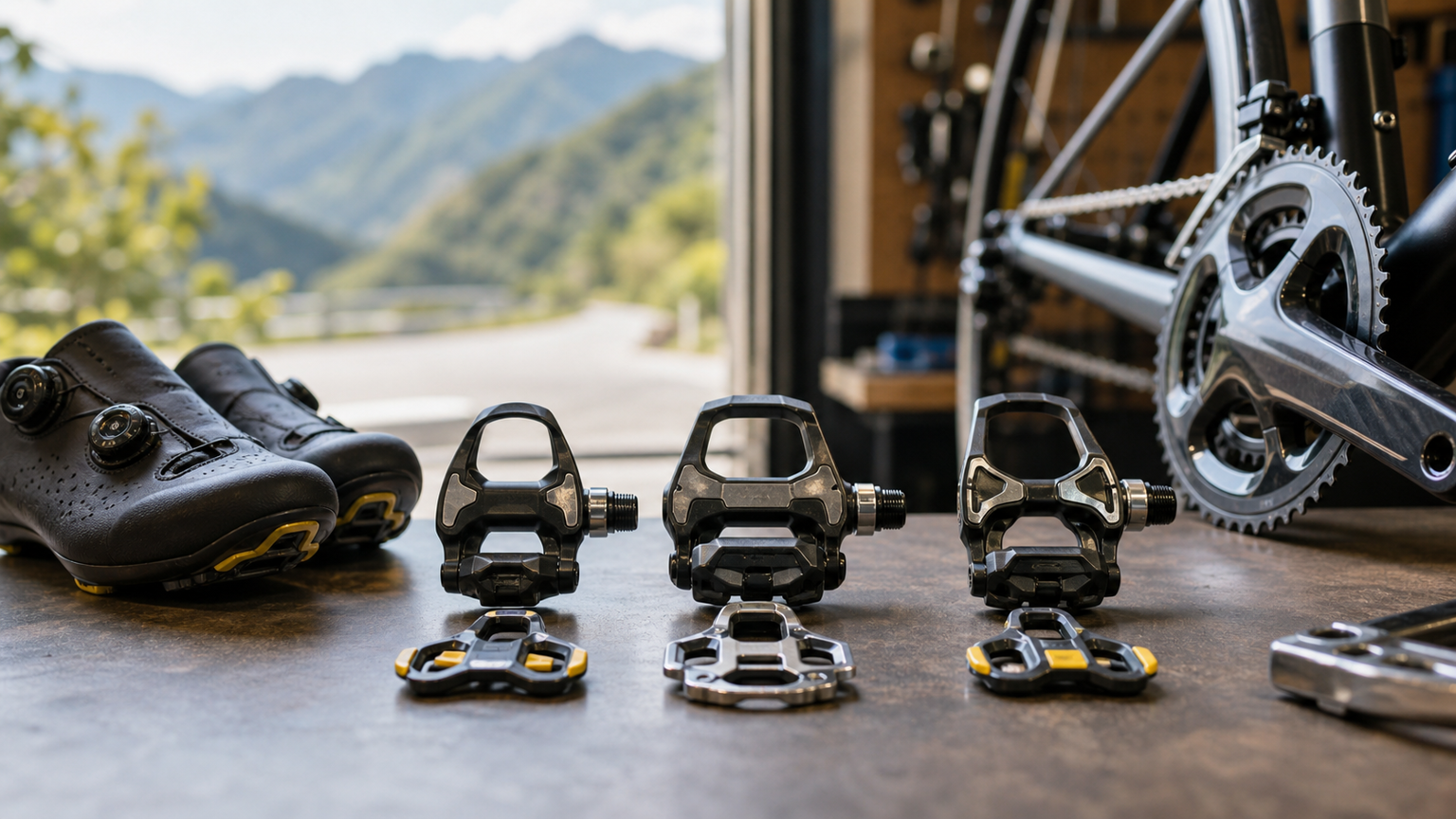
The name “clipless pedal” may seem contradictory, but it actually refers to the absence of toe clips and straps. The core mechanism involves a metal cleat mounted on the bottom of the cycling shoe. When you mount the bike, you step into the pedal’s engagement mechanism, forming a mechanical lock. To release, you simply twist your heel outward.
The two core advantages of this system:
- Pedaling efficiency: Effective power can be applied throughout the entire pedal stroke, including the upstroke
- Fixed foot position: Ensures consistent foot placement with every pedal stroke, reducing energy loss
Technical Comparison of the Three Major Systems
| Feature | Look KEO | Shimano SPD-SL | Time XPRO |
|---|---|---|---|
| Contact area | Large | Large | Large |
| Float | 4.5° / 9° | 0° / 2° / 6° | 13° (dynamic float) |
| Cleat material | Plastic/metal | Plastic (three colors) | Plastic |
| Engagement force | Light to heavy, adjustable | Fixed/light option | Light |
| Weight (flagship) | Approx. 128g/pair | Approx. 238g/pair (Dura-Ace) | Approx. 228g/pair |
| Cleat compatibility | Look cleats | SPD-SL cleats | Time cleats |
| Mud and grit resistance | Moderate | Moderate | Better |
Look KEO System
Look is the inventor of the clipless pedal, launching the first-generation automatic-engagement road pedal in 1984. Its design has since become one of the standards in road cycling. The Look KEO series is its main product line, featuring a wide pedal body that distributes pressure effectively, making it suitable for long-distance riding.
KEO float angle options:
- KEO Classic 3: 9° float (most permissive)
- KEO 2 Max: 9° float
- KEO Blade Carbon: 4.5° float (race-oriented)
The greater the float angle, the more freedom your toes have to rotate during the pedal stroke, offering greater tolerance for your knees—but with slightly less directional power transfer.
Shimano SPD-SL System
SPD-SL (SL = Super Light) is currently the highest-market-share road pedal system in the world, widely equipped on everything from entry-level to top-tier road bikes. Its three cleat colors correspond to different float angles:
- Yellow cleats: 6° float, best for beginners
- Blue cleats: 2° float, moderate restriction
- Red cleats: 0° float, fixed position, for racing
The main advantage of SPD-SL is its vast ecosystem—virtually all road cycling shoes support SPD-SL cleats, and bike shops across Taiwan carry them in stock. For entry-level riders, mid-range products like the Shimano RS500 or RS710 offer exceptional value for money.
SPD-SL limitations:
Fine adjustments to cleat positioning have a significant impact on knee comfort. It is recommended to have the fore-aft position and angular alignment set up by a professional bike fitter rather than installing them arbitrarily yourself. A considerable proportion of the knee pain issues commonly seen in Taiwan stems from improperly positioned cleats.
Time XPRO/XPRESSO System
Time is a French brand whose pedal philosophy centers on “dynamic float.” Time pedals do not restrict float to a fixed mechanical angle; instead, a spring system provides natural dynamic support for the foot.
Time’s 13° dynamic float allows the knees to move along their natural rotational path, making it particularly beneficial for riders sensitive to knee joint issues. The engagement mechanism is unique and takes some getting used to, but once mastered, it operates smoothly.
Time is less well-known in Taiwan than Look and Shimano, but it has a loyal following in the racing community, especially among riders with prior knee injuries or those demanding the highest level of pedaling comfort.
The Importance of Cycling Shoes
The performance of a pedal system is highly dependent on the accompanying cycling shoes. The higher the stiffness index of the shoe’s rigid sole (carbon fiber sole, rated via BOA scores or brand-specific values), the better the pedaling energy transfer efficiency. However, rigid soles are extremely uncomfortable for walking, so this must be weighed against your intended use.
Key considerations when buying cycling shoes:
- Sole material: Full carbon soles offer the highest stiffness but are the heaviest; fiberglass composite soles are slightly heavier but more affordable
- Closure system: BOA dials for quick micro-adjustment are currently the mainstream choice; traditional Velcro plus buckle combinations remain common
- Breathability: Ventilated mesh designs make a noticeable difference to comfort during Taiwan’s summers
- Walkability: For walking at feed stations or in parking lots, some shoes feature rubber anti-slip inserts
Pedal Maintenance
The core moving parts of road pedals are the bearings. In Taiwan’s high-humidity environment, regularly cleaning and replenishing bearing grease (especially after riding in the rain) can greatly extend pedal lifespan. Steps:
- Unscrew the bearing cover from the back of the pedal
- Clean out the old grease
- Apply fresh bearing grease
- Screw the bearing cover back on
Entry-level pedals are recommended to be serviced once a year; premium bearing pedals once every two years.
Practical Recommendations
- Best for beginners: Shimano RS500 SPD-SL + yellow cleats (6° float)—the easiest parts to source in Taiwan
- Riders with knee issues: Prioritize Time XPRO or Look KEO Classic 3 (9° float)
- Racing use: Choose the appropriate float angle based on your bike fit results; there is no need to chase the lowest float
- Cleat wear inspection: Regularly check the wear level of your cleats. Severely worn cleats make release difficult and dangerous; it is recommended to replace cleats every 5,000–8,000 km
Conclusion
Choosing a pedal system is not just a matter of brand preference—it is a precise match between your body’s biomechanics and your riding habits. Look, Shimano SPD-SL, and Time each have their engineering strengths, suited to different rider body types and riding needs. Investing time in a proper bike fit and selecting a pedal system with the appropriate float angle offers long-term benefits for preventing knee injuries that far outweigh any difference in brand prestige.
Related Reading
- Road Bike Pedal System Comparison: Look vs Shimano SPD-SL vs TIME
- In-Depth Road Bike Pedal System Comparison: SPD-SL vs LOOK vs SPEEDPLAY
- Buying Guide for Cycling Shoes and Pedal Systems: How to Choose Between SPD, SPD-SL, Look, and Time
- The Complete Guide to Cycling Shoe Cleats: Differences Between Look, Shimano SPD-SL, and Speedplay Systems
來都來了!改好改滿 / CS大導輪 + BB 可以省幾瓦? / 同場加映 TIME XPRO卡踏 / #公路車 #ceramicspeed / CT Yeh
1 年前
超開放的自行車錶!可以玩遊戲裝APP!?/ SRAM合併的 Hammerhead Karoo深入開箱!/ 即時爬坡偵測 / 全球導航地圖 / Garmin Bryton / CT Yeh
1 年前
碟煞公路車 銑面器 !? 原來銑完差這麼多! 降低蹭碟機率! | TIME 公路車 保養小記錄 | CT Yeh
3 年前
#公路車 #Fitting 靠人工智慧APP 幫你調整單車
6 年前
SRAM FORCE E1 首發!/ 改成短腿了 / 煞車升級有感嗎? / TIME ADH 變速大升級 / 公路車 / CT Yeh
1 年前
高雄綠園道鐵路自行車道 / 外地人能輕鬆駕馭 還是整路崩潰? / 2025 全線開通 春節實地探索一次!(附GPS連結)/ 公路車 / CT Yeh
1 年前
公路車 BB培林大升級! / 備戰海鷗繞圈賽 Canyon Aerod & TIME 一起改 / MIT大廠 CEMA對鎖式陶瓷培林BB & 導輪 / 公路車 / CT Yeh
2 年前
全台首發!邁金P715踏板功率計!市場價格撼動者再出招 / 功率對比實測 / FAVERO ASSIOMA 可參考! / 公路車 / CT Yeh
1 年前