Introduction
Among all bicycle components, tires are the single most direct factor affecting the riding experience. Rubber compounds, casing construction, tire width, and inflation pressure all intertwine into a complex equation of rolling resistance, grip, and comfort. Taiwan’s riding environment spans from Taipei’s asphalt roads to mountain gravel paths, from flatland high-speed riding to the 3,000-meter high-altitude descents of Wuling, demanding a comprehensive and rigorous performance from tires.
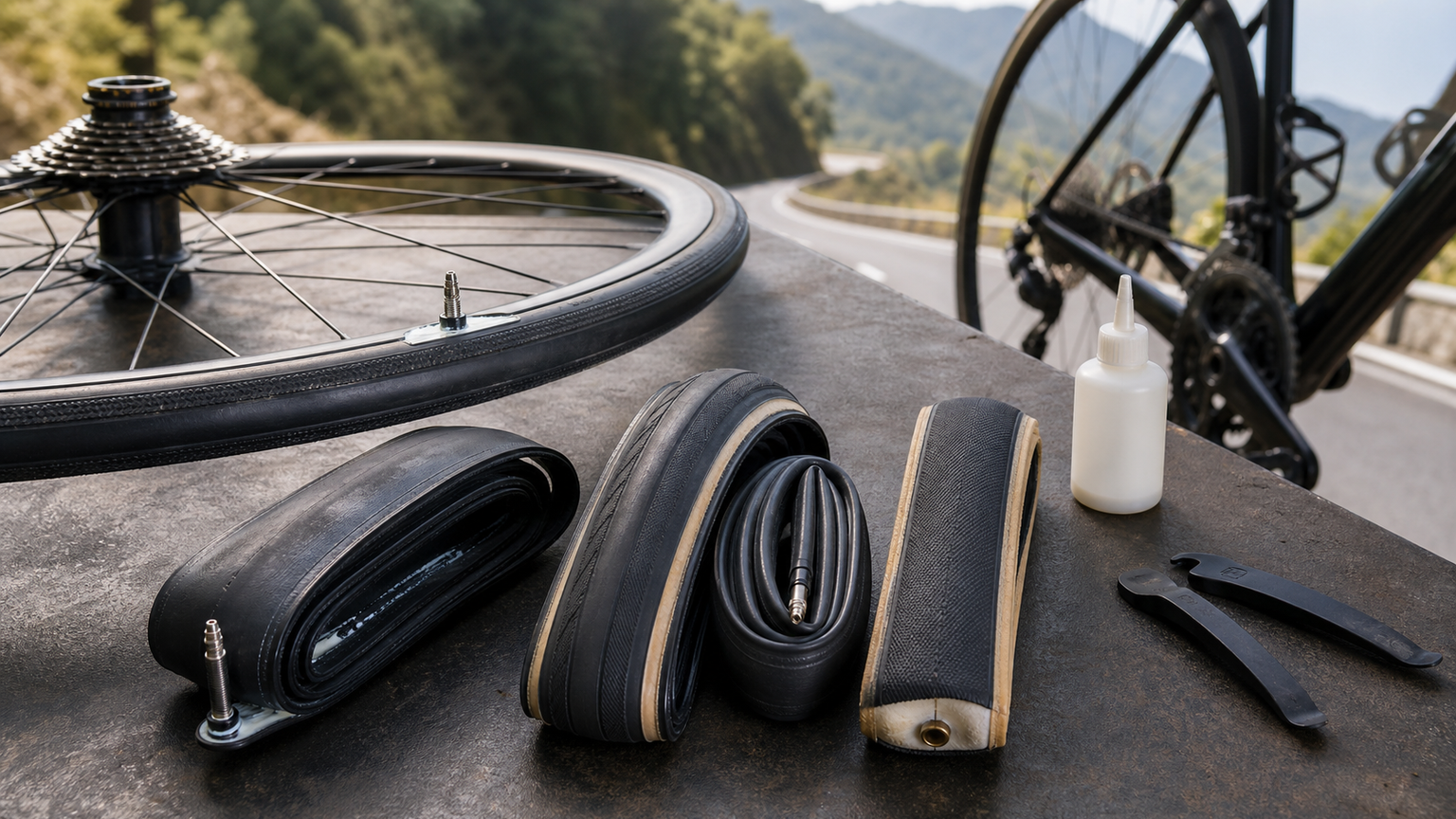
Comparison of the Three Major Tire System Architectures
| System | Bead Design | Inner Tube | Puncture Repair | Minimum Pressure | Ideal Use Case |
|---|---|---|---|---|---|
| Clincher | Hooked bead seats into rim channel | Required | Replace tube/patch | Limited (approx. 80 PSI) | Commuting, training |
| Tubeless | Airtight bead | Not required | Sealant auto-seals/plug strip | Can be lowered (50-70 PSI) | Training, gravel |
| Tubular | Sewn casing, glued to rim | Built-in | Replace entire tire | Can be high or low | High-end racing |
Clincher System In-Depth Analysis
Clincher is currently the most widespread tire system globally. An inner tube is installed inside the outer tire, with the bead locking into the rim channel and held in place by air pressure.
Advantages:
- Easy puncture repair (a spare tube can be swapped in within 10 minutes)
- Widest selection of rims
- Entry-level pricing
Limitations:
- Pinch Flat risk: when the tire hits a hard object, the inner tube gets pinched against the rim edge and tears
- Pressure must be maintained in a higher range, limiting comfort
Key Casing Specification Parameters:
TPI (Threads Per Inch) is an indicator of casing density. High TPI (e.g., 120-320 TPI) means finer, denser casing fibers, making the tire lighter, thinner, and offering better grip; low TPI (approx. 60 TPI) is more durable but heavier. For training purposes in Taiwan, 60-120 TPI is generally sufficient, while racing tires pursue high-density casings of 220 TPI and above.
Tubeless System Analysis
Tubeless technology evolved from mountain bikes to road bikes and has rapidly gained popularity over the past five years. The core principle is that the rim and tire form an airtight system, with sealant automatically sealing small punctures.
The Practical Benefits of Tubeless:
- Lower pressure: 28c road tires can drop from the traditional 90-105 PSI to 65-80 PSI, greatly improving comfort
- Lower rolling resistance: Lower pressure allows the tire to deform more naturally over road irregularities. According to multiple independent tests, Tubeless can reduce rolling resistance by 5-15% compared to clinchers at the same speed
- Self-sealing: Sealant can seal punctures up to 5mm, and most road debris is sealed instantly without affecting the ride
- Pinch flat prevention: The tubeless structure eliminates the Pinch Flat problem
Considerations for Using Tubeless in Taiwan:
- Sealant needs replenishing every 3-5 months (Taiwan’s hot summers accelerate evaporation; it is recommended to shorten this to 3 months)
- Large cuts (>6mm) still require a spare inner tube
- Installation requires a high-volume pump (compressor or air reservoir pump) to seat the bead quickly
- Taiwan’s summer heat causes some sealants to clump faster; choose heat-resistant formulas (such as Stan’s Race Sealant)
The Racing Philosophy of Tubular Tires
Tubular tires sew the outer casing and inner tube into a single unit, fixed to a specially designed tubular rim with double-sided tape or adhesive. This has long been the mainstream system in professional road racing, and it remains widely used in time trials and European cobbled classics (such as Paris-Roubaix).
The Engineering Advantages of Tubulars:
- Lowest rolling resistance: The round cross-section and sewn construction allow the most natural deformation at the same pressure
- Can use extremely high or extremely low pressure: Cobbled classics are ridden at 5 Bar, while Paris-Roubaix can drop to 3 Bar
- Safety: Even with a puncture and air loss, the casing remains fixed to the rim, allowing you to continue riding for several hundred meters
The Significant Disadvantages of Tubulars:
- Repair almost always means replacing the entire tire (requiring you to carry a spare tubular)
- The gluing process is complex, and inexperienced riders are prone to errors
- Tubular rims are incompatible with clincher rims, meaning you must maintain two separate wheel systems
- Very few riders in Taiwan use tubulars, making parts relatively difficult to source
Rubber Compounds and Service Life
A tire’s grip and durability depend on its rubber compound. High-grip compounds (such as Continental GP5000’s “Black Chili”) have shorter molecular chains and higher rebound, but they also wear faster. Durable compounds wear slowly but offer slightly less grip.
The Impact of Common Taiwanese Road Surfaces on Tires:
Asphalt in Taipei has relatively coarse particles, and the front tire wears slower than the rear; gravel and asphalt grit on mountain roads accelerate wear. In Taiwan, the typical service life of racing tires is about 3,000-5,000 km, while durable commuting tires can reach 8,000-10,000 km. Regularly check the tread thickness indicators (wear indicator bars); once past the wear line, the tire should be replaced.
Tire Width Trends
The width trend for road bike tires is clear: from the former 23c mainstream, 25c is now the standard, and 28c is rapidly gaining popularity. According to multiple studies, in ISO-standard inflated tire width testing, a 28c tire at 80-90 PSI actually has lower rolling resistance than a 23c at 110-130 PSI—overturning the traditional notion that “narrower is faster.”
Practical Recommendations
- First choice for daily training: 25-28c Tubeless Ready tires; the Continental GP5000 STR or Pirelli P ZERO Race TLR are the most highly regarded options in Taiwan
- First choice for durable commuting: Continental Grand Prix 4-Season, with strong puncture resistance and stable performance on Taiwan’s wet roads
- For racing: Evaluate Tubeless or high-end clinchers (such as the Continental GP5000 S TR), and choose tire width based on the characteristics of the race course
- Tubulars: Unless you have a complete tubular wheel system and are familiar with maintenance, they are generally not recommended for Taiwanese riders
- Tire pressure calculation: Use the Silca or SRAM tire pressure calculators (based on rider weight and tire width) to avoid over-inflation
Conclusion
Advances in tire technology have replaced the old “narrower is faster” mindset with a new paradigm of “wider is faster.” For Taiwanese riders, adopting Tubeless technology is currently the most worthwhile upgrade to consider—it not only improves comfort and reduces rolling resistance, but also provides excellent puncture protection. Facing the challenges of Taiwan’s diverse terrain, choosing the right tire often brings a more significant change to the riding experience than swapping wheelsets.
Related Reading
- Bicycle Inner and Outer Tire Selection: A Guide to Pressure Settings and Valve Types
- Tubular vs Clincher vs Tubeless: A Comprehensive Comparison of the Three Tire Systems
- Road Bike Inner Tube vs Tubeless System: A Complete Performance and Convenience Comparison
- 2026 Road Bike Tires and Pressure Science: How to Choose Between Clincher, Tubular, and Tubeless
再一組! 全碳幅條 碟煞/無內胎輪組 開箱! 到底好騎嗎? UNAAS X40 | 公路車 | CT Yeh
4 年前
單車胎壓觀察到的有趣現象,SRAM Quarq TyreWiz 2.0 無內胎胎壓計 / 裝了有哪些幫助? / Tubeless / 公路車 / CT Yeh
1 年前
Nepest NOVA 碳條輪組:輕量、空力、舒適一次滿足!/ 公路車 / CT Yeh
7 個月前
鉅齒紋輪組!? ControlTech MEG-T50 EVO 碳纖維幅條輪組/ 功率對比實驗 / 公路車 / CT Yeh
2 年前
Unaas X50 全碳纖幅條輪 數據實測對比PK | Lun Hyper 的高階版 | 板輪爬坡也可以很厲害? ! 武嶺2小時大師一起親測! CP值超高 | 公路車 | CT Yeh
4 年前
碟煞公路車 銑面器 !? 原來銑完差這麼多! 降低蹭碟機率! | TIME 公路車 保養小記錄 | CT Yeh
3 年前
CT新輪組測試中 #cycling #公路車
2 年前
2023自行車展!與環台賽選手一同表演賽 / 全自動AI Fitting?/ TIME新車發表/神秘充電桌等 精華分享 VLOG | CT Yeh | 公路車
3 年前