Introduction
In Taiwan’s summer riding, hydration is one of the most critical factors for maintaining performance. Riding in 35°C conditions, the human body can lose 1,000-1,500ml of sweat per hour; severe dehydration not only impacts power output but also poses the safety risk of heat exhaustion. Yet in competitive scenarios where aerodynamic efficiency is paramount, the mounting position and design of bottle cages can also account for differences of dozens of watts in drag. This article provides a comprehensive analysis of this seemingly simple but deeply nuanced piece of equipment.
Types of Bottle Cage Systems
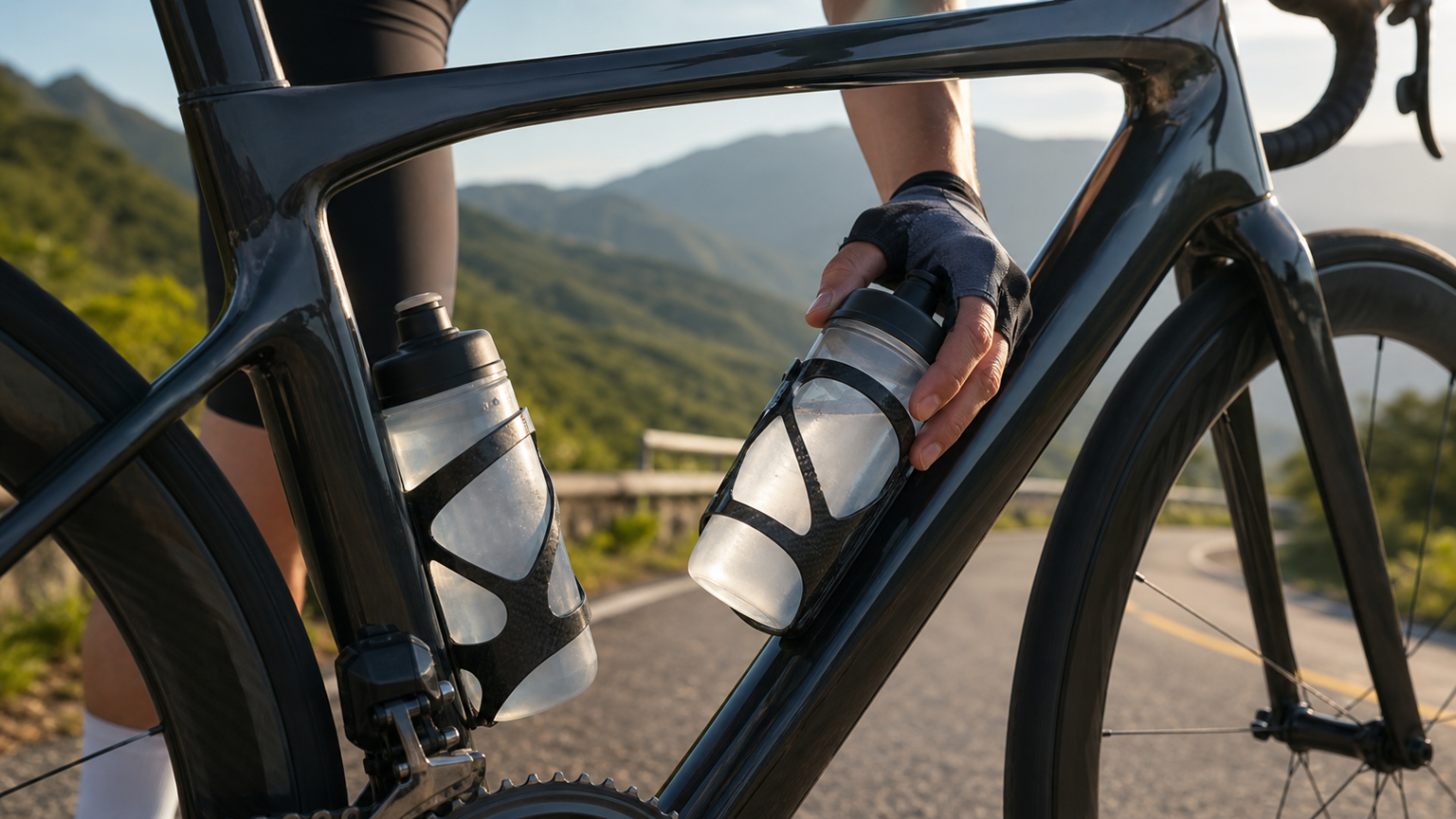
Standard Positions: Down Tube and Seat Tube Bottle Cages
The standard configuration for traditional road bikes is one bottle cage on the down tube and one on the seat tube—a golden setup that has persisted for decades.
Down Tube Bottle Cage: The most convenient to access, easily reachable with one hand, and serves as the primary bottle position. On modern race bikes, the down tube bottle cage is often optimized alongside integrated cable routing, with some brands offering integrated carbon cages (such as the integrated cage on the Cannondale SuperSix EVO).
Seat Tube Bottle Cage: The secondary bottle position, requiring a larger range of motion to access, but the weight sits closer to the frame’s center of gravity, resulting in less impact on handling.
| Mounting Position | Accessibility | Aerodynamic Impact | Capacity | Notes |
|---|---|---|---|---|
| Down Tube | Best | Moderate | Standard (500-800ml) | Primary bottle |
| Seat Tube | Good | Smaller | Standard | Secondary bottle |
| Rear Triangle/Behind Seat | Poor | Minimal | Standard | Suitable for climbing with multiple bottles |
| Top Tube | Moderate | Moderate | Small (300ml) | For TT/triathlon |
| Stem/Front of Bars | Good (TT position) | Depends on design | 200-400ml | Time trial/triathlon |
Aerodynamic Bottle Cage Systems
Aerodynamic design on modern high-end road bikes extends to bottle cages, primarily in two directions:
Integrated Aero Bottles: Such as the bottle design that came stock on the Specialized Venge, where the bottle’s shape blends with the aerodynamic profile of the down tube; the Decathlon Aeolus factory configuration also adopts a similar concept. The advantage is the best overall aerodynamic performance; the disadvantage is that bottle specifications are restricted, and standard commercially available bottles cannot be used.
Aero Bottle Behind Saddle: A common setup in time trials and triathlon, mounting the bottle behind the seat post (e.g., brands like Xlab, Profile Design), which does not affect frontal aerodynamics but is limited on technical mountain routes. Riders at Taiwan’s IRONMAN Taiwan (eastern route) often adopt this configuration.
Special Position Bottle Cages
Rear Triangle Bottle Cage: Mounted on the chainstay/seatstay, suitable for carrying an extra bottle on climbs, but inconvenient to access; mostly used on Gran Fondo or long-distance self-supported touring bikes.
Top Tube Bag/Bottle: Small bottles (approximately 200-300ml) or feed bags, suitable for hydration in the aero tuck position on TT bikes. Taiwan’s IRONMAN athletes commonly adopt a multi-point hydration strategy during the bike leg (180km).
Bottle Materials and Design
Material Choices
Standard Plastic (LDPE/PP):
- Most common on the market, weighing approximately 90-120g (750ml)
- BPA-free is now standard
- Under Taiwan’s summer heat, some low-cost materials may develop odors
- Representative brands: Elite, Camelbak Podium
Double-Wall Insulated Bottles:
- Maintains beverage temperature (keeps cold drinks cool for an additional 1-2 hours)
- Weighs approximately 150-180g, heavier than standard plastic
- Clearly beneficial for long rides in Taiwan’s summer; recommended for electrolyte drinks
- Representative: Camelbak Podium Ice
Carbon Fiber Bottles:
- Extremely lightweight (approximately 50-70g, 750ml)
- Limited insulation performance
- Highly race-oriented, with a premium price tag (approximately NT$1,500-2,500)
- A choice for time trial or lightweight race bikes
Straw Design
The straw/bite valve design directly affects hydration efficiency when riding one-handed. Self-sealing bite valves prevent leaking over bumps; large opening designs make it easier to clean out electrolyte powder. Given the high-vibration environment of Taiwan’s mountain roads, race-grade bottles with leak-proof designs are recommended.
Bottle Cage Material Comparison
Plastic Bottle Cages: Entry-level choice, durable with excellent value for money, weighing approximately 35-60g.
Carbon Fiber Bottle Cages: Flagship lightweight choice, weighing approximately 18-30g; common options in Taiwan include the Elite Ciussi Carbon and King Cage Ti, priced at NT$800-2,500.
Titanium Bottle Cages: Weight falls between carbon fiber and plastic, with outstanding durability; suitable for long-distance touring bikes or commuters.
Bottle Cage Mounting Mechanism: The standard ISO-size two-hole M5 screw mount is the universal specification for road bikes, but some integrated cages (such as mounts molded directly into carbon frames) are only compatible with specific bottle specifications. Confirm compatibility before purchasing.
Electrolyte Replacement Strategy
During Taiwan’s hot summer riding, a hydration strategy should not simply be plain water—electrolyte replacement (sodium, potassium, magnesium) is equally important. Common products on the market:
- Electrolyte Tablets (Nuun, High5, etc.): Easy to carry, dissolve in water to replenish electrolytes without adding calories
- Sports Drinks (Pocari Sweat, Gatorade, etc.): Contain carbohydrates and electrolytes, suitable for higher-intensity training
- Energy Gels with Plain Water: Replenish calories, but additional electrolytes are needed; avoid consuming only gels without sodium
General recommendation: consume 500-800ml of fluid per hour (adjusted based on sweat rate), with sodium as the primary electrolyte (approximately 400-700mg per hour).
Practical Recommendations
- Standard Setup: One 750ml bottle on the down tube and one on the seat tube, paired with lightweight Elite Fly cages, offering excellent weight and value
- Long Summer Rides: At least one insulated bottle with electrolyte drink, and another with plain water for quick hydration
- Time Trial/IRONMAN: Evaluate behind-the-saddle bottle systems to maximize hydration capacity while maintaining aerodynamics
- Bottle Cleaning: Wash after every ride, especially bottles used for electrolyte drinks; clean weekly with diluted white vinegar or a bottle brush to prevent mold growth
- Aerodynamic Assessment: Outside of time trial events, the aerodynamic impact of bottles is far less significant than the rider’s own position; there is no need to over-invest in aero bottles
Conclusion
The choice of bottle cages and hydration systems, in Taiwan’s hot and humid riding environment, has an impact on performance that far exceeds aerodynamic numbers. Ensuring a sufficient and easily accessible hydration system, paired with an appropriate electrolyte replacement strategy, is the key to Taiwan’s cyclists maintaining peak performance during summer rides. Leave the investment in aero bottles to those whose primary goal is speed competition; for everyone else, staying properly hydrated is the most effective “equipment upgrade.”
Related Reading
- Bicycle Bottle Cages and Bottles: Optimizing Material, Mounting Position, and Capacity
- Bottle Cage vs. Hydration System Comparison: Traditional Bottles vs. Backpack Hydration Packs
- Bicycle Bottle Cage Buying Guide: Comparing Side-Entry, Rear-Entry, and Sloping-Tube Mounts
- Carbon Fiber Bottle Cage Buying Guide: The Trade-off Between Weight, Grip, and Aerodynamics
洗單車神器 吹水機! 實際洗車用用看 暴力洗鍊條大法 | 公路車 | CT Yeh
4 年前
3D 列印車褲墊 / 舒適改善? / 無痕 x 分區壓縮 / ATK & Decider系列 / JE22黑科技 / #公路車 #CTYEH
11 個月前
再一組! 全碳幅條 碟煞/無內胎輪組 開箱! 到底好騎嗎? UNAAS X40 | 公路車 | CT Yeh
4 年前
單車 重低音 藍芽喇叭 音質實測 SoundBot SB525 Real Sound Test
8 年前
Unaas X50 全碳纖幅條輪 數據實測對比PK | Lun Hyper 的高階版 | 板輪爬坡也可以很厲害? ! 武嶺2小時大師一起親測! CP值超高 | 公路車 | CT Yeh
4 年前
#公路車 #Fitting 靠人工智慧APP 幫你調整單車
6 年前
#公路車 #西進武嶺 配速配瓦實驗 坡度分析 四小時內攻略 建大盃 NeverStop #西進武嶺攻略
6 年前
Vision Metron RS 37碳幅條輪組 (非SL)官網沒有的 低調開箱 / 這重量太銷魂了 / 公路車 / CT Yeh
6 個月前