Bike Trainers: Comparing the Training Effects of Rollers, Smart Trainers, and Direct-Drive Trainers
Introduction
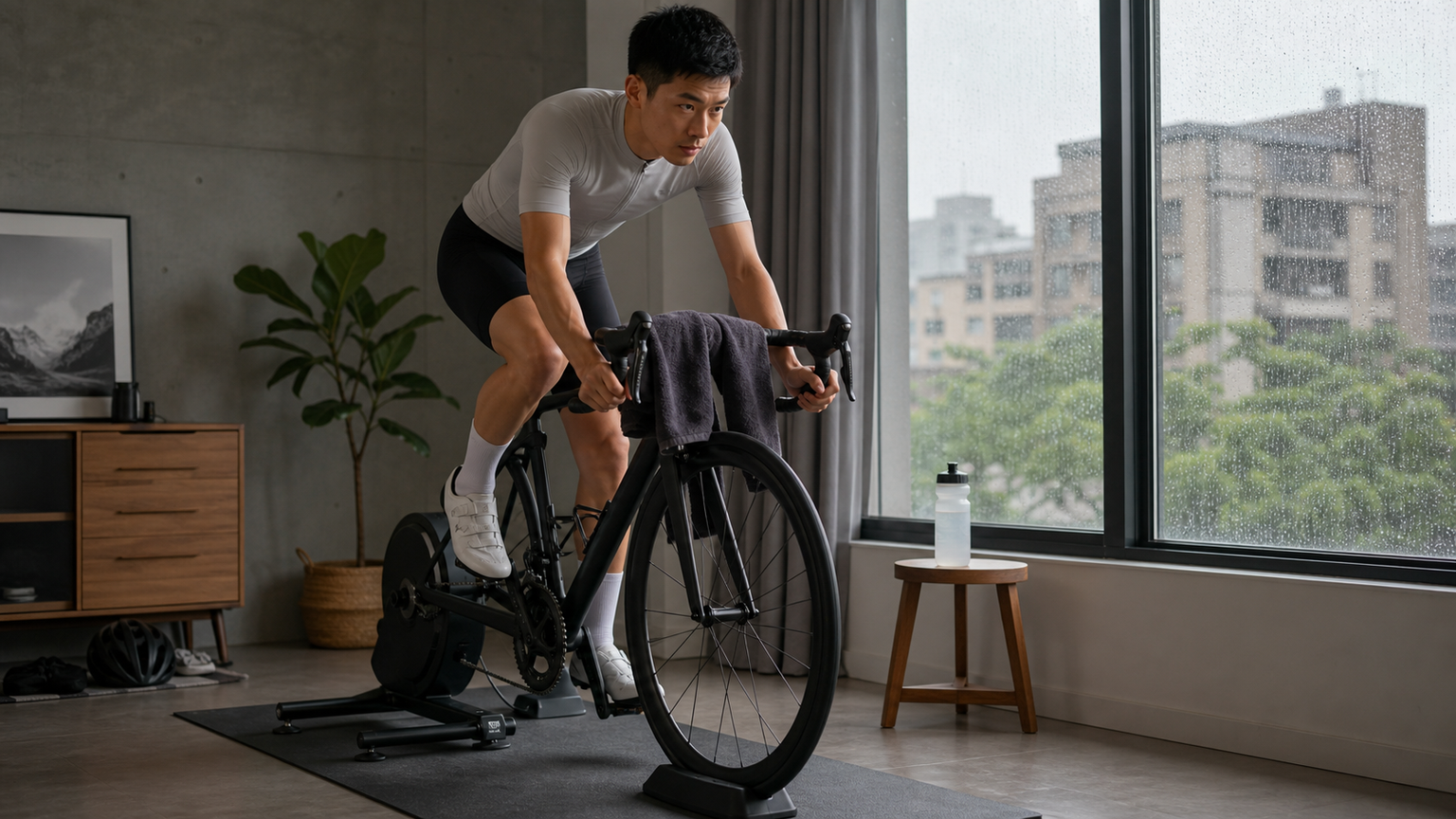
Taiwan’s plum rain season (May-June) and the days of continuous rain brought by the northeast monsoon in autumn and winter are training disruptions every serious rider has to face. The rise of indoor trainers has made indoor training a key part of race preparation, and the emergence of virtual riding platforms like Zwift and RGT Cycling has greatly boosted the interactivity and fun of training indoors. This article systematically compares the three main types of trainers along two dimensions: training effect and technical specifications.
Overview of the Three Trainer Types
| Type | Realism | Balance Training | Noise | Power Accuracy | Price Range (TWD) |
|---|---|---|---|---|---|
| Roller | High | Best | Low | None (requires external power meter) | NT$2,000-8,000 |
| Resistance Trainer (Fluid/Magnetic) | Medium | None | Medium | Low/estimated | NT$5,000-15,000 |
| Smart Direct Drive | High | None | Low | ±1-2.5% | NT$20,000-60,000 |
Roller Trainer
Rollers are the most traditional form of indoor trainer, consisting of three rotating drums on which the wheels roll freely. There is no fixed mounting mechanism at all — balance is maintained entirely by the rider.
The unique training advantages of rollers:
- Balance training: Requires continuous core stability and pedaling technique; studies show long-term roller use can improve pedaling smoothness
- Low noise: No fixed mounting mechanism means less vibration transfer, making it more apartment-friendly
- Natural riding feel: The whole bike moves freely, giving the feeling closest to riding outdoors
- Technical training: Best for practicing low-speed bike handling, single-leg pedaling, and similar technical drills
Limitations of rollers:
- Beginners need time to learn (practicing near a wall or fixed object)
- High-intensity sprint efforts are harder to control, with a risk of falling
- Cannot accurately measure power (unless paired with an external power meter)
- Does not support gradient simulation, so it cannot interact with the climb features on platforms like Zwift
Many competitive riders in Taiwan do one to two roller sessions a week, focusing on improving pedaling efficiency, alongside their direct-drive trainer training.
Traditional Resistance Trainers (Fluid/Magnetic Trainer)
A traditional resistance trainer fixes the rear wheel to a frame, with a resistance unit (fluid or magnetic) providing the resistance. This is the most common entry-level trainer format in Taiwan.
Fluid Trainer:
- Resistance increases automatically with speed, giving a fairly natural resistance feel
- Low noise, apartment-friendly
- Resistance cannot be precisely controlled, and power estimation error is large (±10-20%)
Magnetic Trainer:
- Some models have manual or electronic resistance adjustment
- Low cost, good durability
- Slightly noisier than fluid trainers
- Power estimation relies on speed conversion, with limited accuracy
The main limitations of traditional resistance trainers: rear wheel wear (a dedicated trainer tire such as the Continental Home Trainer is recommended), inaccurate power data, and no gradient interaction with platforms like Zwift.
Smart Direct Drive Trainer
Smart direct-drive trainers represent the current pinnacle of trainer technology, with flagship products including the Wahoo KICKR, Tacx NEO 2T, and the Elite Direto series.
Core technical features of direct-drive trainers:
- Rear-wheel-free direct drive: The rear wheel is removed and the cassette is mounted directly on the trainer, eliminating tire wear and tire-slip measurement error
- Precise power measurement: Built-in strain gauges achieve an accuracy of ±1-2.5%, so the unit can double as a power meter
- Gradient simulation: The electromagnetic resistance system can adjust resistance in real time to simulate gradients of up to 25% (the Wahoo KICKR CLIMB, paired with a mechanical rising fork, can even simulate the actual tilt of the bike)
- ERG mode: Once a target power is set, the system automatically adjusts resistance to hold that wattage regardless of cadence, ideal for precise power-zone training
Comparison of major brands:
| Brand/Model | Power Accuracy | Max Gradient | Cassette Compatibility | Price (TWD) |
|---|---|---|---|---|
| Wahoo KICKR v6 | ±1% | 20% | 11-speed SRAM/Shimano | NT$55,000 |
| Tacx NEO 2T | ±1% | 25% | Multiple options | NT$50,000 |
| Elite Direto XR | ±1.5% | 24% | Multiple options | NT$30,000 |
| Saris H3 | ±2% | 20% | Multiple options | NT$28,000 |
Integration with Virtual Platforms Like Zwift
The best way to maximize the value of a smart direct-drive trainer is through interactive training on platforms like Zwift, TrainerRoad, or Wahoo RGT. Zwift already has a fairly large user base within Taiwan’s cycling community, and its virtual island route (Watopia) is designed with real-world terrain in mind — on steep sections the trainer automatically increases resistance, and it eases off automatically on descents, creating an immersive experience close to real riding.
TrainerRoad, by contrast, is a purer training platform that provides systematic training plans based on power zones, making it especially valuable for riders preparing for an island loop or a Gran Fondo.
Practical Considerations for Using Trainers in Taiwan
Apartment noise concerns:
Most people in Taiwan’s cities live in apartments or high-rises, so trainer noise is an important consideration. Recommended measures:
- Use a vibration-isolating mat (such as trainer-specific mats from brands like Giant or Feedback Sports)
- Direct-drive trainers are significantly quieter than rear-wheel-mounted resistance trainers
- The Tacx NEO series, which relies mainly on electromagnetic resistance, has the lowest actual noise level
Sweat management:
Taiwan’s high temperatures mean indoor training produces a surprising amount of sweat. Recommendations:
- Use a fan (smart fans like the Wahoo HEADWIND can automatically adjust speed based on power output)
- Lay a sweat towel where the frame meets the trainer to prevent sweat from corroding the frame and trainer
- Regularly clean the housing of the trainer’s resistance unit
Practical Recommendations
- For riders on a limited budget: A traditional fluid resistance trainer + an external power meter (such as 4iiii or Favero Assioma) offers sufficient power accuracy, with total cost kept under NT$20,000
- The top choice for serious training: The Elite Direto XR (the best value entry-level direct-drive trainer), paired with Zwift or TrainerRoad, for a systematic indoor training setup
- For balancing technical improvement: 1-2 roller sessions per week alongside your main direct-drive trainer training
- For the flagship experience: Wahoo KICKR + KICKR CLIMB (rising fork) + HEADWIND (smart fan) offers close to the most realistic indoor riding experience available
Conclusion
The return on a trainer investment depends on how often you use it and how systematic your training is. If you can maintain 3-4 structured indoor sessions per week during Taiwan’s plum rain season from April to June, the precise power data and interactive experience offered by a smart direct-drive trainer will provide a solid fitness foundation for outdoor riding in summer. Choosing a system that fits your budget and that you’ll actually keep using consistently is the smartest investment decision.
Related Reading
- Bike Trainer Setup and Maintenance: Rollers and Direct-Drive Trainers
- In-Depth Bike Trainer Review: Direct Drive vs. Resistance Trainers Compared on Ride Feel, Noise, and Training Value
- Trainer Buying Guide: Comparing Wheel-On, Direct-Drive, and Smart Trainers
- Indoor Training Alternatives for Typhoon Season: Don’t Let Bad Weather Be an Excuse
ThinkRider 智騎 XXPRO 訓練台,高階機種功能 只要 1/3價格!? 實測功率對比、噪音實測 / 公路車 / CT Yeh
1 年前
訓練台體驗) 2019台北自行車展 三大家 訓練台體驗 Tacx Neo Flux 2 Xepdo Apx Wahoo Kickr
7 年前
Fitting訓練兩用功率車 ! Thinkrider ST900 完整實測!/ 坡度升降 / 鄰居測試/ smart bike/公路車/ CT Yeh
2 年前
邁金 T500 訓練台開箱!有下坡輔助、路感模擬、不用插電、直驅電機 !兩萬級距頂規享受新選擇!/ 公路車 / 室內訓練 / CT Yeh
1 年前
智騎 X5 Neo 不到15000的價格就入手 智能訓練台! 阻力反應/功率精準度/Zwift Rouvy相容度 全面實測 | 公路車 | CT Yeh
4 年前
元宇宙單車運動!智騎 X7 Pro 智能訓練台 ThinkRider 居家線上練功
5 年前
2022台北國際自行車展 訓練台 試騎心得大全 差點腿軟走出! 元宇宙武嶺!| Garmin Tacx Oreka Xpedo Wahoo | 公路車 | CT Yeh
4 年前
沉浸室內單車練功房開箱! 100吋大畫面,最便宜的花費? 居然還能K歌!? | 公路車 | CT Yeh
3 年前