Introduction
“I can only ride five or six hours a week — is that enough?” This is one of the most common questions asked by working cyclists in Taiwan. The answer is: yes, it’s enough, but only if you spend those five or six hours wisely.
Professional cyclists often train 25–30 hours a week, giving them plenty of time for low-intensity, long-duration rides. But for working professionals who spend eight hours a day at the office and still need to take care of their families, time is the scarcest resource. This means every minute of your training must count — you can’t afford to waste it on rides with the wrong intensity or no clear purpose.
The Time Reality for Working Cyclists
According to a survey of amateur cyclists in Taiwan, the typical weekly riding time available to a working cyclist breaks down as follows:
| Type | Training Time Allocation | Notes |
|---|---|---|
| Weekday commute ride | 30–60 minutes per day (one way) | Requires shower facilities |
| Weekday evening ride | 60–90 minutes (2–3 times/week) | Lights needed after dark |
| Weekend long ride | 2–4 hours (1–2 times) | Main source of training volume |
| Indoor trainer | 45–75 minutes | Most flexible in scheduling |
Most working cyclists have between 5 and 10 hours of actual available training time per week.
Core Concept: Quality Over Quantity
When time is limited, you must accept a basic reality: you cannot copy a professional cyclist’s training model. What you need is a “high-efficiency training” approach, built on two main strategies:
Strategy One: Sweet Spot Training (SST)
Training at 88–94% of FTP for medium-to-long intervals (15–30 minutes per set). This intensity produces an extremely high ratio of “training stimulus to recovery time,” making it the best choice for time-crunched cyclists.
Strategy Two: High-Intensity Interval Training (HIIT)
Short, high-intensity sessions — such as 5-minute VO2max intervals or 30-second Tabata-style efforts — that deliver high-quality training within 45–60 minutes. Ideal for days when weekday time is extremely tight.
Six Models for Weekly Training Scheduling
Model A: “3-Ride” Foundation Model
Suitable for cyclists who can commit 5–7 hours per week:
- Tuesday: 60-minute SST (15-min warm-up + 30-min SST + 15-min cool-down)
- Thursday: 75-minute aerobic ride + skills practice
- Saturday or Sunday: 150–180-minute long ride
Model B: “4-Ride” Advanced Model
Suitable for cyclists who can commit 7–10 hours per week:
- Tuesday: 60-minute HIIT (VO2max intervals)
- Wednesday: 45-minute easy recovery ride
- Friday: 75-minute SST
- Saturday: 180–240-minute long ride
Model C: “Commute + Weekend Long Ride” Hybrid Model
For cyclists whose workplace is suitable for a cycling commute:
- Monday to Friday: 30–45-minute commute ride (morning) + 30–45-minute commute ride (evening), totaling 60–90 minutes per day
- But keep commute intensity easy: Stay in Zone 1–2 — don’t treat your commute as a training sprint
- Saturday: One additional high-intensity session (90 minutes)
- Sunday: Long ride (2–3 hours)
The Indoor Trainer: The Working Cyclist’s Secret Weapon
The smart indoor trainer has become an essential training tool for working cyclists in Taiwan. Its main advantages:
- Weather-independent: Taiwan’s summers bring frequent typhoons and winters bring heavy rain — an indoor trainer lets you train year-round without interruption
- Extremely efficient: No red lights or coasting downhill, so the proportion of time actually spent pedaling is much higher
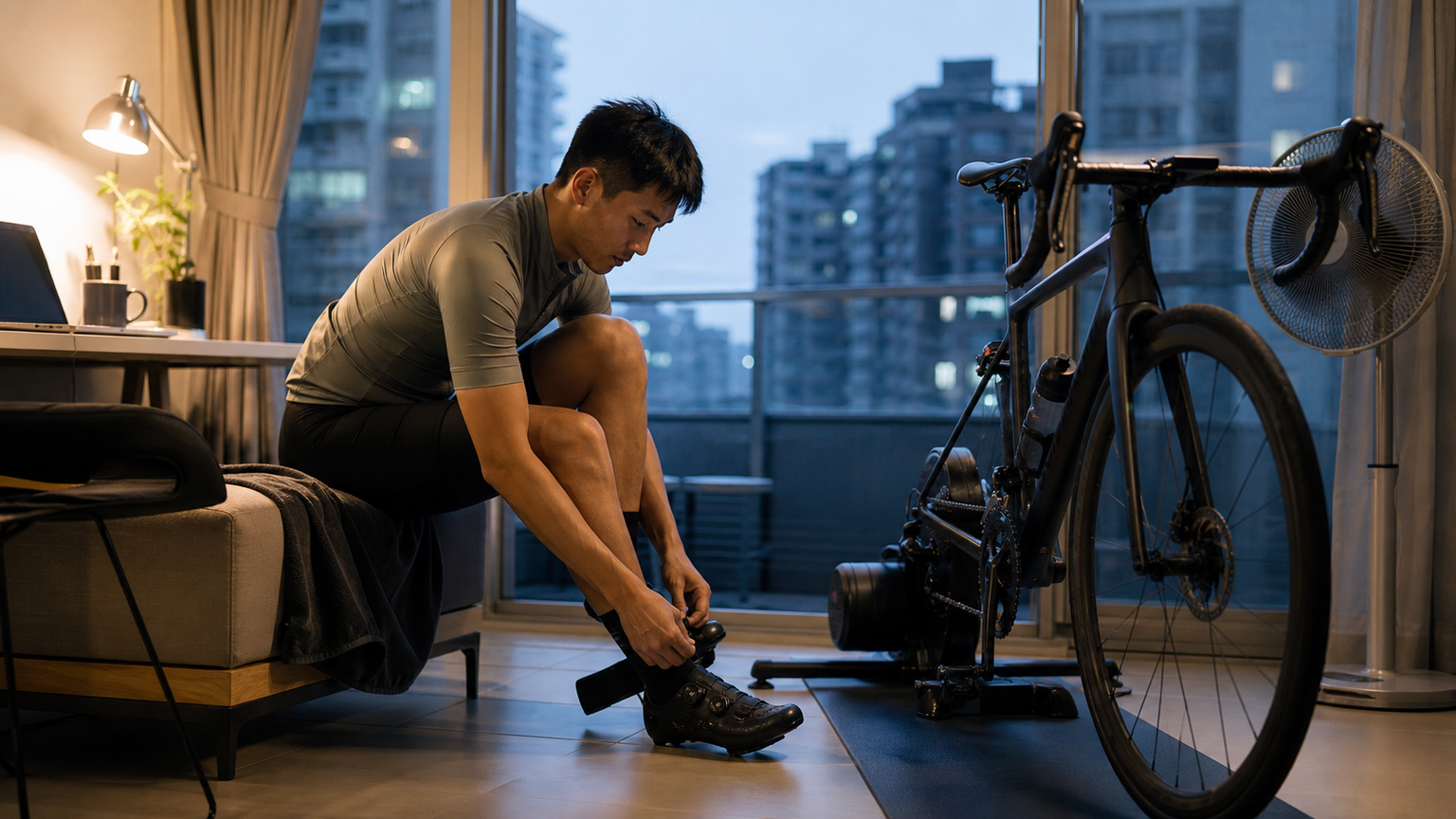
- Fits around family life: Once the kids are asleep, set up the trainer in the living room and complete a high-quality 40-minute Zwift session
- Easy to follow structured workouts: Platforms like Zwift and TrainerRoad provide structured workouts that tell you exactly how much power to output at every moment
A recommended indoor trainer workout (40–60 minute version):
- 10-minute warm-up (low intensity)
- 3 × 8-minute SST intervals (3-minute recovery between sets)
- 10-minute cool-down
- Total duration: approximately 55 minutes, but with training benefits equivalent to a 90-minute outdoor ride
Stress Management: Work Fatigue Is Training Stress Too
Many working cyclists overlook a key fact: work and family stress consume your recovery resources just like training fatigue does. If you’ve been working overtime and getting insufficient sleep, pushing through a planned high-intensity session can actually do more harm than good.
HRV (Heart Rate Variability) monitoring is a useful tool for gauging your recovery state. Measure your HRV while lying still right after waking up (Garmin, Polar, or the free Kubios app can all do this). If the value is 10–15% below your recent average, it’s better to switch to an easy recovery ride rather than forcing through a high-intensity workout.
Practical Tips
Put training on your calendar: If training time isn’t scheduled, it will easily get displaced by other things. Treat your training sessions like meetings and give them real priority.
Prepare your gear in advance: Keep your riding clothes, helmet, and cycling shoes somewhere visible and easy to grab, lowering the psychological barrier to heading out the door.
Find a training partner: A Saturday long ride with a partner dramatically reduces the chance of skipping it. Active cycling communities (on Facebook, LINE groups) exist all over Taiwan — finding a group that matches your level is a great way to stay motivated.
Conclusion
5–7 hours of training per week is enough for a dedicated working cyclist to complete a century ride, take on the Wuling Challenge, or even compete in amateur races. The secret lies in using the right method, sticking to the plan, and having the courage to slow down when your body needs rest. Training is a long game, not a sprint.
Related Reading
- Balancing Work and Training for Amateur Cyclists: Practical Time Management for Working Professionals
- How Working Professionals Can Maintain a Weekday Cycling Habit: Time Management Strategies
- Data Analysis Strategies for Time-Crunched Cyclists: Getting Maximum Training Benefit from Minimum Time
- Time Management in Triathlon Training: How Working Professionals Train for Three Sports a Week
單車 一日北高 ( 雙城 ) 肥宅雙人瘋狂行 紀錄片 REACTO
10 年前
靠單車減肥35公斤 心得分享與整理
7 年前
一日北高常見問題大集合 | 攻略 | 路線 | 訓練 | 補給 | 自行車 單車 | 一日雙城 | 雙塔 | TWB北高360 | 屁股痛
6 年前
2019 夏季KOM 5小 完賽心得 準備攻略 東進武嶺 夏季登山王之路 Taiwan KOM Challenge
7 年前
西進武嶺 免費訓練分析服務 Intervals | 練不夠還是練過頭?你哪一種類型選手?AI模型告訴你! | 備戰神器 | 公路車 訓練 | CT Yeh
4 年前
2026 車錶排行榜!誰是最多車友正在使用?練家子最愛哪款?🏆 (2萬名車友數據) / 公路車 / CT Yeh
5 個月前
#公路車 #Fitting 靠人工智慧APP 幫你調整單車
6 年前
一日北高 11小時 賽後心得分享篇 | TWB北高360 | 一日雙城 | 單車 | 公路車
6 年前