Introduction
“You improve by training”—this is many people’s intuitive understanding of exercise. But sports science tells us that real progress happens during the recovery period after training, not during the training itself.
Training places stress on the body, breaking down muscle fibers, depleting glycogen, and accumulating fatigue. When you rest, the body begins to repair, and it repairs to a stronger state than before—this is the principle of Supercompensation. If new stress is applied before supercompensation is complete, the body remains fatigued, and progress stalls or even regresses; if you wait too long before the next training session, the supercompensation effect fades.
The Physiology of Recovery: What Your Body Is Doing
After a high-intensity training session, the body needs to repair the following:
| Repair Item | Recovery Time (Estimated) | Influencing Factors |
|---|---|---|
| Muscle glycogen replenishment | 24–48 hours | Dietary carbohydrate intake |
| Muscle fiber micro-tear repair | 48–72 hours | Training intensity and volume |
| Nervous system fatigue | 48–96 hours | Degree of high-intensity intervals |
| Immune system recovery | 24–72 hours | Training volume and sleep quality |
| Hormonal balance restoration | 24–48 hours | Stress management and sleep |
The recovery demands of high-intensity training (VO2max intervals, threshold training) are far greater than those of low-intensity aerobic training. A single 5×5-minute VO2max session may require 48–72 hours for full recovery.
Active Recovery vs. Complete Rest
Active Recovery
A 30–60 minute easy ride at very low intensity (50–60% of maximum heart rate, below 40–50% of FTP power).
Advantages:
- Promotes blood circulation, accelerating the removal of waste products (lactate, metabolic waste)
- Maintains muscle elasticity and mobility
- Reduces post-training muscle stiffness
- Maintains the daily habit of training
When to use:
- The day after moderate-intensity training (e.g., after threshold training)
- The day after a long ride
- When the body has mild fatigue but overall condition is still good
How to execute: The intensity must be “truly easy”—you should be able to watch a video or listen to a podcast, feeling like you rode without really riding. Many cyclists unconsciously speed up during active recovery, losing the purpose of recovery.
Complete Rest
No deliberate exercise or training at all.
Advantages:
- Allows the nervous system to fully relax
- Lowers overall stress hormones (cortisol) in the body
- Provides psychological recharging, sustaining long-term training motivation
When to use:
- The day after high-intensity interval training (especially VO2max)
- 1–2 days after a long, high-intensity event (e.g., Wuling, multi-day endurance challenges)
- When signs of overtraining appear
- Rest days within a recovery week
Suggested Weekly Recovery Day Configuration
Using the example of an amateur cyclist training 4 days per week:
| Day | Training Type | Intensity |
|---|---|---|
| Monday | Complete Rest | — |
| Tuesday | Threshold training (2×20min) | High |
| Wednesday | Active Recovery Ride (45 minutes Zone 1) | Very Low |
| Thursday | VO2max intervals | Very High |
| Friday | Complete Rest | — |
| Saturday | Long ride (3–4 hours, mostly Zone 2) | Moderate |
| Sunday | Active Recovery Ride (60 minutes Zone 1–2) | Low |
Core logic: Schedule recovery days around high-intensity days (Thursday)—active recovery before (Wednesday) and complete rest after (Friday)—ensuring that every high-intensity session is performed in a fully recovered state.
Auxiliary Strategies to Accelerate Recovery
Beyond scheduling appropriate rest days, the following methods can help speed up recovery:
Sleep: The most effective recovery tool. Research shows that less than 7 hours of sleep per night significantly prolongs recovery time. For the sake of training quality, treat sleep as part of your training and take it seriously.
Post-training carbohydrate intake: The 30 minutes after training is the golden window for replenishing muscle glycogen. White rice, sweet potatoes, and bananas paired with protein can accelerate glycogen recovery.
Cold water baths/ice baths: A 10–15 minute cold water bath (15–18°C) after exercise helps reduce muscle inflammation. In Taiwan’s summer, turning on the air conditioning and taking a cold shower is a simple, feasible version.
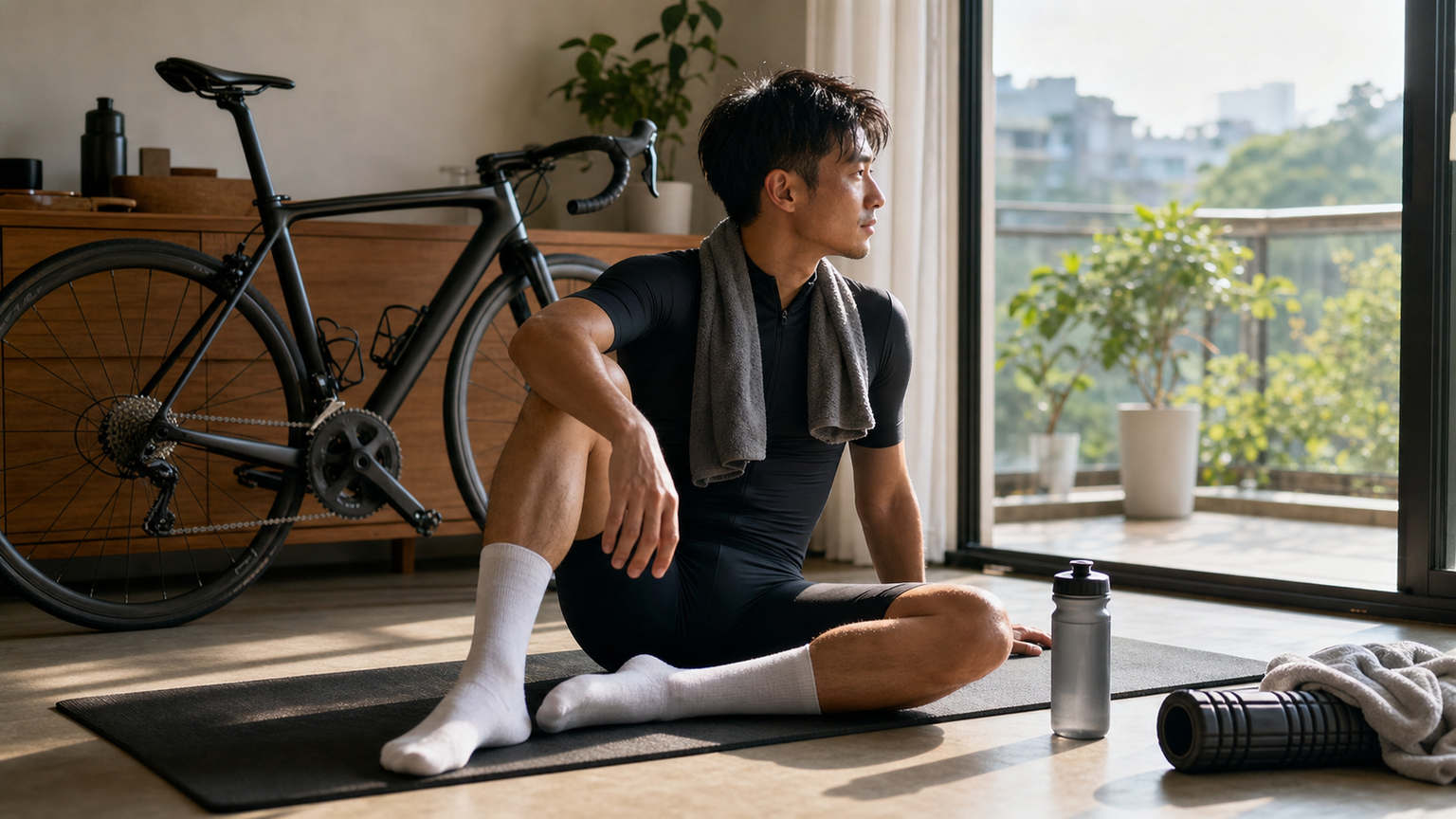
Stretching and foam rolling: Static stretching (10–15 minutes) and foam rolling after training can improve muscle tightness and aid recovery (though their effect on muscle strength itself is limited).
Fluid replenishment: For every 1 kg of body weight lost (through sweat), approximately 1.5 liters of fluid needs to be replenished. Fluid intake after long rides is very important.
Warning Signs of Overtraining
When insufficient recovery accumulates persistently, the body shows early signs of Overtraining Syndrome:
- Resting heart rate is 5–7 bpm above average for 3 consecutive days
- Sudden deterioration in sleep quality (difficulty falling asleep or waking up in the middle of the night)
- Loss of motivation during training; wanting to quit as soon as intensity rises
- Irritability or anxiety
- Recurring colds or minor injuries that won’t heal
If 3 or more signs appear, pause high-intensity training for 1–2 weeks, replacing it with easy rides or complete rest.
Practical Advice
Create a ritual around recovery days: Making recovery days feel “ritualistic” helps with psychological acceptance. For example: soak your feet, do 30 minutes of stretching, go to bed early on recovery days—these behaviors not only benefit the body but also signal to the brain that “today is a recharging day, not a slacking-off day.”
Conclusion
Training progress doesn’t happen while you’re pedaling—it begins the moment you stop. Learning to schedule rest days is no easier than learning interval training, but it is equally important. In Taiwan’s crowded urban life and heavy work pressure, being able to wisely balance the ratio of training to recovery is the key to long-term progress and enjoying the ride as an amateur cyclist.
Related Reading
- The Supercompensation Effect of Interval Training: A Scientific Explanation of Why Rest Makes You Stronger
- The Supercompensation Principle After Cycling Training: The Balance Between Fatigue and Adaptation
- Supercompensation Theory: Why Rest Days Actually Make You Stronger
- Designing Work-to-Rest Ratios for Cycling Intervals: The Scientific Basis
#公路車 #Fitting 靠人工智慧APP 幫你調整單車
6 年前
西進武嶺 免費訓練分析服務 Intervals | 練不夠還是練過頭?你哪一種類型選手?AI模型告訴你! | 備戰神器 | 公路車 訓練 | CT Yeh
4 年前
靠單車減肥35公斤 心得分享與整理
7 年前
CT 喇低賽) 單車 比賽總是沒照片? 攝影師的觀點大公開 姿勢就是力量! 請加速1.25倍收看
7 年前
單車 一日北高 ( 雙城 ) 肥宅雙人瘋狂行 紀錄片 REACTO
10 年前
摔車後補裝備: 好市多新款單車安全帽& Specialized Romin 北高整路屁股都不痛的坐墊 | 一千元居然有MIPS | CT Yeh | 公路車
4 年前
DJI Osmo Action 6 / 單車運動拍攝實用技巧 公路車 CT Yeh
7 個月前
Insta360/DJI做不到的!如何製作「騎士頭頂瓦數特效」單車影片?CycleDash 完整教學 / 超強批次影片數據疊加軟體
13 天前