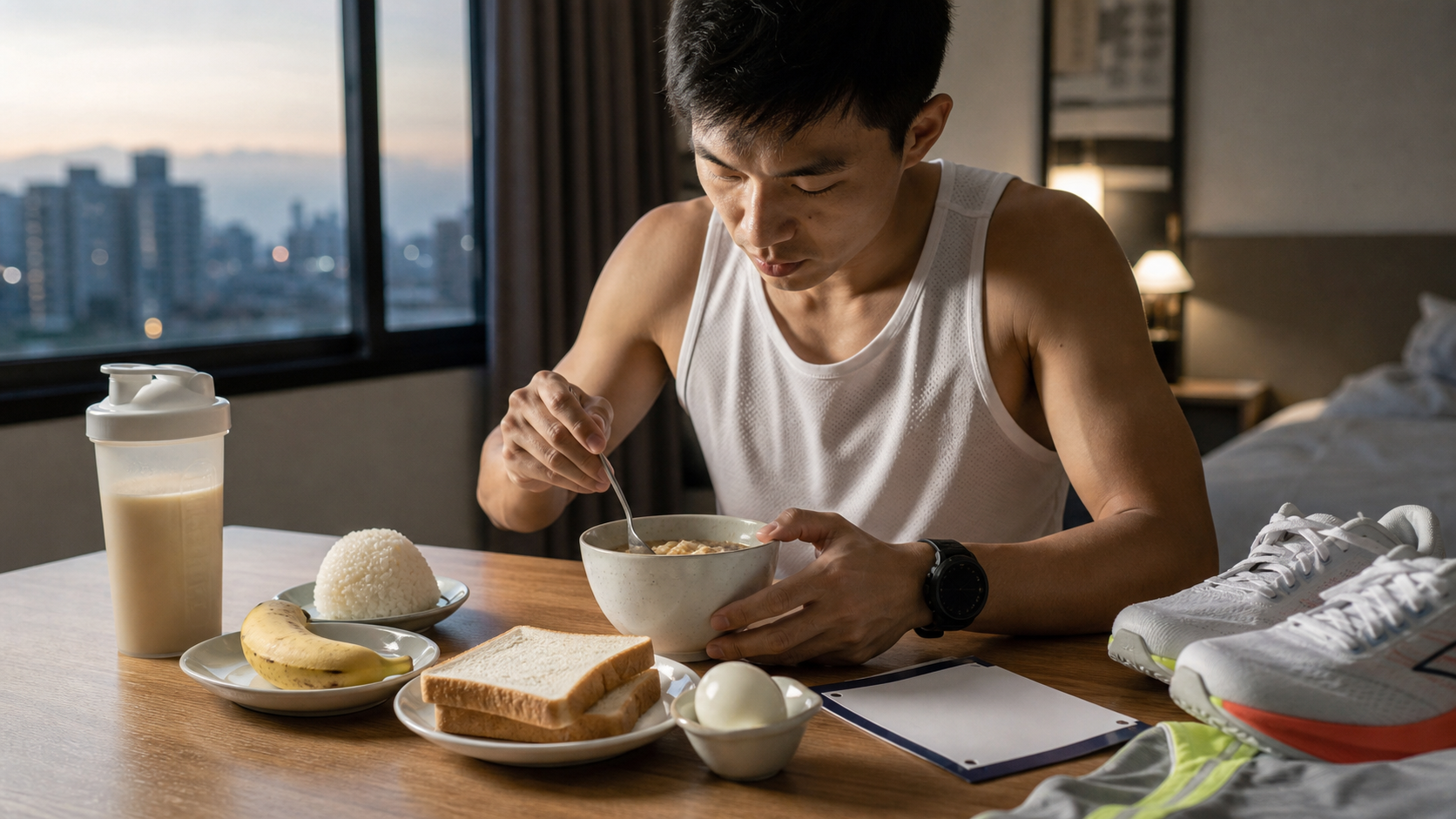
Introduction
The night before the race, you might be too nervous to sleep, but there’s one thing you can’t overlook: your race-day breakfast plan.
Eating too late, eating too much, or eating unfamiliar foods can all lead to gastrointestinal discomfort, bloating, or even diarrhea during the run. Eating too early or too little may cause your blood sugar to drop in the latter half of the race, hitting the “wall” prematurely.
The goal of a pre-race breakfast is clear: maximize glycogen storage, minimize gastrointestinal burden, and maintain stable blood sugar.
Calculating Digestion Time and Start Time
Generally, solid food takes 2–4 hours from consumption to initial digestion, while liquid or semi-liquid foods take 1–2 hours. This means when your breakfast should be finished before the start depends on what you eat:
| Food Type | Digestion Time | Recommended Eating Time (Before Start) |
|---|---|---|
| Large solid breakfast (rice balls, sandwiches, noodles) | 3–4 hours | 3.5–4 hours before the start |
| Medium solid breakfast (toast, oatmeal) | 2–3 hours | 2.5–3 hours before the start |
| Light meal (banana, energy bar) | 1–1.5 hours | 1–1.5 hours before the start |
| Liquid supplement (sports drink, congee) | 1–1.5 hours | 1–2 hours before the start |
Take a common Taiwan marathon with a 6:00 AM gun start as an example: it’s recommended that breakfast be finished no later than 3:30–4:00 AM. This is a challenge for many runners, so the breakfast design should lean toward “easy to digest.”
Ideal Composition of a Race-Day Breakfast
Carbohydrates (The Star)
The carbohydrate target for a pre-race breakfast is 1–4 grams per kilogram of body weight, depending on distance:
- 10K: body weight × 1–2 grams
- Half marathon: body weight × 2–3 grams
- Full marathon: body weight × 3–4 grams
Choose refined carbohydrates that are low in fiber and low in fat (white rice, white toast, oatmeal), and avoid high-fiber whole grains, beans, and large amounts of vegetables to prevent gas or gastrointestinal discomfort.
Protein (Supporting Role)
Moderate protein (15–20 grams) can help maintain stable blood sugar and prevent rapid spikes and dips caused by carbohydrates. Choose easily digestible sources: eggs, soy milk, low-fat milk. Avoid high-fat meats (bacon, sausage).
Fat (Minimal)
Fat digests the slowest, so fat in a pre-race breakfast should be kept to a minimum. There’s no need to eliminate it entirely, but avoid high-oil foods like buttered bread and fried items.
Race-Day Breakfast Examples for Taiwanese Runners
Option A: Traditional Taiwanese (3 hours before the start)
- 2 bowls of plain congee + 2 marinated eggs + a little pickled cucumber
- Carbs approx. 70–80 g, protein approx. 12–15 g, low fat
- Advantages: easy to digest, familiar to Taiwanese stomachs
Option B: Western-Style Breakfast (2.5 hours before the start)
- 2 slices of white toast + honey + 2 boiled eggs + 300 ml low-fat milk
- Carbs approx. 65–75 g, protein approx. 20–22 g
- Advantages: easy to prepare; can be prepped the night before
Option C: Light and Quick (1.5 hours before the start)
- 2 bananas + 1 slice of white toast with jam + 300 ml sports drink
- Carbs approx. 60–70 g, low protein
- Advantages: suitable for runners who are nervous before the race or have sensitive stomachs
Option D: Ultramarathon / Long Distance (3.5 hours before the start)
- 1.5 bowls of white rice + 2 tea eggs + 500 ml unsweetened soy milk
- Carbs approx. 90–100 g, protein approx. 25–28 g
- Advantages: ample energy, suitable for distances over 42K
Foods to Avoid Before the Race
The following foods should be strictly avoided in the race-day breakfast:
- High-fat foods: egg yolk pastries, buttered bread, bacon, scallion pancakes with fried dough sticks (fat slows digestion)
- High-fiber foods: sweet potato leaves, water spinach, beans (heavy burden on the stomach)
- Gas-producing foods: cruciferous vegetables (broccoli, cabbage), carbonated drinks
- Unfamiliar foods: anything you don’t normally eat for breakfast
- Large amounts of coffee: a small amount of coffee can be stimulating, but too much may accelerate intestinal motility, triggering the urge to use the restroom mid-run
Final Top-Up 30 Minutes Before the Start
If you feel slightly hungry or need a final top-up, you can consume 30 minutes before the start:
- Half a banana or one energy bar
- 100–150 ml of sports drink
- Or one energy gel (with water)
Practical Tips
- Rehearse your race-day breakfast during long training runs: Don’t try it for the first time on race day. Follow the plan before your weekend long runs to confirm your stomach handles it well.
- Prep ingredients the night before: For races like the Wan Jin Shi Marathon, you may be staying in another city. Prepare breakfast ingredients in advance rather than gambling on finding breakfast at the last minute.
- Set your alarm: If you need to wake up at 3–4 AM to eat breakfast, set multiple alarms to make sure you don’t oversleep.
- Smaller, more frequent is better than one large meal: If you can’t finish breakfast 3 hours before the start, eat less of easily digestible foods and top up with energy gels closer to the start.
Conclusion
The race-day breakfast is the final piece of the puzzle in race preparation. When you stand on the starting line feeling comfortable in your stomach and full of energy, that feeling is the result of a correct nutrition strategy. Treat your race-day breakfast plan with the same seriousness as your pacing and fueling strategies in training, and you’ll thank yourself for the preparation.
Related Reading
- Breakfast Design for Runners: Ideal Carb-to-Fat Ratio 3 Hours Before a Race
- Pre-Race Meal Guide for Road Races: Best Food Combinations 2–3 Hours Before the Start
- Trail Race Day Breakfast: What to Eat 3 Hours Before the Start So Your Stomach Doesn’t Turn on You at 10K
- Pre-Ride Breakfast Design: Best Timing and Food Choices for Race-Day Morning
CT暗黑廚房) 車友必備 宇宙無敵鮮蚵湯 幫助訓練恢復 天然食補 好市多 超肥鮮蚵 破PR
7 年前
Live) 備戰2019彰化經典百K 賽前攻略 (已完賽請看新影片
7 年前
一日北高前的高裝檢 | 北高 360 | 挑戰11小時的裝備 | 一日雙塔 | 補給
6 年前
CT 喇低賽) 武嶺牽車 才是王道 西進牽車四小時內秘訣 攝手位置 如何判斷 防抽筋小秘訣
7 年前
FTL 與 SYB 車隊專訪 西進武嶺 實用攻略分享! 2小時 如何練?!你不知道的眉角!新手準備武嶺必看 EP1 | 實力派女車友 | 精華版 | 公路車 | CTYeh
4 年前
2019 夏季KOM 5小 完賽心得 準備攻略 東進武嶺 夏季登山王之路 Taiwan KOM Challenge
7 年前
一日北高/長距離團騎 常見問題補充篇 / 組團或跟團的眉角 / 壯車友容易被瘦車友慢性拉爆 / 原來屁股痛可能是這個原因...? / 風場配速法 / 公路車 / CT Yeh
2 年前
單車 一日北高 ( 雙城 ) 肥宅雙人瘋狂行 紀錄片 REACTO
10 年前