A 12-Week Progressive Plan for Beginner Swimmers: From 25 Meters to Swimming 1,000 Meters Continuously
Introduction
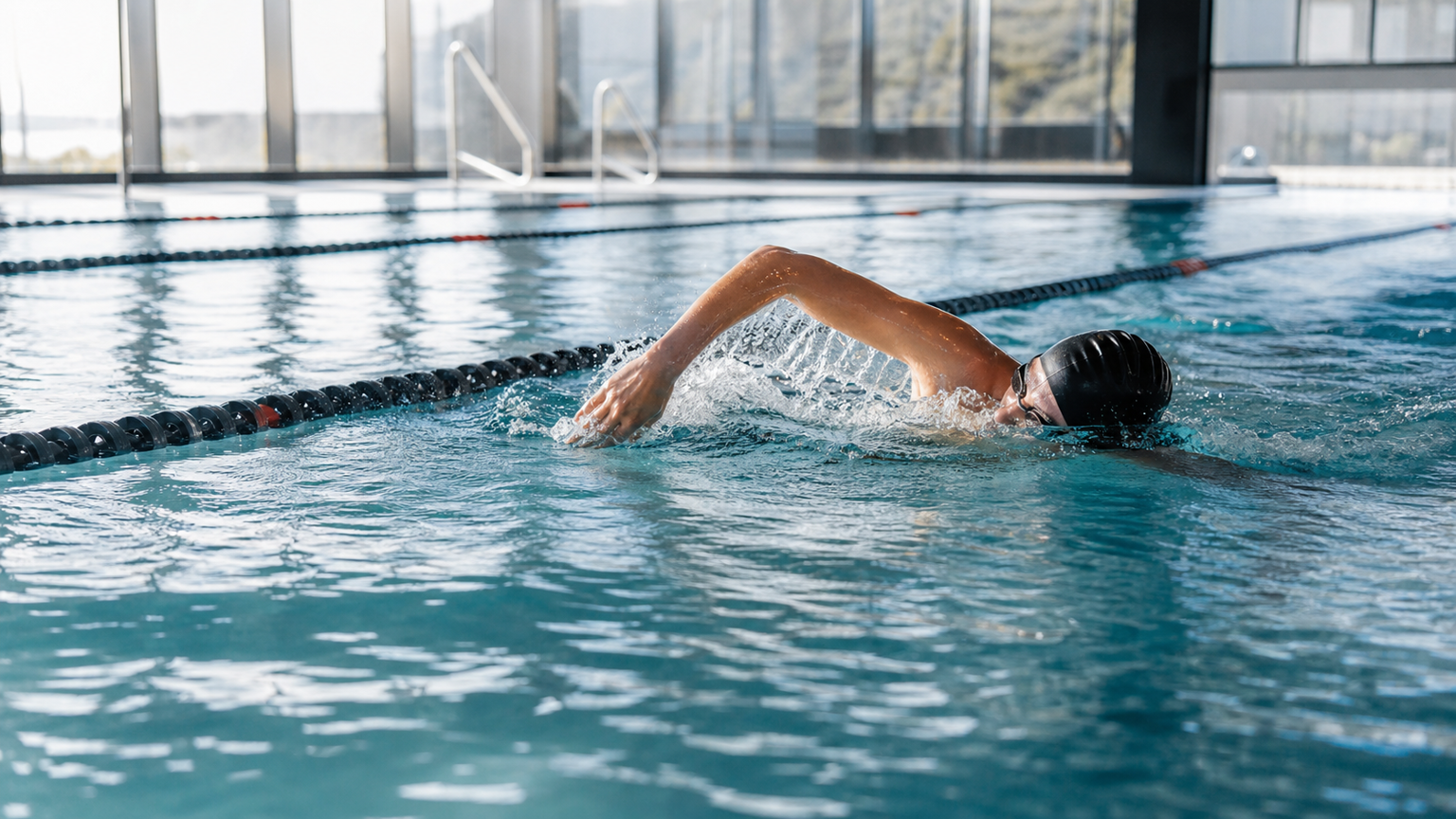
Swimming pool resources in Taiwan are quite abundant, from sports centers in the Greater Taipei area to public pools in various counties and cities—there are practice venues almost everywhere. However, many beginners often don’t know how to practice on their own after receiving their first swimming instructor certificate. “I get tired after just swimming 25 meters” is the most common predicament.
In fact, going from 25 meters to 1000 meters isn’t something you can achieve just by “swimming your heart out.” It requires a systematic training plan, including building an aerobic base, consolidating technical movements, and scheduling recovery time. The 12-week schedule designed in this article is suitable for beginners who already have basic freestyle technique, with the goal of steadily completing 1000 meters without stopping within three months.
Pre-Training Assessment and Preparation
Before starting the 12-week plan, do a basic assessment first:
- 25-meter time trial: Test single-lap speed and breathing rhythm
- Maximum continuous distance: How many meters you can swim without resting
- Per-100-meter pace awareness: Whether you can control your breathing without getting overly winded
If you need to stop at the wall and gasp for air for more than 30 seconds after 25 meters, it’s recommended to extend your warm-up and get your breathing rhythm adjusted before starting the plan.
Additionally, equipment recommendations:
- Goggles (anti-fog, form-fitting to the face)
- Swim cap (reduces drag, protects hair)
- Kickboard and pull buoy (auxiliary tools for technique practice)
12-Week Periodization Structure
The overall plan is divided into three months, with different focuses each month:
| Week | Training Focus | Sessions per Week | Recommended Total Volume per Session |
|---|---|---|---|
| Weeks 1–4 | Aerobic base, breathing rhythm | 3 times | 600–800 meters |
| Weeks 5–8 | Continuous swimming ability, pace awareness | 3–4 times | 800–1200 meters |
| Weeks 9–12 | Long-distance integration, endurance building | 4 times | 1200–1600 meters |
Month One (Weeks 1–4)
The focus is on helping your body adapt to aerobic exercise in the water. Each session includes:
- Warm-up: 200 meters easy swimming (can be done in segments)
- Main set: 4×50 meters, with 30 seconds rest in between
- Auxiliary drill: 100 meters kickboard kicking
- Cool-down: 100 meters slow swimming
It’s recommended to maintain a fixed breathing rhythm of “breathe every three strokes” (take a breath once every three arm strokes)—this is key to building your aerobic base.
Month Two (Weeks 5–8)
Begin attempting longer continuous swims, no longer stopping every 50 meters:
- Warm-up: 300 meters
- Main set: Attempt continuous swimming of 200 meters → 300 meters → 400 meters (gradually increasing each week)
- Interval supplement: 2×100 meters, with 20 seconds rest
- Cool-down: 100 meters
The most common issue at this stage is “heart rate spiking and gasping for air.” If this happens, actively slow down rather than stopping, adjusting your pace to maintain an intensity where you can still hold a conversation (RPE 4–5).
Month Three (Weeks 9–12)
The push-to-goal phase—aim for at least one long-distance continuous swim session per week:
- Warm-up: 400 meters
- Main set: 1×800 meters continuous swimming, challenging 1000 meters in Week 12
- Auxiliary drill: 200 meters technique swimming (focusing on stroke efficiency)
- Cool-down: 200 meters
Common Mistakes and Corrections
The most common mistakes beginners make during these 12 weeks:
- Rushing to increase distance: Don’t increase weekly training volume by more than 10–15% to avoid shoulder overuse
- Skipping the cool-down: Swimming slowly for 5–10 minutes at the end helps with lactate metabolism
- Uneven breathing: Only being used to breathing to one side can easily cause shoulder and neck imbalance
- Not logging workouts: Use your phone’s notes app or a training app to record total volume and how you felt each session
Practical Tips
- When practicing at public pools in Taiwan, it’s recommended to choose the “slow lane” to avoid having faster swimmers pass you and disrupt your rhythm
- In Weeks 10–12, you can incorporate the concept of “resistance swimming”: wearing hand paddles to increase drag and improve stroke efficiency
- If you can only manage 2 sessions in a given week due to work or physical condition, don’t panic—simply return to the previous week’s training volume and continue from there
Conclusion
Going from 25 meters to 1000 meters in 12 weeks is a reasonable and achievable goal. The key isn’t how hard you push yourself in each session, but rather that every workout has a clear purpose: building your aerobic base, consolidating technique, and gradually increasing distance. By following the periodized plan in this article and maintaining a consistent training frequency, most beginners should be able to steadily complete a continuous 1000 meters within three months. Swimming is a lifelong sport, and building a solid foundation matters far more than chasing speed.
Related Reading
- An 8-Week Beginner Swimming Plan: From 25m to a Continuous 1000m
- A 12-Week Beginner Swimming Plan: Progressive Training from 25m to 1000m
- A 12-Week Beginner Swimming Plan: A Progressive Schedule from 25m Without Stopping to a Continuous 1500m
- A 4-Week Beginner Swimming Plan: First Steps for Complete Novices
西進武嶺 免費訓練分析服務 Intervals | 練不夠還是練過頭?你哪一種類型選手?AI模型告訴你! | 備戰神器 | 公路車 訓練 | CT Yeh
4 年前
一日北高常見問題大集合 | 攻略 | 路線 | 訓練 | 補給 | 自行車 單車 | 一日雙城 | 雙塔 | TWB北高360 | 屁股痛
6 年前
live) 超越北高 之一日北高12小時 策略
7 年前
半日 小台灣 極限單車路線挑戰實錄
7 年前
一日北高前的高裝檢 | 北高 360 | 挑戰11小時的裝備 | 一日雙塔 | 補給
6 年前
滑雪新手們慘摔學習全紀錄(請開字幕),滑雪好好玩 | Snowboard + Ski | 岩原 スキー場 | 滑雪APP使用 | GoPro Max
6 年前
單車 一日北高 ( 雙城 ) 肥宅雙人瘋狂行 紀錄片 REACTO
10 年前
Live) 備戰2019彰化經典百K 賽前攻略 (已完賽請看新影片
7 年前