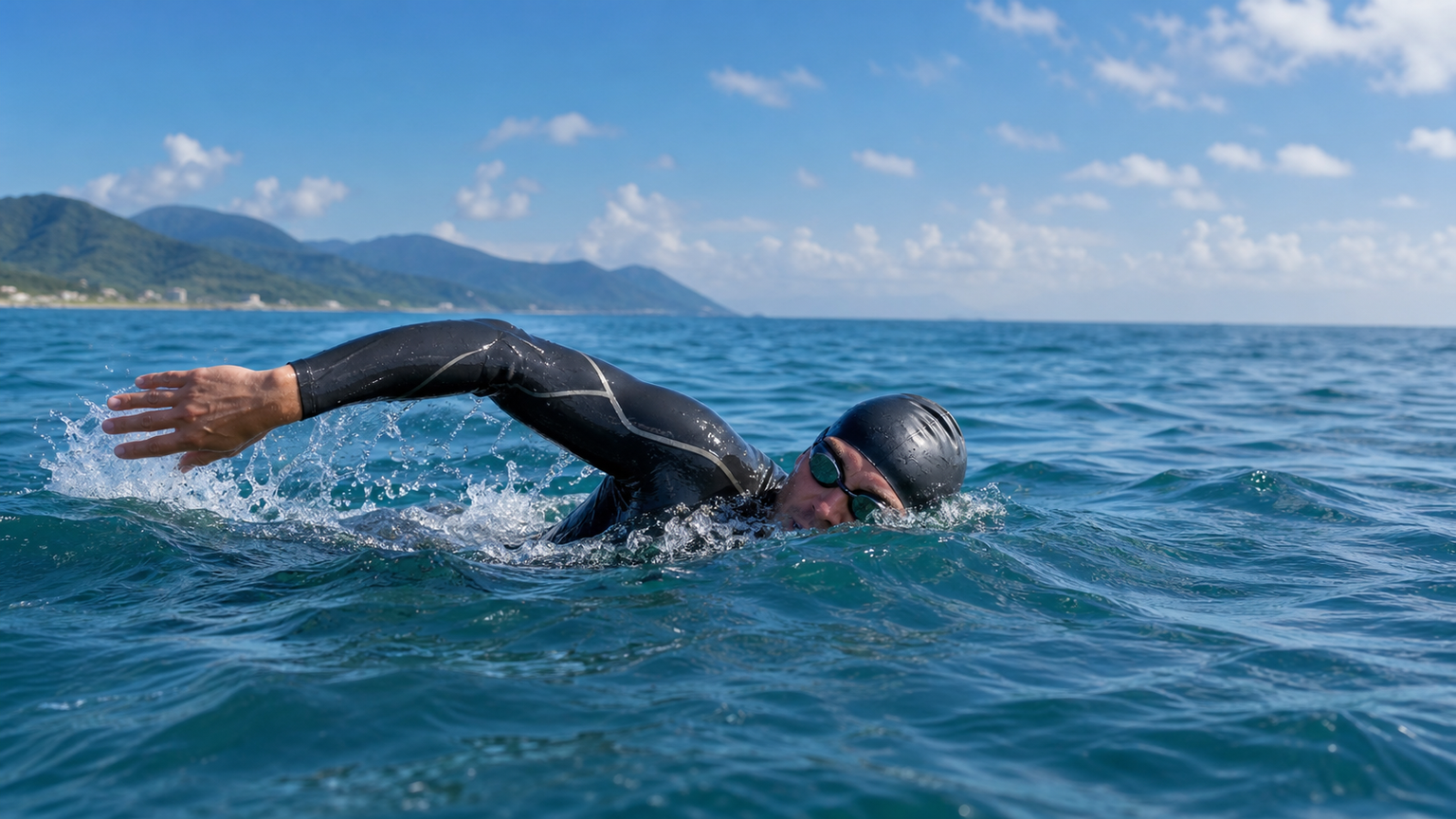
Introduction
Taiwan is surrounded by sea, with a coastline stretching over 1,600 kilometers. Every year, numerous open-water swimming events are held, including triathlons and pure swimming races in Penghu, Kenting, and the Northeast Coast. However, many swimmers who train successfully in the pool feel anxious once they enter open water: no lane lines, no visible bottom, and no idea how to handle incoming waves…
The technical demands of open-water swimming differ from those of pool swimming. In a pool, there are walls every 25 or 50 meters to push off and rest, but in open water, there are no support points. Additionally, sighting, maintaining rhythm in rolling waves, and cold-water adaptation are all skills that must be honed before race day.
This 8-week transition plan is designed for swimmers who can steadily complete 1,500 meters in the pool, with the goal of safely finishing a 1km open-water race.
Key Differences Between Pool and Open Water
Before designing the training, it’s important to understand the core differences:
| Aspect | Pool | Open Water |
|---|---|---|
| Navigation | Guided by lane lines | Requires sighting every 6–8 strokes |
| Support points | Walls every 25/50m | No support; must swim continuously |
| Water temperature | Usually 26–28°C | Taiwan waters range 22–30°C in summer |
| Current | Still water | Tides and waves disrupt direction |
| Visibility | Clear | Saltwater irritation, light refraction |
| Starting competition | Separate lanes, minimal contact | Mass start, prone to collisions |
8-Week Training Plan
Weeks 1–2: Pool Strengthening + Introduction to Sighting Technique
These two weeks remain in the pool, but incorporate “head-up swimming” drills:
- During every 100m swim, perform a sighting action every 10m (lift head above water to spot the target ahead)
- Maintain training volume at 3,000–3,500m per week
- No wall push-offs: avoid pushing off the wall at turns; instead, flip and continue swimming in the water to simulate open-water conditions
Sighting technique key points:
- When lifting your head, look above the water surface with both eyes, maintaining your line of sight for 2 seconds to confirm direction
- You don’t need to fully stop stroking when sighting; you can synchronize it with your final breath
- Sight every 6–8 strokes (standard race frequency)
Weeks 3–4: Wetsuit and Open-Water Adaptation
If the race venue water temperature is below 26°C, it’s recommended to practice swimming in a wetsuit. Many open-water events in Taiwan allow wetsuits, and they actually provide additional buoyancy:
- First wetsuit practice: do it in the pool to feel the difference in buoyancy and restricted movement
- Breathing rate may need adjustment (the wetsuit slightly compresses the chest)
- If possible, head to a harbor or lake for short-distance (200–400m) open-water adaptation swims
Weeks 5–6: Actual Open-Water Practice
This is the core of the entire plan:
- At least 1 session per week in an actual sea or lake environment
- Week 5: Complete two 400m open-water swims
- Week 6: Complete one 800m open-water swim
- Always have a companion or safety spotter; never enter the sea alone
Recommended locations in Taiwan for beginner open-water practice:
- North: Bitan (freshwater lake, small waves)
- Northern coast: Fulong, Shimen (during periods of stable summer wave conditions)
- South: Chengcing Lake (Pingtung)
Weeks 7–8: Intensification and Race Simulation
- Week 7: Simulate a full 1km open-water swim (can be done in the pool, without wall push-offs)
- Week 8: Pre-race taper, reducing each session to 400–600m to maintain feel
- 48 hours before the race: do a 200m adaptation swim at the race venue
Safety Considerations
- Never swim in open water alone; always have at least one companion or kayak escort
- For wave forecasts around Taiwan, refer to the Central Weather Bureau’s wave forecast, and choose time slots with wave heights below 0.5m for practice
- If you experience cramps, immediately flip onto your back to float, relax the muscle, and call for help while waiting for assistance
Practical Tips
- On race day, wear the same gear used in training (wetsuit, goggle model) to avoid unfamiliarity
- Before registering, confirm whether the organizer provides safety boats and lifeguards
- During training, incorporate “stroke counting” (counting strokes instead of watching the clock) to build water feel and distance awareness
Conclusion
Going from the pool to open water is not just a distance challenge—it’s a test of environmental adaptability. This systematic 8-week transition plan will help you build confidence and capability step by step. Taiwan boasts a得天獨厚的海洋環境; as long as you prepare thoroughly and prioritize safety, open-water swimming will bring you an entirely different sporting experience.
Related Reading
- Open-Water Swimming for Beginners: A Safe Transition Guide from Pool to Ocean
- Pool vs. Open-Water Fitness Differences: How to Simulate Open-Water Intensity in Pool Training
- Open-Water Swimming for Beginners: A Complete Adaptation Guide from Pool to Ocean and Lakes
- The Complete Open-Water Swimming Guide: Transition Training from Pool to Ocean
一起升級!海鷗盃LSD團練...JJSC Zone2招待 騎到手抖 / 公路車 / CT Yeh
1 天前
備戰 戀戀197 賽前關門點分析 西濱團練 #公路車 4K高畫質
6 年前
半日 小台灣 極限單車路線挑戰實錄
7 年前
FTL 與 SYB 車隊專訪 西進武嶺 實用攻略分享! 2小時 如何練?!你不知道的眉角!新手準備武嶺必看 EP1 | 實力派女車友 | 精華版 | 公路車 | CTYeh
4 年前
2019 夏季KOM 5小 完賽心得 準備攻略 東進武嶺 夏季登山王之路 Taiwan KOM Challenge
7 年前
單車 一日北高 ( 雙城 ) 肥宅雙人瘋狂行 紀錄片 REACTO
10 年前
一日北高前的西濱集訓 | 跟著11小時軍團 | 300W踩不動的大逆風 | 輪車破風差幾瓦?
6 年前
西進武嶺 免費訓練分析服務 Intervals | 練不夠還是練過頭?你哪一種類型選手?AI模型告訴你! | 備戰神器 | 公路車 訓練 | CT Yeh
4 年前