Introduction
In swimming training, there is a training method often overlooked: the Technical Set. Many amateur swimmers simply swim a few kilometers or perform interval sets every time they enter the water, rarely systematically practicing to improve their technique. As a result, even with increased training volume, speed remains stuck at a plateau because the fundamental movement patterns have not improved.
The “water feel” and technical efficiency in swimming are essentially neuromuscular coordination patterns. Research indicates that to change movement patterns, highly focused repetitive practice must be conducted under low fatigue conditions (the principle of Deliberate Practice). The design of technical sets is based on this principle: focusing on low intensity and high concentration to correct specific technical flaws.
Core Elements of a Swimming Technical Set
A good technical set includes the following elements:
- Clear Technical Goals: Each technical set focuses on only 1–2 technical points.
- Low-Intensity Execution: Avoids compensation due to fatigue.
- Sensory Feedback: Uses auxiliary tools (such as paddles or hand paddles) to enhance movement perception.
- Shorter Distances: Most technical drills are done in 25–50 meter segments to ensure movement quality is maintained in every lap.
Common Technical Set Drills
Freestyle Technical Drills
| Drill Name | Description | Technical Goal |
|---|---|---|
| Side Kick | Kick while lying on the side | Body rotation, axis stability |
| Catch-up | One hand waits until the other reaches the front before pulling | Pulling rhythm, extended entry |
| High Elbow Catch | Establish a high elbow position before pulling after entry | Pulling efficiency, forearm engagement |
| Fist Drill | Swim with clenched fists | Forearm water feel, using the arm to push water |
| Single-Arm Swim | Swim using only one arm | Individual arm movement correction |
Backstroke Technical Drills
- Flag Counting: Count the number of pulls from the wall to the flag (5 meters from the wall) to stabilize the timing of the roll turn.
- Single-Arm Backstroke: Feel the axis rotation and breathing timing.
Breaststroke Technical Drills
- Kickboard Breaststroke Legs: Practice only the legs, feeling the pinching motion of the breaststroke kick rather than a kicking motion.
- 2 Pulls 1 Kick: Two pulls paired with one kick to break the habit of over-relying on the legs.
Designing a Technical Set Schedule
Recommended Proportion of Weekly Technical Sets
Technical sets should account for 20–30% of weekly training time. For a swimmer training 4 times a week:
- 2 sessions of fitness training (aerobic or intervals)
- 1 session focused on technical sets
- 1 mixed session (aerobic + technical supplementation)
Typical Technical Set Schedule
Using a technical set designed to correct “entry crossing the centerline” as an example:
- Warm-up: 400 meters easy swim
- Main Technical Set:
- 8×25 meters single-arm swim (4 laps with left hand, 4 with right hand), focusing on ensuring the entry point does not cross the centerline
- 4×50 meters catch-up drill, paying attention to hand entry position with each pull
- 4×50 meters normal swim, attempting to retain the corrected feeling
- Auxiliary Drill: 4×25 meters fist drill to improve forearm water feel
- Cool-down: 200 meters easy swim
- Total Volume: 1600–1800 meters
Note: The total volume of a technical set is usually less than that of a fitness session, but rest intervals between laps are longer (at least 30–45 seconds) to give the body enough time to reset neuromuscular patterns.
Common Mistakes in Technical Sets
- Doing Technical Sets Too Fast: Once movements speed up, habitual error patterns return, rendering technical practice ineffective.
- Correcting Too Many Technical Points at Once: Attention is scattered, limiting improvement in each technical point.
- High-Intensity Training Immediately After Technical Sets: Technique breaks down after muscle fatigue; it is recommended to conduct technical sets independently.
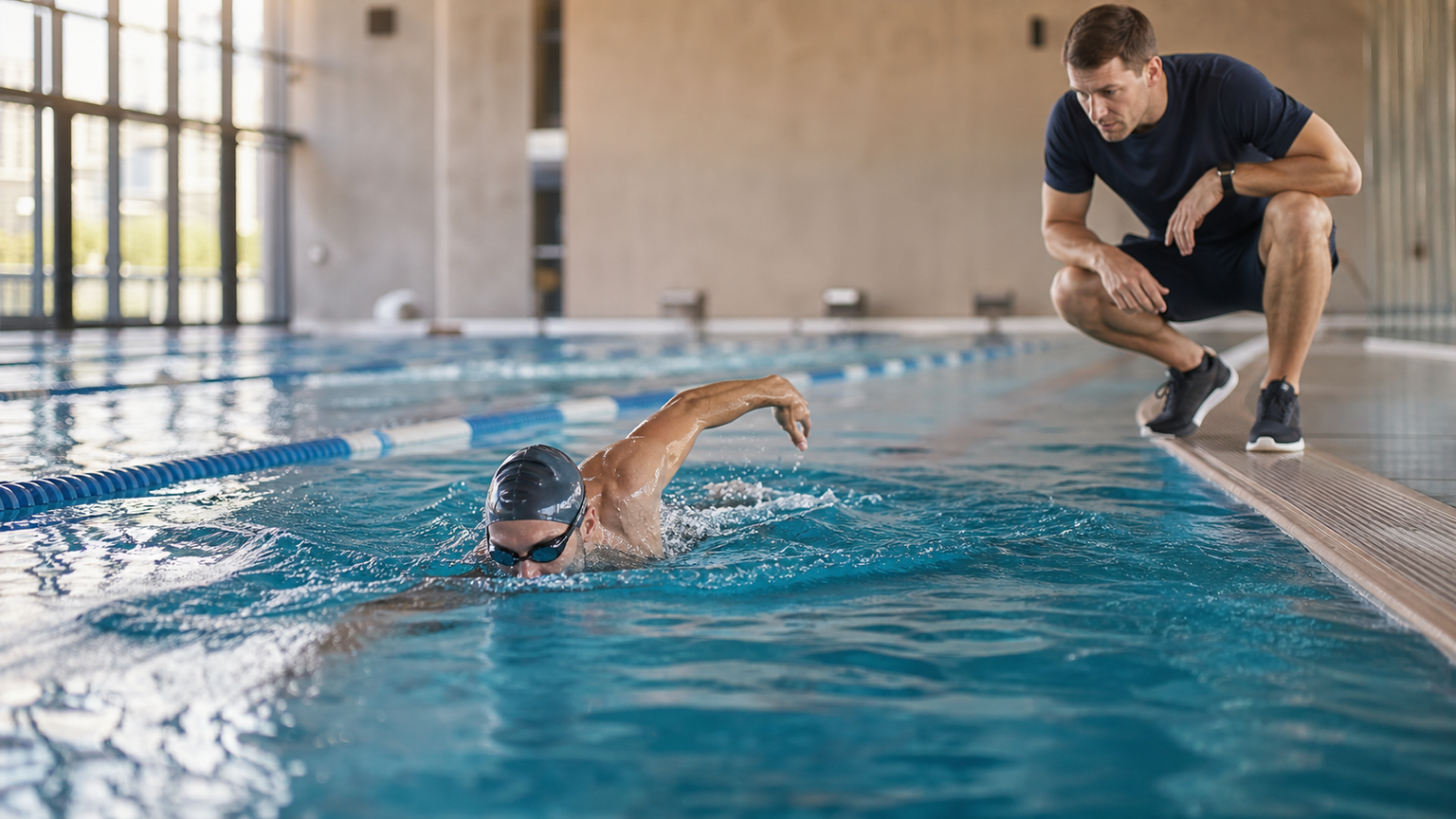
- Lack of Coach Feedback: There is often a gap between how a swimmer feels their movement and the actual movement; occasionally recording video or having a coach observe is very important.
Practical Advice
- Many sports centers in Taiwan offer “Advanced Technique Classes” for swimming. Even accomplished swimmers can gain valuable external feedback by occasionally attending a few technique classes.
- Using a waterproof phone pouch or underwater camera to record your technical set and comparing it with standard movements is the most efficient way for self-diagnosis.
- Changing technique takes time; typically, 6–8 weeks of continuous practice are needed to stabilize new movement patterns. Do not expect significant changes from a single technical set.
Conclusion
Technical sets are “investment-type training” in swimming—short-term, they may not make you gasp for breath like interval training, but in the long term, good technique is the foundation for breaking through pace. Incorporating technical sets into your weekly training plan and regularly conducting deliberate practice on your technical weaknesses will gradually improve your stroke efficiency. Over time, this accumulates into significant performance progress.
Related Reading
- Swimming Technical Set: Schedule Design for One Technique-Focused Session Per Week
- Optimal Proportion and Design Methods for Swimming Technical Sets (Drill Sets) in Training Plans
- Swimming Transition Sets: Transition Design from Technique Strengthening to Race-Pace Training
- Swimming Technical Training Schedule Design: Periodization of Technique Weeks vs. Distance Weeks
西進武嶺 免費訓練分析服務 Intervals | 練不夠還是練過頭?你哪一種類型選手?AI模型告訴你! | 備戰神器 | 公路車 訓練 | CT Yeh
4 年前
教學) 如何做出專業 慢動作 影片 Slow Motion 120fps GoPro 7 ActionCam AX700 A99II
7 年前
FTL 與 SYB 車隊專訪 西進武嶺 實用攻略分享! 2小時 如何練?!你不知道的眉角!新手準備武嶺必看 EP1 | 實力派女車友 | 精華版 | 公路車 | CTYeh
4 年前
實景訓練台) 彰化經典百K 高強度喵團 90分鐘 跟著一起練功 2019 Indoor workout Changhua Classic 100 Taiwan
7 年前
[教學] Premiere 影片 手震 修正 教學 防抖 單眼 影像 GoPro 穩定 Video Stabilization
8 年前
單車AI教練!全新 ChatGPT4o 幫你分析訓練成果!排武嶺課表,分析騎車姿勢! 太神了! / 公路車 / CT Yeh / feat. 緯緯
2 年前
Live) 備戰2019彰化經典百K 賽前攻略 (已完賽請看新影片
7 年前
一起升級!海鷗盃LSD團練...JJSC Zone2招待 騎到手抖 / 公路車 / CT Yeh
1 天前