Introduction
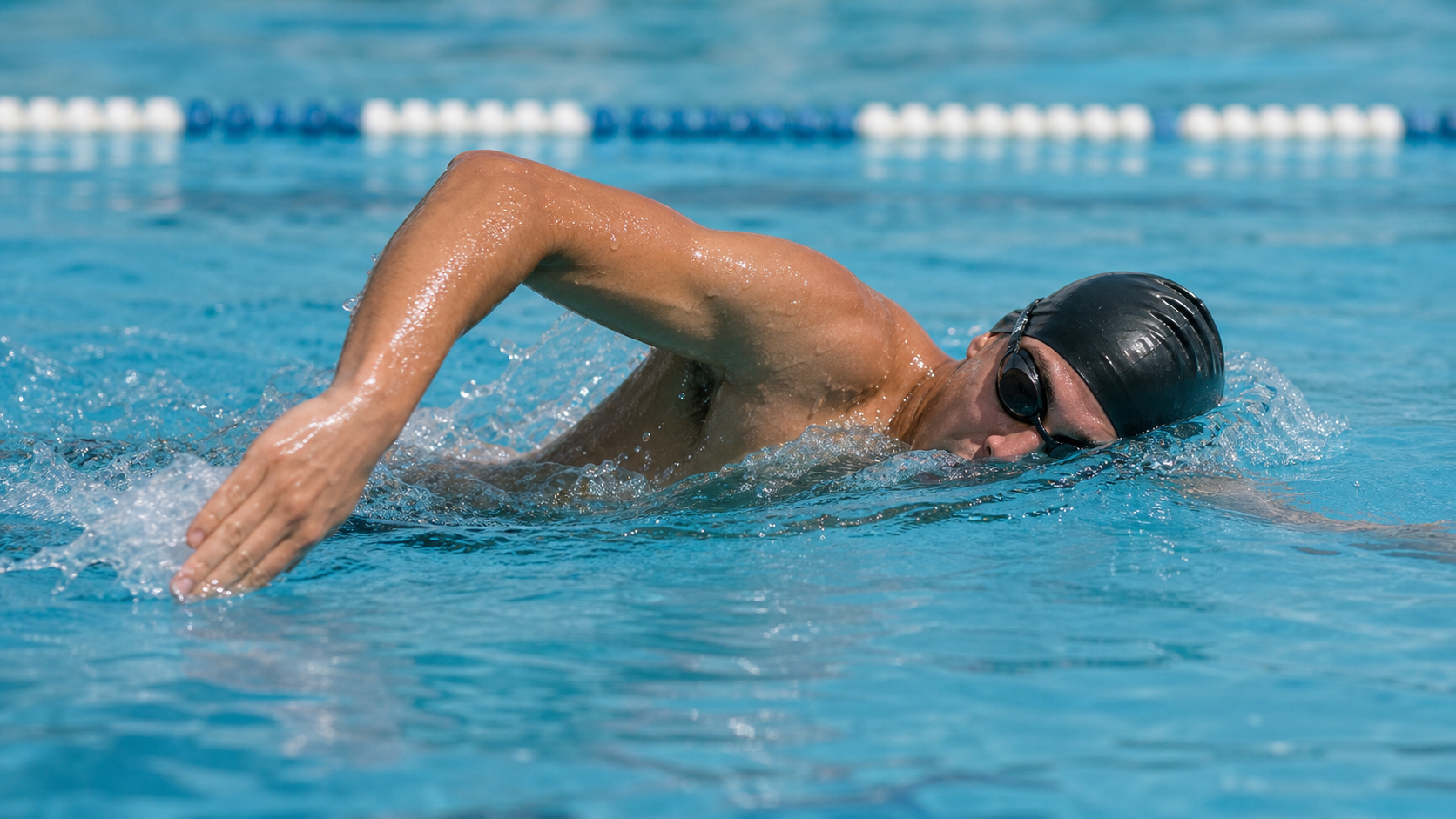
At swimming pools across Taiwan, coaches often remind students to “insert your hand into the water at an angle,” but why exactly can’t you enter vertically? This seemingly minor difference in angle is one of the key factors affecting propulsion efficiency in freestyle. Whether you’re a triathlete training at the Taipei City Swimming Pool or an enthusiast doing open-water swimming in Kenting, mastering the correct entry angle can significantly enhance your swimming performance.
This article will delve into the fundamental differences between a 45-degree entry and a vertical entry from the perspectives of biomechanics and fluid dynamics, helping you understand why elite swimmers all adopt a specific entry technique.
The Mechanical Principles of Entry Angle
Water Surface Resistance and Impact Force
When the hand enters the water at different angles, the resulting resistance and impact force are completely different. During a vertical entry, the palm faces the water surface head-on, generating maximum impact resistance, much like slapping the water. This not only wastes energy but can also cause injury as the impact force is transmitted to the shoulder joint.
In contrast, a 45-degree angled entry allows the fingertips to pierce the water first, creating a “wedge” effect. This action significantly reduces the impedance of surface tension, allowing the hand to slide into the water more smoothly and reach an effective pulling position.
Propulsion Comparison for Different Entry Angles
| Entry Angle | Water Surface Resistance | Entry Impact | Propulsion Efficiency | Shoulder Joint Stress |
|---|---|---|---|---|
| Below 15° (Near Horizontal) | Very High | Low | Low | Medium |
| 30–45° (Angled) | Low | Low | High | Low |
| 60–70° (Steep) | Medium | Medium | Medium | Medium |
| 90° (Vertical) | High | High | Low | High |
The Importance of Finger Entry Sequence
The 45-degree entry technique requires the middle or index finger to contact the water first, forming a natural “wedge-shaped” cutting path. This action has several key advantages:
- Reduces splash: Splash signifies wasted energy; a clean entry preserves more propulsive force.
- Lowers resistance transition time: The hand can reach the effective pulling depth (typically 20–30 cm) in the shortest possible time.
- Establishes immediate feel for the water: The angled entry lets the fingers sense water pressure first, aiding the subsequent execution of a high-elbow pull.
- Reduces body sway: A vertical entry tends to cause the body to rock side-to-side, whereas an angled entry helps maintain a better body rotation axis.
Common Entry Mistakes
Crossing Over the Midline (Cross Over)
Many beginners insert their hand past the body’s midline during entry, which is one of the most common mistakes. This entry method not only disrupts body balance but also distorts the subsequent pulling path, drastically reducing propulsion efficiency. In Taiwanese triathlon races, this problem is particularly noticeable in fatigued athletes.
Entry Point Too Close (Short Arm)
When the elbow enters the water before the hand, or the hand plunges in directly in front of the head, it shortens the effective pulling path. The ideal entry point should be on the extension line of shoulder width, with the arm almost fully extended.
The “Slamming” Action After Entry
Some swimmers deliberately press down on the water upon entry, creating a noticeable splash. This action stems from the misconception that a more forceful entry generates more propulsion. In reality, this only creates unnecessary resistance; true propulsion comes from the subsequent pulling motion.
Training Suggestions and Improvement Methods
Mirror Drill (Dryland Training)
Stand in front of a mirror and simulate the freestyle arm stroke, paying special attention to:
- After extending your arm, point your middle finger forward at roughly a 45-degree angle.
- Imagine inserting your hand into a glass tube beneath the water’s surface without touching the tube walls.
- Keep your wrist naturally relaxed; do not deliberately rotate it.
Slow-Motion Drill in Water
Use a pull buoy between your legs and focus on practicing the single-arm entry motion. After each entry, pause motionless in the water for 2–3 seconds to feel if your hand position is correct. It is recommended to perform 10–15 minutes of technical drills before each training session, followed by your regular swim workout.
Self-Assessment via Video Recording
Ask a friend to film your entry motion from directly above the poolside, paying particular attention to:
- Whether the entry point is on the shoulder extension line.
- Whether there is a noticeable splash upon entry.
- Whether the hand crosses over the body’s midline.
Practical Advice
- Beginners: First ensure the entry position is correct (on the shoulder-width extension line), with an angle of about 35–45 degrees. Do not pursue a perfect angle while neglecting the basic position.
- Intermediate Swimmers: Intensify training on the sensation of finger entry. Practice the “silent entry”—an entry that produces almost no audible sound indicates correct angle and technique.
- Advanced Swimmers: Maintaining the same entry angle at high speeds is a challenge. Use interval training to check the consistency of your entry technique at different speeds.
- Triathletes: Wave conditions in open water affect entry stability. It is recommended to incorporate irregular movement simulations into training to strengthen entry technique on a dynamic water surface.
Conclusion
The freestyle entry angle may seem like a small detail, but it is the starting point of the entire stroke cycle. The low-resistance, high-efficiency advantages of a 45-degree angled entry are magnified many times over in long-distance swimming. Changing a habitual movement takes time and deliberate practice. It is recommended to perform 5–10 minutes of entry technique drills before each swim session. Remember, refining swimming technique is a continuous process. Start with this detail—the entry angle—and gradually build your own efficient stroke.
Related Topic Reading
- The “High-Elbow Entry” Technique in Freestyle: The Impact of Elbow Angle on Pulling Efficiency
- A Complete Analysis of Freestyle Entry Angles: Choosing Between Thumb-First and Flat-Hand Entry
- The Propulsion Mechanics of Swimming: Hand Surface Area, Pulling Angle, and Propulsion Efficiency
- Freestyle Arm Stroke Technique: Modern Perspectives on High-Elbow Entry and the S-Shaped Pull
CT 喇低賽) 武嶺牽車 才是王道 西進牽車四小時內秘訣 攝手位置 如何判斷 防抽筋小秘訣
7 年前
西進武嶺 自製新版AI配速表產生器 x 賽前攻略 抱佛腳! 沒有功率計也可以產生配速表嗎?有什麼其他眉角賽前要注意的呢? | 西進武嶺 / 東進武嶺 KOM 攻略 | 公路車 | CT Yeh
4 年前
類空拍神器 Feiyu Pocket 2s (有優惠連結)三軸穩定 運動攝影機 開箱!比GoPro 還強的滑順視角!三小時長時間錄影 行車記錄器 | 環花東365實測 | 公路車 CT Yeh
4 年前
西進武嶺 免費訓練分析服務 Intervals | 練不夠還是練過頭?你哪一種類型選手?AI模型告訴你! | 備戰神器 | 公路車 訓練 | CT Yeh
4 年前
抖肩舞 台灣x日本交流版 (台灣 vs 前橋) 赤城山登山賽 coincidance
8 年前
戰略) Zwift Race 如何咬在第一集團 如何評估自己要開多少推力 (請開1.5倍速看)
7 年前
#公路車 #西進武嶺 配速配瓦實驗 坡度分析 四小時內攻略 建大盃 NeverStop #西進武嶺攻略
6 年前
單車 梅山36灣 坡度介紹 路段介紹 空拍 (相關遊記影片,請參考說明或我的頻道喔,歡迎訂閱)
6 年前