Introduction
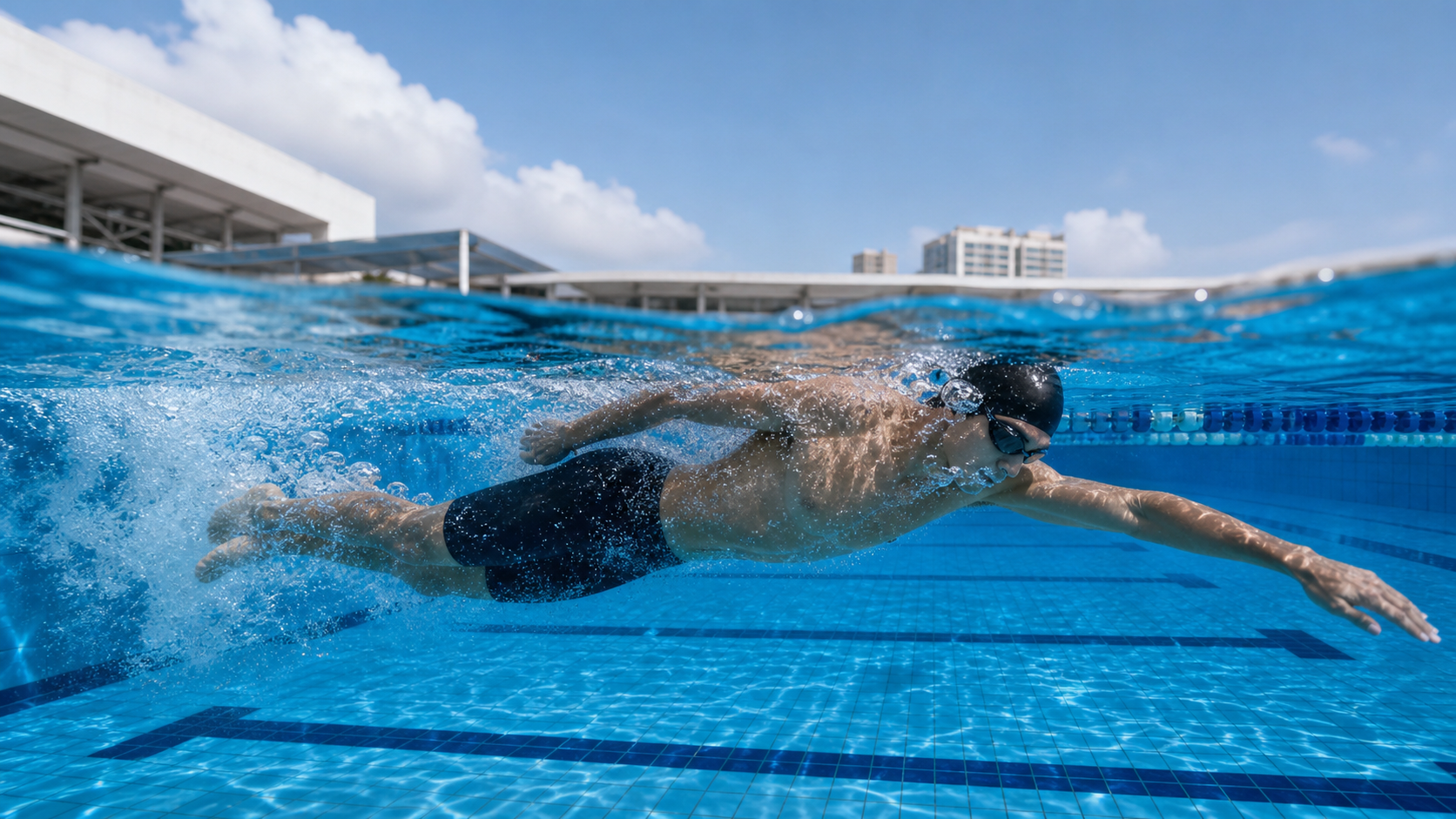
“Should I kick fast or slow?” is a common question among swimming learners. At swimming clubs across Taiwan, you’ll see various kicking styles: some swimmers rapidly flutter their feet, churning up spray; others keep their legs nearly still, relying only on their arms to pull. Which approach is correct? The answer is: it depends on the situation.
The 6-beat, 4-beat, and 2-beat kicks are the three primary kicking rhythms in freestyle, each suited to different distances, physical conditions, and racing goals. Understanding the differences between these three techniques allows you to make the best choice in different scenarios.
The Basic Functions of Kicking
Before diving into rhythm selection, we need to understand the two main roles kicking plays in freestyle:
- Balance function: The lower-body kicking motion helps maintain a horizontal body position, preventing the hips from sinking and increasing drag
- Propulsion function: The up-and-down motion of the feet can provide a certain degree of forward thrust, but its efficiency is far lower than arm pulling
Research indicates that among elite swimmers, the leg kick contributes roughly 10–15% of overall propulsion, yet it can account for as much as 25–30% of oxygen consumption. This explains why controlling kick frequency is crucial in long-distance swimming.
Detailed Breakdown of the Three Kicking Rhythms
6-Beat Kick
The 6-beat kick means that for each complete arm stroke cycle (one pull with each arm), the feet perform 6 kicks. This is the most common kicking style in sprint racing.
Characteristics:
- Legs maintain continuous high-frequency motion, providing additional propulsion and balance
- Requires large amounts of oxygen, with high energy expenditure
- Maintains good body stability when swimming at high speed
- Demands high technical skill, requiring ankle flexibility and leg coordination
Best suited for: 50m and 100m sprint events; sprint segments; when rapid acceleration is needed
4-Beat Kick
The 4-beat kick falls between the 6-beat and 2-beat, with 4 kicks per arm stroke cycle. It’s a rhythm that is less frequently discussed but is actually quite practical.
Characteristics:
- Balances propulsion needs against energy expenditure
- Suitable for middle-distance races or swimming that requires rhythm
- Requires adjustment when stroke tempo changes, with relatively high technical demands
- Commonly seen among 200–400m middle-distance swimmers
Best suited for: 200–400m middle distances; transitions to high-speed segments in triathlon; moderate-paced open water swimming
2-Beat Kick
The 2-beat kick involves only 2 kicks per arm stroke cycle, with the opposite-side foot kicking downward as one hand enters the water. The range of motion is small, and energy expenditure is extremely low.
Characteristics:
- Legs provide almost exclusively a balancing function, with minimal propulsion
- Highest energy efficiency, ideal for long-distance endurance swimming
- Requires good body rotation coordination to execute correctly
- Allows leg muscles to “rest,” preserving energy for running or cycling (triathlon)
Best suited for: 1500m and longer distances; open water swimming; the swim leg of a triathlon; marathon swimming
Comparison of the Three Kicking Styles
| Kicking Style | Kicks per Stroke Cycle | Propulsion Contribution | Energy Expenditure | Suitable Distance |
|---|---|---|---|---|
| 6-beat | 6 kicks | High | High | 50–200m |
| 4-beat | 4 kicks | Medium | Medium | 200–800m |
| 2-beat | 2 kicks | Low | Low | 800m and above |
How to Choose the Right Kicking Rhythm for You
Based on Distance
The simplest guiding principle is: the shorter the distance, the more suitable a high-frequency kick; the longer the distance, the more suitable a low-frequency kick. For common triathlon distances in Taiwan (swim legs ranging from 750 meters to 3.8 kilometers), the 2-beat kick is most suitable for most athletes, preserving more energy for the subsequent bike and run.
Based on Individual Characteristics
- Those with strong leg power and flexible ankles: The 6-beat kick offers greater returns, with a larger propulsion contribution
- Those with strong core strength: The 2-beat kick is easier to execute, as the core is responsible for maintaining body stability
- Swim-specific athletes: Choose based on your primary race distance, and practice different rhythms in training across various distances
- Triathletes: Should almost always prioritize learning the 2-beat kick
Hybrid Strategy
Advanced swimmers can master a “hybrid kicking” strategy:
- Use the 6-beat kick at the start and for the final sprint
- Maintain rhythm in the middle section with the 2-beat or 4-beat kick
- Briefly use the 6-beat kick to accelerate after turns
Key Kicking Technique Points
Regardless of which rhythm you choose, the following technical points apply:
- Generate power from the hips, not just the lower legs; the leg motion should be initiated from the hip joint
- Keep the kick amplitude small; the maximum distance between the feet should not exceed 30–40 centimeters, as a larger kick amplitude increases drag
- Keep the ankles relaxed, and don’t forcefully point the toes; a relaxed ankle can move effectively like a fish fin
- Keep the feet slightly pigeon-toed, with toes turned slightly inward, to increase the effective surface area during the kick
Practical Advice
- It’s recommended to learn the 2-beat kick first, then the 6-beat kick, because the 2-beat emphasizes movement quality while the 6-beat relies more on muscular strength
- When using a kickboard for kick-only drills, pay special attention to keeping your lower back from sinking—a sinking lower back indicates insufficient hip flexibility or weak core strength
- Use a timer to test during each practice session: under the same perceived effort, which kicking rhythm gives you the fastest 1000m time? Find your optimal rhythm
- The 6-beat kick technique deteriorates first when fatigued; use this opportunity to practice switching to the 2-beat kick
Conclusion
Choosing a kicking rhythm is not an either-or decision; it requires flexible adjustment based on race goals, physical condition, and swimming distance. For most swimming enthusiasts and triathletes in Taiwan, learning an efficient 2-beat kick often yields more direct performance improvements than practicing the 6-beat kick. The ultimate goal is to make the kicking motion a natural reflex, allowing your brain to focus on stroke technique and breathing rhythm. Starting today, consciously practice your kicking rhythm and feel the differences in propulsion that various frequencies bring you.
Related Reading
- Freestyle Kicking Efficiency: The Speed vs. Endurance Trade-off Between 6-Beat and 2-Beat Kicks
- Freestyle Arm Stroke Rhythm: Suitable Scenarios and Training Strategies for 2-Beat, 4-Beat, and 6-Beat Kicks
- Freestyle Kicking Rhythm: Which Distances and Body Types Suit 2-Beat, 4-Beat, and 6-Beat Kicks
- The Science of Freestyle Kicking: How to Choose Between 2-Beat, 4-Beat, and 6-Beat? Leg-Saving Strategies for Long-Distance Swimming and Triathlon
CT 喇低賽) 武嶺牽車 才是王道 西進牽車四小時內秘訣 攝手位置 如何判斷 防抽筋小秘訣
7 年前
教學) 如何做出專業 慢動作 影片 Slow Motion 120fps GoPro 7 ActionCam AX700 A99II
7 年前
西進武嶺 免費訓練分析服務 Intervals | 練不夠還是練過頭?你哪一種類型選手?AI模型告訴你! | 備戰神器 | 公路車 訓練 | CT Yeh
4 年前
多機位拍片神器 DJI Action 2 拍出速度張力感 | 類空拍機視角 4陣列麥克風超強降風噪 實測! | 公路車 | CT Yeh
3 年前
Live) 備戰2019彰化經典百K 賽前攻略 (已完賽請看新影片
7 年前
類空拍神器 Feiyu Pocket 2s (有優惠連結)三軸穩定 運動攝影機 開箱!比GoPro 還強的滑順視角!三小時長時間錄影 行車記錄器 | 環花東365實測 | 公路車 CT Yeh
4 年前
如何把 GoPro 影片 翻轉 批次 轉正?
6 年前
#公路車 #西進武嶺 配速配瓦實驗 坡度分析 四小時內攻略 建大盃 NeverStop #西進武嶺攻略
6 年前