Introduction
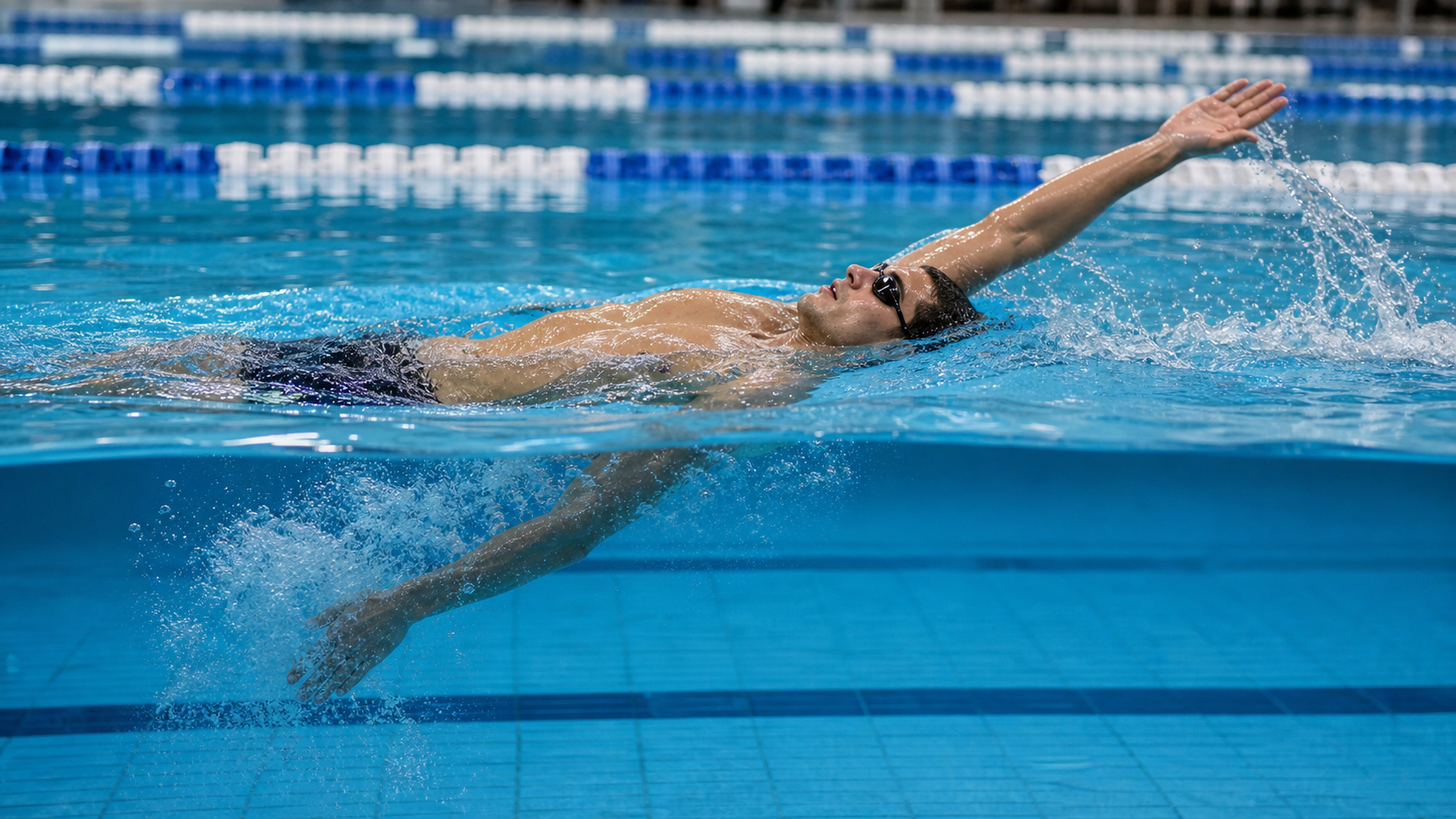
Backstroke is the only one of the four competitive swimming strokes swum face-up, and this unique body position gives the pull technique mechanical characteristics that differ markedly from the other strokes. In swimming instruction in Taiwan, the teaching of the backstroke pull path has varied over time: the older approach emphasized an “S-curve pull path,” mimicking the fluid dynamics of freestyle, while modern competitive swimming has gradually shifted toward “straight-arm pulling,” replacing complex curved movements with a simpler, more efficient straight-line path.
Which of the two techniques is superior? This article analyzes the question from a biomechanical perspective.
Historical Background of the S-Curve Pull
Theoretical Basis of the S-Curve Pull
The S-curve pull (also called “propeller pull”) originates from the lift theory of fluid dynamics. Its core idea is that the hand moves along a curved path through the water, like a propeller blade, generating propulsion through “lift” rather than pure “drag.”
This theory was proposed by American swimming biomechanist James Counsilman in the 1960s–70s and influenced swimming instruction for decades. According to this theory, the hand in backstroke should trace an S-shaped curve outward, downward, and then inward through the water.
Modern Assessment of the S-Curve Pull
Recent research has re-examined the effectiveness of the S-curve pull. Researchers found:
- The S-shaped path lengthens the pulling distance but does not necessarily increase propulsion
- Complex curved movements increase learning difficulty and the cost of maintaining technique
- At high swimming speeds, the S-shaped path is harder to coordinate
Modern Straight-Arm Pull Technique
Principles of the Straight-Arm Pull
Modern backstroke technique favors a more “direct” pull path: after the hand enters the water, the arm pushes backward along a relatively straight path, using the drag generated by the fast-moving hand to propel the body directly forward.
The advantages of this technique are:
- Simple movement, easy to maintain consistency: technique is less likely to break down, especially when fatigued
- Reduces unnecessary wrist and elbow angle adjustments: lowers the demand for shoulder joint rotation
- Pairs more naturally with body rotation: the straight-arm pull coordinates more smoothly with the body roll of backstroke
Comparison of the Two Pull Techniques
| Technique Type | Pull Path | Propulsion Principle | Learning Difficulty | Fatigue Stability | Suitable Swimmers |
|---|---|---|---|---|---|
| S-curve pull | Curved (outward → downward → inward) | Lift + drag | High | Low | Technique-oriented swimmers |
| Straight-arm pull | Nearly straight | Primarily drag | Moderate | High | Swimmers of all levels |
| Hybrid | Slight curve | Lift + drag | Moderate | Moderate | Advanced swimmers |
Key Technical Points of the Backstroke Pull
Regardless of which path is used, the following technical points are equally important in both methods:
Hand Entry Position and Angle
When the arm enters the water in backstroke, the hand should enter directly above the line of the shoulder’s extension, with the little-finger side contacting the water first (hand externally rotated). After entry, the arm extends backward to prepare for the subsequent catch.
Common errors:
- Entering across the midline: the hand enters above the head or across the midline, causing body twisting
- Elbow entering first: the hand (little-finger side) should enter first
Catch Depth
After the arm extends upon entry, it should sink to a depth of about 15–25 cm before beginning the catch. A catch that is too shallow cannot fully utilize the water’s resistance.
Pushing to the Hip
The pull should continue from the catch position to around the hip; a full push distance maximizes the benefit of each stroke. Many swimmers exit the hand before it reaches the hip, shortening the effective push distance.
Body Roll
The body in backstroke should roll 15–30 degrees in sync with the pull, allowing more back and shoulder muscle groups to be engaged rather than relying solely on arm strength. Insufficient roll turns backstroke into an inefficient, arm-only movement.
Kicking Technique
The kicking principle in backstroke is the opposite of freestyle—backstroke propulsion comes primarily from the upward kick (upkick), while freestyle relies mainly on the downward kick. Characteristics of correct backstroke kicking:
- Driven from the hips, not just the lower legs
- The instep applies force on the upward kick and relaxes on the downward recovery
- Feet maintain a relatively narrow spacing (no more than 30 cm)
- Ankles relaxed to increase the kicking surface area
Practical Advice
- For most recreational swimmers, the straight-arm pull or a slightly curved pull is more practical; there is no need to insist on the S-shaped path
- The hardest part of backstroke technique is usually not the pull path but maintaining a stable horizontal body position—a sinking hips is the most common problem
- When practicing backstroke, you can place a kickboard between your legs to focus on pull technique, then release the legs to integrate the kick
- Breathing in backstroke is relatively simple (face-up), but be careful not to lift the head when breathing; the head should rest near the water surface (ears around the waterline)
- In swimming pools in Taiwan, backstroke requires swimming close to the wall (to avoid colliding with other swimmers), so pay special attention to lane awareness and turn timing
Conclusion
The debate between the S-curve pull and the straight-arm pull reflects the ongoing evolution of swimming technique. Modern research and competitive performance show that simplifying the pull path, strengthening body roll, and improving pulling efficiency often yield greater performance gains than pursuing complex curved paths. For recreational swimming enthusiasts in Taiwan, it is recommended to start with the straight-arm pull and, after mastering the fundamentals, fine-tune the pull path according to individual characteristics. Progress in technique lies not in complexity, but in efficient and stable execution.
Related Reading
- Freestyle Catch Technique: Is the S-Curve Pull Really Outdated?
- Key Technical Points of Backstroke: Rotation Axis and Pull Efficiency Guide
- Refining Backstroke Technique: Coordination of S-Shaped Hand Pull Path and Kick Rhythm
- Freestyle Pull Arc: Is the S-Curve Pull Outdated? What the Latest Research Says
CT 喇低賽) 武嶺牽車 才是王道 西進牽車四小時內秘訣 攝手位置 如何判斷 防抽筋小秘訣
7 年前
抖肩舞 台灣x日本交流版 (台灣 vs 前橋) 赤城山登山賽 coincidance
8 年前
一起升級!海鷗盃LSD團練...JJSC Zone2招待 騎到手抖 / 公路車 / CT Yeh
2 天前
碟煞公路車 銑面器 !? 原來銑完差這麼多! 降低蹭碟機率! | TIME 公路車 保養小記錄 | CT Yeh
3 年前
2025 彰化經典百K 多視角VLOG / 今年摔好多 / 全新LIVE系統測試 / 公路車 / CT Yeh
1 年前
2021 96聯賽 桃園市長盃 4K多視角實況 當天選手瓦數/推力比/均速/時間 即時數據分析 | 公路車 | CT Yeh
5 年前
2016 彰化經典百K - 風景宜人精華版
10 年前
一個測試有沒有認真練車的方法😂 #公路車
10 個月前