Introduction
In a 50-meter lane training session, each lap involves two wall-contact turns; in a 1500-meter race, there are 29 turn opportunities. The quality of each turn directly affects overall swimming performance. Yet in Taiwan’s swimming training, turn technique is often the most neglected aspect—swimmers spend extensive time practicing strokes and kicks, but almost no systematic training is devoted to turn technique.
The core of turn technique is not just about “flipping fast enough,” but more importantly, the “mechanical efficiency of the wall push-off.” A correct push-off allows you to leave the wall at maximum speed, extending the distance of high-speed gliding. This article will delve into the wall-push mechanics of the flip turn.
The Basic Structure of the Flip Turn
A complete flip turn consists of the following phases:
- Approach: Judging the timing of the final stroke
- Initiation: Tucking the head and rolling forward, rotating the body 180 degrees
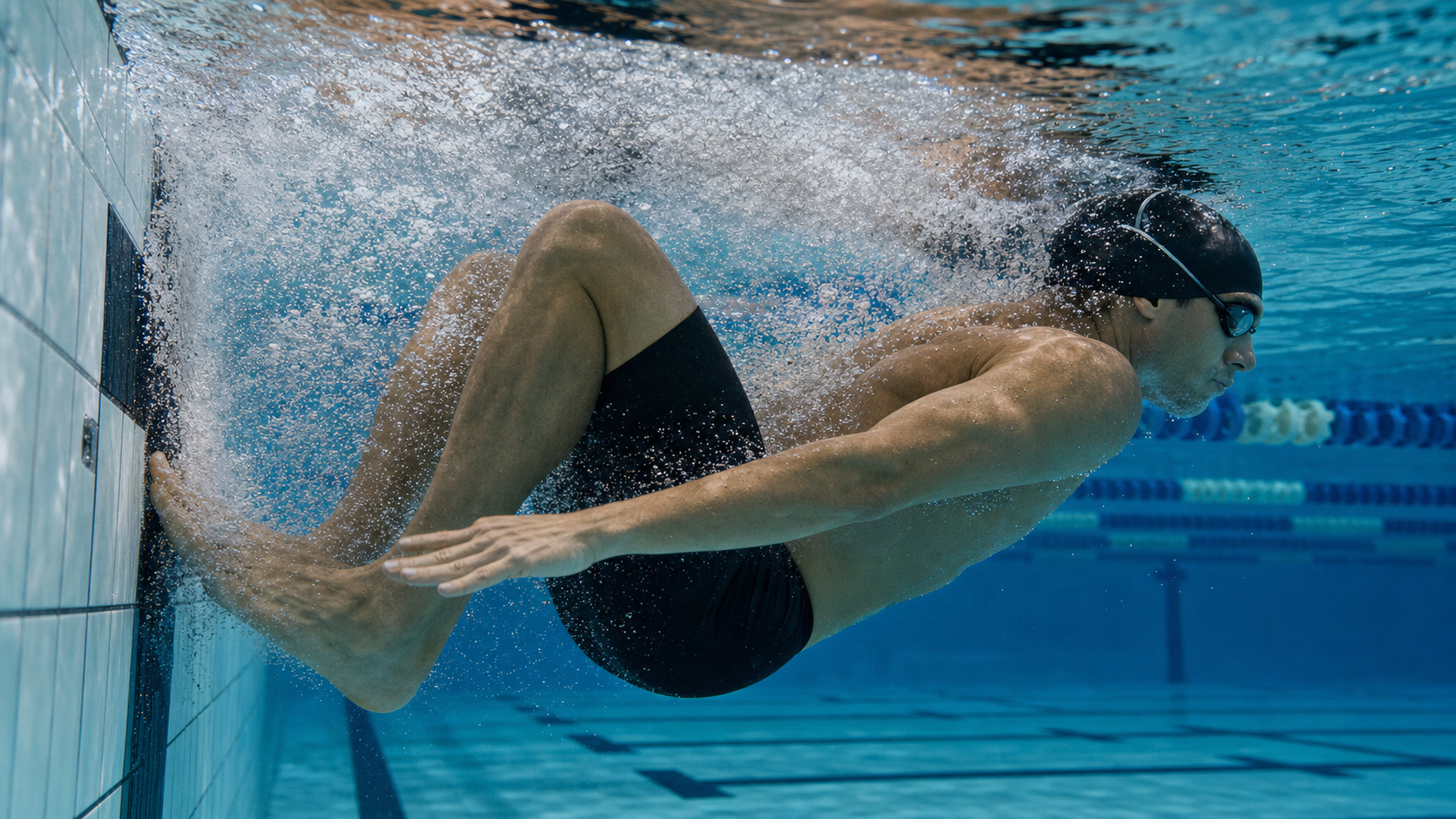
- Feet Contact: Both feet making contact with the wall
- Push-off: Extending the legs to push off
- Streamline Glide: Gliding through the water after the push-off
- Rotating to the Front and Resuming Swimming: Rotating from the backstroke position to the front and starting to kick and stroke
Key Mechanical Points of the Wall Push-off
The Importance of Foot Placement
The position where your feet contact the wall is the decisive factor in push-off efficiency. Sports biomechanics literature recommends: the optimal foot contact depth is approximately 30–40 cm below the water surface, with the knees bent at an angle of about 90–100 degrees when the feet touch the wall.
| Foot Contact Depth | Knee Angle | Push-off Efficiency | Explanation |
|---|---|---|---|
| Too Shallow (<20cm) | >130 degrees | Low | Legs too straight, insufficient range for force generation |
| Optimal (30–40cm) | 90–100 degrees | Highest | Optimal angle for muscular force output |
| Too Deep (>50cm) | <80 degrees | Moderate | Excessive bending, reduced explosive power |
A knee bend of approximately 90 degrees is the angle at which the human lower limbs generate maximum muscular force (similar to the optimal position for a squat jump), which is why the depth of foot placement is so critical.
Ankle Position and Push-off Direction
The ankles should maintain a natural dorsiflexion (toes pointing upward), with both feet placed parallel against the wall. The push-off direction should be slightly downward, not completely horizontal. This is because after pushing off, the body’s gliding position in the water is slightly below the surface, and pushing slightly downward allows for a more natural streamline position.
Arm Position During the Push-off
At the moment the flip is completed and the feet contact the wall, the arms should have already completed the “streamline hand-stack” preparation—arms extended straight in front of the head, hands stacked on top of each other, elbows pressed tight against the ears, forming a low-resistance streamline.
Many people make the mistake of pushing off first and then “bringing the arms to the front.” During the most precious acceleration moment of the push-off, this poor arm position increases water resistance, negating the benefits of the push-off.
Optimizing the Glide Phase
The Value of Streamlining
The gliding speed after the push-off is often significantly higher than normal swimming speed, so the quality of the streamline becomes several times more important during this phase. Among world-class swimmers, the initial push-off speed of a flip turn can exceed 2.5 meters per second, while normal swimming speed may only be 1.5–2 meters per second.
Key elements for maintaining an optimal streamline:
- Arms pressed tight against the ears, hands stacked
- Core engaged, no bending at the waist
- Ankles naturally extended, without deliberately pointing the toes
- The entire body forming a straight line
When to Start Kicking
When the gliding speed drops close to normal swimming speed, begin incorporating kicking and stroking movements. Starting to kick too early will disrupt the streamline and reduce gliding efficiency; starting too late wastes the inertial advantage gained from the turn.
A general recommendation is to start kicking at approximately 5–7 meters from the wall, though this distance varies depending on individual speed and streamline quality.
Training Methods to Improve Turn Speed
- Wall Practice Flips: Stand in the shallow end of the pool and practice flipping in place, focusing on the timing and speed of tucking the head during the flip
- Set Up Markers: Use colored tape on the bottom of the lane to mark the “ideal final stroke position,” and practice initiating the flip at a fixed distance
- Segment Timing: Record the time from wall contact until the head resurfaces, with the goal of shortening this turn duration
- Exaggerated Streamline Practice: After each push-off, deliberately glide for an extended distance to reinforce streamline muscle memory
Practical Recommendations
- It is recommended to dedicate 100–200 meters of each training session to “turn-specific drills,” rather than treating turns merely as an incidental part of swimming
- The force of wall contact should be substantial—during turn practice, you can place a waterproof paper on the wall and check afterward whether the footprint position is consistent, ensuring stable foot placement each time
- In-water timing: From the end of the final stroke to the completion of the streamline, the entire turn should ideally be completed within 1.0–1.5 seconds
- Turn technique deteriorates most easily during the fatigued later stages, so it is advisable to consciously remind yourself to maintain turn quality during the latter part of high-intensity sets
Conclusion
The wall-push technique of the flip turn is one of the few technical aspects in swimming where noticeable performance improvements can be seen in a relatively short period. There is no need to increase training volume—simply executing the correct movements more deliberately with each turn will accumulate significant time savings over time. For swimmers training in Taiwan, treat the turn as a technique equally important as the stroke in your next practice, giving it the attention and training time it deserves.
Related Reading
- Swimming Turn Explosive Power: Land-Based Strength Training for Instant Wall Push-off Force
- Refining Turn Technique: Foot Placement Angle and Push-off Timing in the Flip Turn
- Analyzing Swimming Turn Efficiency: Maximizing Wall Push-off Force and Glide Distance in the Flip Turn
- Complete Turn Technique Analysis: Foot Placement Timing and Push-off Angle in the Freestyle Flip Turn
CT 喇低賽) 武嶺牽車 才是王道 西進牽車四小時內秘訣 攝手位置 如何判斷 防抽筋小秘訣
7 年前
大禹嶺 到 武嶺牌樓 全程前後實況錄影 | 北進武嶺 | 東進武嶺 | KOM | 訓練台 | 坡度分析 | Taiwan KOM Last 10 km HARD | 公路車
6 年前
公路車 爬坡 破PR 紀錄 小技巧 分享
6 年前
抖肩舞 台灣x日本交流版 (台灣 vs 前橋) 赤城山登山賽 coincidance
8 年前
西進武嶺 8000名單車友數據分析 PART1 | 從新手到高手數量/瓦數/推力比/FTP推力比/功率計使用率 大解析 | 公路車 | CTYeh
5 年前
戰略) Zwift Race 如何咬在第一集團 如何評估自己要開多少推力 (請開1.5倍速看)
7 年前
碟煞公路車 銑面器 !? 原來銑完差這麼多! 降低蹭碟機率! | TIME 公路車 保養小記錄 | CT Yeh
3 年前
單車 梅山36灣 坡度介紹 路段介紹 空拍 (相關遊記影片,請參考說明或我的頻道喔,歡迎訂閱)
6 年前