Introduction
Swimming education in Taiwan has gained increasing attention in recent years, with the Ministry of Education’s “Full Coverage of Swimming Skills for Elementary and Middle School Students Over 5 Academic Years” program giving more students the opportunity to learn to swim. However, many parents are unsure how to continue guiding their children after they finish basic swimming lessons, and weekend parent-child swimming often just becomes “splashing around in the water” without a systematic direction for development.
In fact, parent-child swimming is one of the best opportunities to build a child’s swimming ability—not because parents need to “teach lessons,” but because with a familiar family member present, a child’s sense of security and willingness to explore in the water increase significantly. As long as you grasp a few basic principles, parents don’t need to be swim coaches to design age-appropriate parent-child swimming activities.
This article provides workout design ideas for parent-child swimming across different age groups from 3–12 years old, while also addressing parents’ own training needs.
Key Developmental Focus by Age Group
| Age Group | Primary Goals | Suitable Activities |
|---|---|---|
| 3–5 years | Water safety, natural buoyancy experience | Water games, blowing bubbles, back floating |
| 6–8 years | Basic kicking, freestyle foundation | Kickboard drills, kicking races, 25-meter attempts |
| 9–12 years | Complete strokes, building distance | Structured workouts, timing, multiple strokes |
Ages 3–5: Building Water Confidence
The core goal at this age is not “how many meters they can swim,” but rather “liking the water and not fearing it.” Research shows that establishing positive water experiences before age 5 can significantly reduce the difficulty of learning to swim later on:
- Blowing bubbles: Submerging the face to blow bubbles is the first step in overcoming the fear of breathing
- Back floating: Parents support the child floating on the water surface, letting the child experience buoyancy
- Water games: Toss water toys for the child to retrieve (gradually deepening), learning through play
- Jumping in (shallow area): Let the child jump from the pool edge into a parent’s arms, building trust and courage to explore
Keep each parent-child swimming session to 30–45 minutes to avoid excessive fatigue or getting chilled.
Ages 6–8: Building Basic Technique
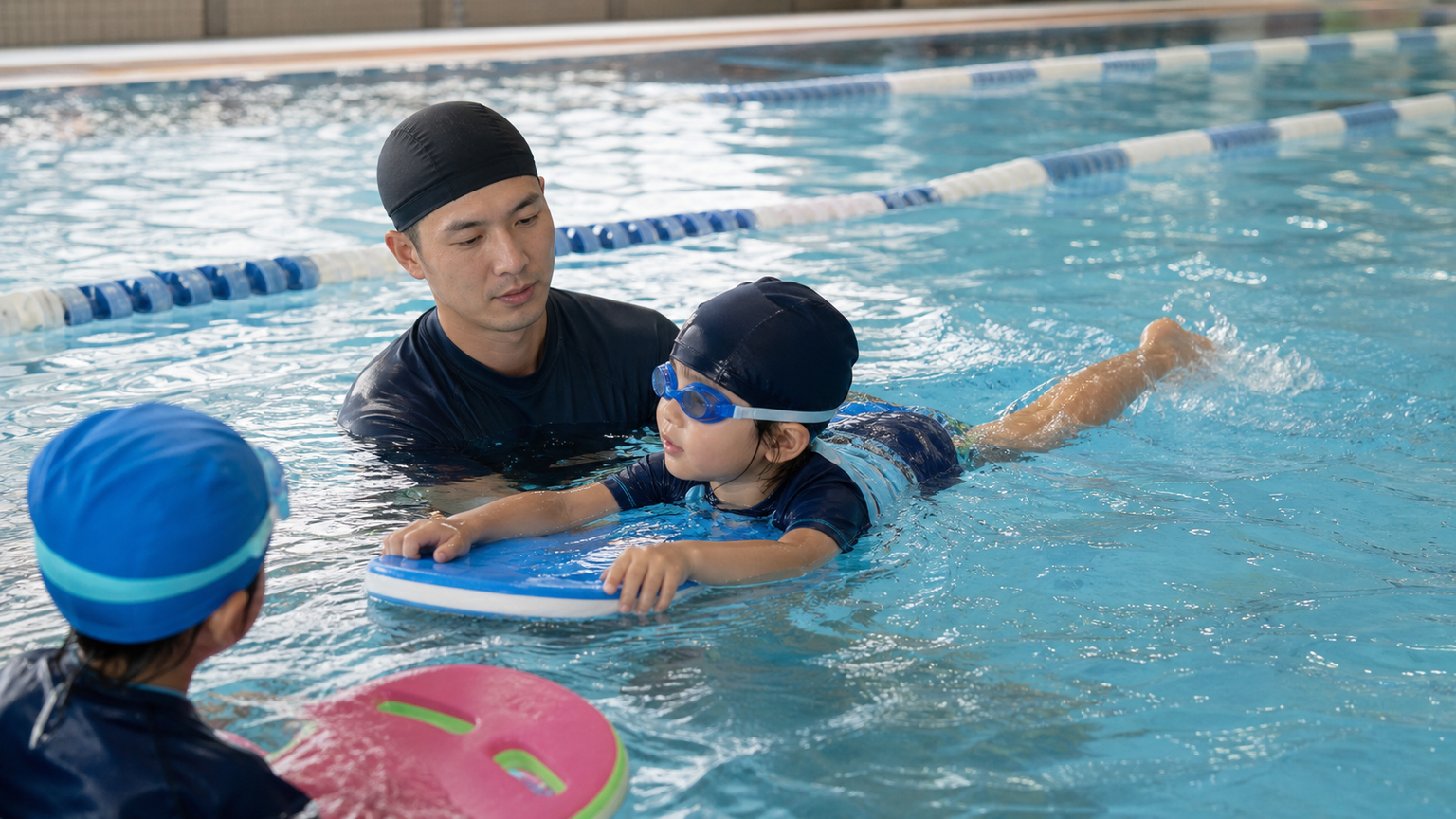
- Kickboard kicking: Hold a kickboard with both hands and practice kicking forward for 25 meters
- Breath-holding underwater: From a standing position, squat down and hold breath underwater, gradually extending the duration
- Basic freestyle: Attempt a full 25-meter swim with parental accompaniment, without demanding perfect form
- Gamified training: “Who can swim to the other side first,” “timed kicking races” keep training fun
The parent’s role: At this age, parents are more “playmates” than “coaches.” Instructions should be short and clear, with positive encouragement taking priority over technical corrections.
Ages 9–12: Introducing Structured Workouts
Children at this age can accept lightly structured training:
Typical workout (45–60 minutes):
- Warm-up: 200 meters easy swimming (can swim together with the child)
- Main set: 4×50 meters, timed each lap (children usually enjoy being timed)
- Technique drills: 100 meters kickboard kicking + 100 meters pull drills
- Choice: Child picks which stroke to practice for 100 meters
- Cool-down: Free play in the water for 5–10 minutes
Letting children participate in designing the workout (e.g., “Do you want to practice breaststroke or backstroke today?”) significantly boosts intrinsic motivation.
How to Balance Parent-Child Training with Your Own Training
Many serious swimmer parents face the dilemma of “wanting to train myself while also accompanying my child.” Practical solutions include:
- Alternating schedule: While the child is in a swim lesson with a coach, the parent trains in a lane; after the lesson, it’s parent-child time
- Training side by side: The child plays in the shallow area while the parent does their own workout in the adjacent lane, staying within each other’s sight
- Full weekend parent-child day: Train on your own during the week, and dedicate one full weekend session to parent-child swimming
Safety Considerations
- Always maintain visual contact: Never take your eyes off your child while they are in the water, even if the child can already swim
- Shallow water rule: Children under 6 must stay in the shallow area (water depth at or below the child’s waist)
- Body temperature management: Outdoor pools in Taiwan have high water temperatures in summer, but indoor air-conditioned pools may have cooler water (25–27°C). Children are more prone to getting chilled than adults, so use hot showers as needed
- Never force it: If a child shows clear fear, never force them into the water—forcing only deepens the fear
Practical Tips
- Many sports centers in Taiwan offer “parent-child swimming classes”—30-minute sessions led by a coach that serve as an excellent entry point
- Let children choose the color or pattern of their swim gear (swim caps, goggles) to increase their sense of ownership over their equipment
- Record your child’s progress (first time swimming across the pool, first 25 meters without stopping)—these records are highly motivating for children
Conclusion
The greatest value of parent-child swimming lies not in developing competitive swimmers, but in helping children build a positive relationship with the water in a safe, fun environment, cultivating lifelong water self-rescue skills. A parent’s companionship and encouragement are a source of motivation that no swim coach can replace.
Related Reading
- Children’s Swim Workout Design: Balancing Technique Learning and Fitness for Ages 6–12
- Parent-Child Interaction in Family Swimming: A Guide to Parent-Child Classes at Taiwan’s Pools
- The Complete Guide to Teaching Kids to Swim: Stage-by-Stage Workouts for Ages 6, 8, and 12
- Youth Swimming Training Plans: Multi-Discipline Development and Fun Design for Under 12
西進武嶺 免費訓練分析服務 Intervals | 練不夠還是練過頭?你哪一種類型選手?AI模型告訴你! | 備戰神器 | 公路車 訓練 | CT Yeh
4 年前
#PUSHBIKE 原來這麼好玩! 小朋友 滑步車 初體驗 超可愛
6 年前
滑雪新手們慘摔學習全紀錄(請開字幕),滑雪好好玩 | Snowboard + Ski | 岩原 スキー場 | 滑雪APP使用 | GoPro Max
6 年前
2023桃園團體繞圈賽 / 海鷗繞圈賽 | 全程空拍數據版 | 公路車 | CT Yeh
2 年前
一日北高前的高裝檢 | 北高 360 | 挑戰11小時的裝備 | 一日雙塔 | 補給
6 年前
一日北高常見問題大集合 | 攻略 | 路線 | 訓練 | 補給 | 自行車 單車 | 一日雙城 | 雙塔 | TWB北高360 | 屁股痛
6 年前
備戰 戀戀197 賽前關門點分析 西濱團練 #公路車 4K高畫質
6 年前
live) 超越北高 之一日北高12小時 策略
7 年前