Introduction
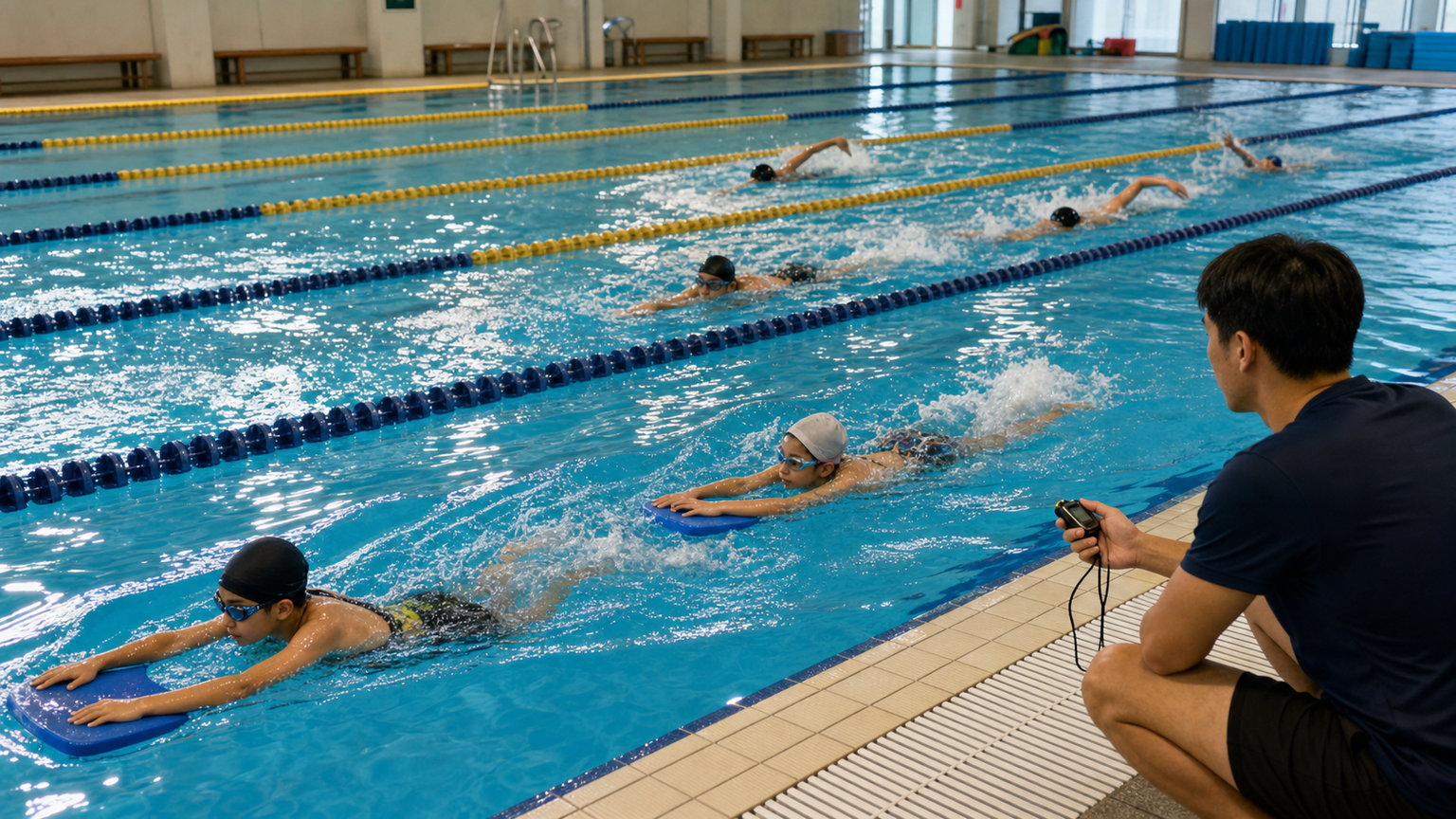
Swim clubs, school swim teams, and community swim classes across Taiwan often face a common challenge: within the same training session, there are beginners who have just learned to swim and advanced athletes who can steadily swim 5,000 meters. How to design “the same workout with different difficulty versions” so that everyone receives appropriate training stimulus is a key issue in workout design.
The core concept of Grouped Training is that the effectiveness of training stimulus depends on the “relative relationship between the stimulus and the individual’s ability,” not on absolute distance or speed. For beginners, swimming 200 meters continuously is already a high challenge; for advanced swimmers, the same 200 meters can be completed easily in under 3 minutes. If both groups use the same workout, the former is overloaded while the latter is undertrained—neither achieves optimal results.
This article designs a three-level swim workout framework and explains how to implement it in actual training settings.
Ability Characteristics of the Three Training Levels
| Level | Ability Description | 100m Pace Reference | Weekly Training Volume |
|---|---|---|---|
| Beginner (Group A) | Can swim 25–100m, technique unstable | > 2:30 | 1,500–3,000m |
| Intermediate (Group B) | Can swim 400–1,000m continuously | 1:40–2:15 | 3,000–6,000m |
| Advanced (Group C) | Can swim 1,500m+ steadily, has pace awareness | < 1:40 | 6,000m+ |
This is only a rough grouping guideline. When actually grouping swimmers, technical quality should also be considered (rather than purely speed).
Grouped Workout Design for the Same Time Slot
Design Principles
A quality grouped workout should have:
- The same workout structure (warm-up → main set → supplementary set → cool-down), adjusting only distance and intensity
- Synchronized training rhythm: each group finishes each training segment at roughly the same time, making it easier for the coach to give unified instructions
- Consistent technical theme: the entire group focuses on the same technical point (e.g., “high-elbow catch”), only the practice intensity differs
Example: A Grouped Workout Centered on 100m Intervals
Group A (Beginner):
- Warm-up: 200m (can be broken into segments, kickboard + easy freestyle)
- Main set: 4×50m, no pace limit, 60 seconds rest after each repeat
- Technique: kickboard kicking 4×25m
- Cool-down: 100m
- Total volume: approximately 700m
Group B (Intermediate):
- Warm-up: 400m (including 100m backstroke or breaststroke)
- Main set: 6×100m, target pace (personal 400m average pace × 1.05), 30 seconds rest between repeats
- Technique: single-arm drill 4×50m
- Cool-down: 200m
- Total volume: approximately 1,600m
Group C (Advanced):
- Warm-up: 600m (including 200m technique set)
- Main set: 10×100m, target pace (3–5 seconds faster than 400m average pace), 15–20 seconds rest between repeats
- Supplementary set: 4×50m sprints (accelerate on the last 25m)
- Cool-down: 300m
- Total volume: approximately 2,500m
Timing Coordination of the Workout
In actual practice, each group will finish each segment at different times. Coaches can:
- Have Group A start the warm-up first, with Group C entering the water slightly later
- Or add “water games/free technique practice” for Group A to fill the waiting time
How to Set Intensity Baselines for Each Group
The most practical approach is to conduct regular “T-baseline tests”:
- Group A: Test maximum continuous swimming distance and subjective fatigue
- Group B: 400m timed swim, used as the baseline for workout pacing
- Group C: 1,000m timed swim, to assess aerobic endurance status
Retest every 4–6 weeks and adjust groupings based on progress. Group B swimmers who improve rapidly can gradually incorporate Group C workout elements, achieving “natural promotion.”
Common Challenges in Grouped Training
Challenge 1: Swimmers are unwilling to admit they are in Group A
Use positive labels such as “Technique Group” or “Progress Group” instead of numeric groupings to reduce psychological barriers.
Challenge 2: Insufficient lanes for grouping
In public pools with limited lanes, stagger the time slots (Group A in the first half hour, Group B in the second half), or have groups share a lane starting from different ends.
Challenge 3: Progress gaps between groups keep widening
Conduct regular regrouping tests to ensure grouping criteria remain updated. Give promotion incentives to swimmers who improve rapidly.
Practical Recommendations
- When grouping, let swimmers understand the ability indicators for each group, allowing them to find a balance between “wanting a challenge” and “being forced into it”
- Grouped training at Taiwanese swim clubs can reference the ability classification system of the “Chinese Taipei Swimming Association” as an external benchmark for designing workouts
- Record each swimmer’s training progress data and share it regularly (e.g., posting timed results in group chats) to foster a positive culture of mutual encouragement
Conclusion
Grouped training is not about “ranking people into tiers,” but about ensuring everyone receives the training stimulus best suited to them. A well-designed grouped workout gives beginners a sense of achievement, intermediate swimmers a sense of challenge, and advanced swimmers a sense of competition—all three groups swimming the most meaningful training in the same time slot. That is the highest goal of grouped training design.
Related Reading
- Pool Training Grouping Strategies: Workout Design Differences for Fast, Medium, and Slow Lanes
- Weekly Swim Workout Templates: Training Volume Arrangements for Beginner, Intermediate, and Advanced Levels (4 Days/Week)
- Complete Pool Training Plan Analysis: Periodized Workouts from Beginner to Advanced Swimmers
- Parent-Child Swim Training Plan: Workout Design for Swimming with Your Kids
西進武嶺 免費訓練分析服務 Intervals | 練不夠還是練過頭?你哪一種類型選手?AI模型告訴你! | 備戰神器 | 公路車 訓練 | CT Yeh
4 年前
滑雪新手們慘摔學習全紀錄(請開字幕),滑雪好好玩 | Snowboard + Ski | 岩原 スキー場 | 滑雪APP使用 | GoPro Max
6 年前
實景訓練台) 彰化經典百K 高強度喵團 90分鐘 跟著一起練功 2019 Indoor workout Changhua Classic 100 Taiwan
7 年前
[教學] Dashware 教學 如何製作有 速度 功率 心律的 騎車影片 Guages Video
8 年前
單車AI教練!全新 ChatGPT4o 幫你分析訓練成果!排武嶺課表,分析騎車姿勢! 太神了! / 公路車 / CT Yeh / feat. 緯緯
2 年前
一日北高常見問題大集合 | 攻略 | 路線 | 訓練 | 補給 | 自行車 單車 | 一日雙城 | 雙塔 | TWB北高360 | 屁股痛
6 年前
一日北高/長距離團騎 常見問題補充篇 / 組團或跟團的眉角 / 壯車友容易被瘦車友慢性拉爆 / 原來屁股痛可能是這個原因...? / 風場配速法 / 公路車 / CT Yeh
2 年前
2026 輪霸西濱200K 挑戰VLOG / 第一集團 / 首次參加..經驗不足、膀胱不足 /死守6H內 / AI戰鬥力顯示系統 / 公路車 / CT Yeh
4 個月前