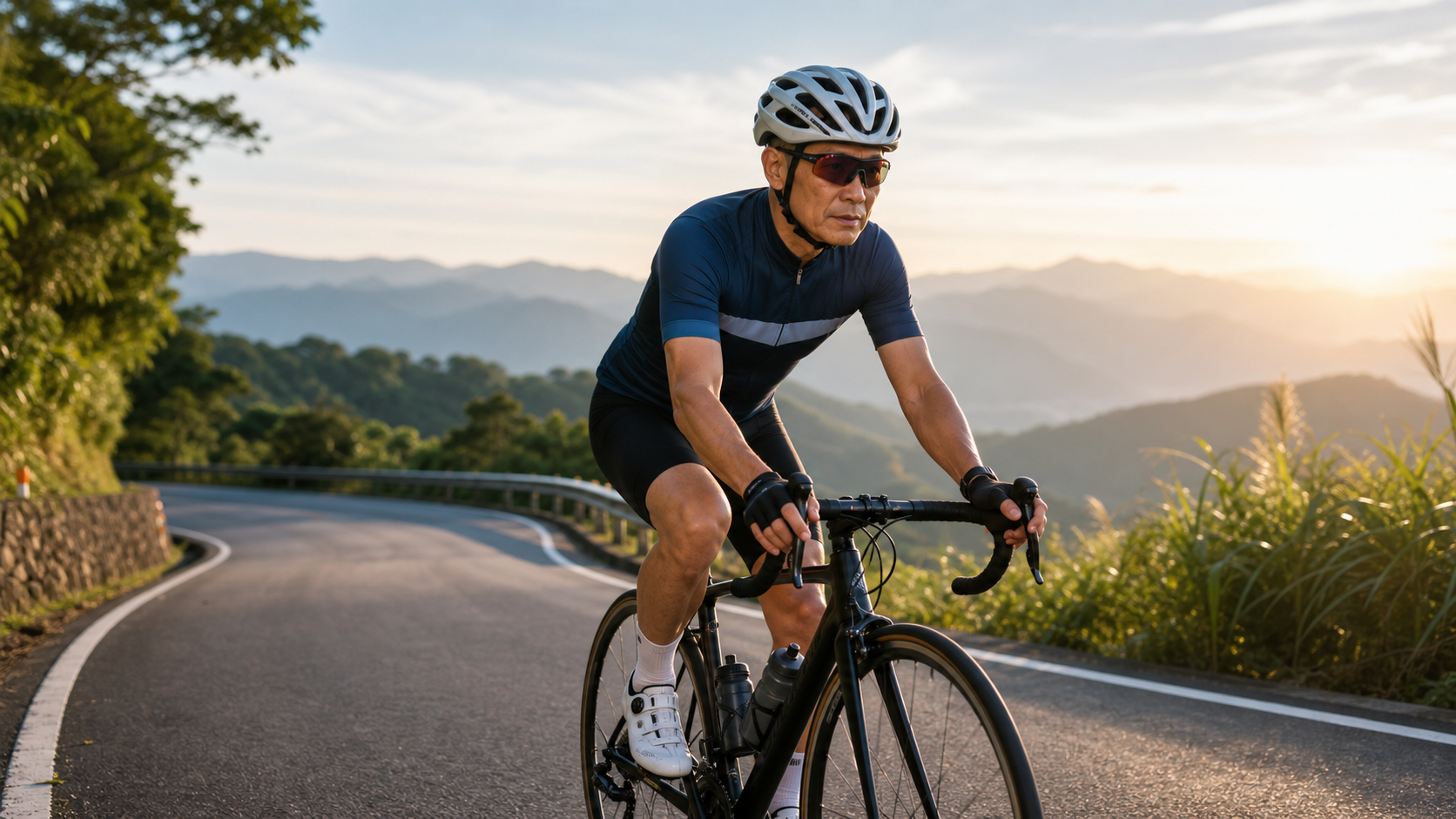
Introduction
In cycling clubs across Taiwan, the proportion of riders over 50 has been rising year after year. On the finisher lists of the Wuling Challenge, there is no shortage of veterans in their 60s and 65s; among island-wide cycling tours, there are many “silver-haired riders” who only started cycling after retirement. This tells us one thing: bone age does not equal the ceiling of your riding ability.
However, the human body does undergo certain physiological changes after 50. If you apply the training methods of your 20s–30s to a 50-year-old body, it often backfires. Understanding the physiological characteristics of older age and making corresponding adjustments is what will make cycling the best health investment after 50.
Physiological Changes After 50: What Training Must Take into Account
| Physiological Change | Impact on Training | Coping Strategy |
|---|---|---|
| VO2max declines by about 1% per year | Slow decline in long-distance endurance | Decline can still be slowed through training |
| Slower recovery | More recovery time needed | Lengthen intervals between high-intensity sessions |
| Declining testosterone (men) | Muscle mass harder to maintain | Add resistance training |
| Muscle fiber type shift (fast-twitch → slow-twitch) | Decreased explosive power, relatively better endurance | Retain a small amount of high-intensity work to maintain fast-twitch fibers |
| Slower collagen synthesis | Slower recovery of ligaments and tendons | Adequate protein intake, avoid overtraining |
| Lower maximum heart rate | Training zones need to be recalculated | Use power or RPE instead of maximum heart rate formulas |
The most important thing to understand: the decline in VO2max after 50 is real, but the rate of decline varies depending on training. A 50-year-old rider who trains regularly may have better aerobic capacity than an inactive 35-year-old.
Training Adjustment Strategies for Older Riders
Strategy 1: Extend Recovery Time
A 25-year-old rider may fully recover 36 hours after high-intensity intervals; a rider over 50 may need 48–72 hours.
Practical adjustments:
- Reduce high-intensity sessions from 2–3 per week to 1–2
- Allow at least 72 hours between two high-intensity sessions
- Schedule one “completely easy week” every 4 weeks (training volume reduced by 50%)
Strategy 2: Listen to Your Body’s Signals
A 25-year-old rider can rely on willpower to ignore fatigue; after 50, the signals your body sends deserve to be taken more seriously.
If any of the following occur, reduce training intensity immediately:
- Resting heart rate is more than 5 bpm above average for 3 consecutive days
- Unexplained joint pain (especially in the knees or hips)
- Consistently declining sleep quality
- Severe fatigue persisting more than 48 hours after training
Strategy 3: Maintain a Sufficient Low-Intensity Base
After 50, maintaining your aerobic base is more important than improving it. Scheduling 2–3 Zone 2 long rides per week (60–120 minutes) is the backbone of an older rider’s training. An aerobic base can:
- Maintain cardiovascular health
- Preserve fat metabolism efficiency
- Provide the foundation for high-intensity training
Strategy 4: Keep Some High-Intensity Training (But Don’t Overdo It)
Abandoning high-intensity training entirely will cause fast-twitch muscle fibers to decline rapidly and will also cause the body to lose its ability to adapt to high intensity. It is recommended to keep one appropriate high-intensity session per week:
- 2×10 minutes at threshold (Zone 4), which is easier to recover from than 2×20 minutes
- 4×2 minutes at VO2max (with full 4-minute recovery between intervals)
- 6×30-second short sprints (to maintain explosive power)
Resistance Training: An Essential Supplement for Older Riders
Research shows that adding resistance training (weight training) after 50 can effectively:
- Slow the loss of muscle mass (an annual loss rate of about 1–2%)
- Increase bone density and reduce the risk of osteoporosis
- Improve neural efficiency in power output
Resistance training recommendations suitable for older riders:
| Exercise | Reps/Sets | Frequency | Purpose |
|---|---|---|---|
| Goblet Squat | 3×10–12 | 2x per week | Leg strength |
| Step-up | 3×8 (each leg) | 2x per week | Coordination and balance |
| Bridge | 3×15 | 2–3x per week | Glutes and core |
| Push-up | 3×8–12 | 2x per week | Upper body and core |
| Farmer’s Walk | 3×30 seconds | 2x per week | Full-body stability |
It is recommended to do resistance training on days separate from cycling training to avoid fatigue accumulation.
Dietary Adjustments: The Growing Importance of Protein
After 50, the body’s efficiency at utilizing dietary protein declines, meaning the same intake synthesizes less muscle protein.
Recommendation: Increase daily protein intake to 1.6–2.0g per kilogram of body weight (the general recommendation is 0.8g). A 60kg rider needs 96–120g of protein per day, equivalent to 3–4 palm-sized portions of chicken breast or tofu.
In the Taiwanese diet, tofu, soy milk, eggs, fish, and lean meat are all high-quality protein sources that are easy to obtain.
Practical Advice
Regular health check-ups: Before riding after 50, it is recommended to undergo a cardiovascular health assessment (including an ECG, blood pressure, and lipid panel) to confirm there are no health risks requiring special attention. Many local governments offer free health screenings for middle-aged and older adults, which are well worth taking advantage of.
Set different progress metrics: After 50, you don’t necessarily have to pursue “a faster Wuling time than last year.” You can also set goals such as “maintaining the same riding ability year after year,” “staying healthy and keeping chronic disease at bay,” or “enjoying more happy hours on the bike”—these are equally worthy achievements.
Conclusion
After 50, you can still ride, you can still improve, and you can still take on the Wuling Challenge. The only things that need to change are how you listen to your body and how you adjust your training strategy. Give yourself more recovery time, consume enough protein, and add resistance training—these three things will extend your cycling career for another 20 years beyond 50.
Related Reading
- Health Guidelines for Older Cyclists: A Complete Guide to Safe Training After 50
- Special Considerations for Middle-Aged and Older Cyclists: Training Adjustments and Health Maintenance After 50
- Cycling Retirement Planning: Staying Active in Later Life by Riding After 50
- Training Adjustments for Older Riders: How to Maintain and Improve Cycling Performance After 40
靠單車減肥35公斤 心得分享與整理
7 年前
2025 自行車錶排行榜 兩萬車友大數據 / Garmin Bryton 排名會大洗牌嗎? / 全新的碼表前身分析 /公路車 / CT Yeh
1 年前
#公路車 #Fitting 靠人工智慧APP 幫你調整單車
6 年前
一日北高/長距離團騎 常見問題補充篇 / 組團或跟團的眉角 / 壯車友容易被瘦車友慢性拉爆 / 原來屁股痛可能是這個原因...? / 風場配速法 / 公路車 / CT Yeh
2 年前
單車AI教練!全新 ChatGPT4o 幫你分析訓練成果!排武嶺課表,分析騎車姿勢! 太神了! / 公路車 / CT Yeh / feat. 緯緯
2 年前
西進武嶺 免費訓練分析服務 Intervals | 練不夠還是練過頭?你哪一種類型選手?AI模型告訴你! | 備戰神器 | 公路車 訓練 | CT Yeh
4 年前
日本公路最高登山賽,台灣首位YT挑戰實錄,乘鞍登山賽40週年,賽前篇完整版,請到我的YT收看 #公路車 #cycling
10 個月前
西進武嶺 自製新版AI配速表產生器 x 賽前攻略 抱佛腳! 沒有功率計也可以產生配速表嗎?有什麼其他眉角賽前要注意的呢? | 西進武嶺 / 東進武嶺 KOM 攻略 | 公路車 | CT Yeh
4 年前