Introduction
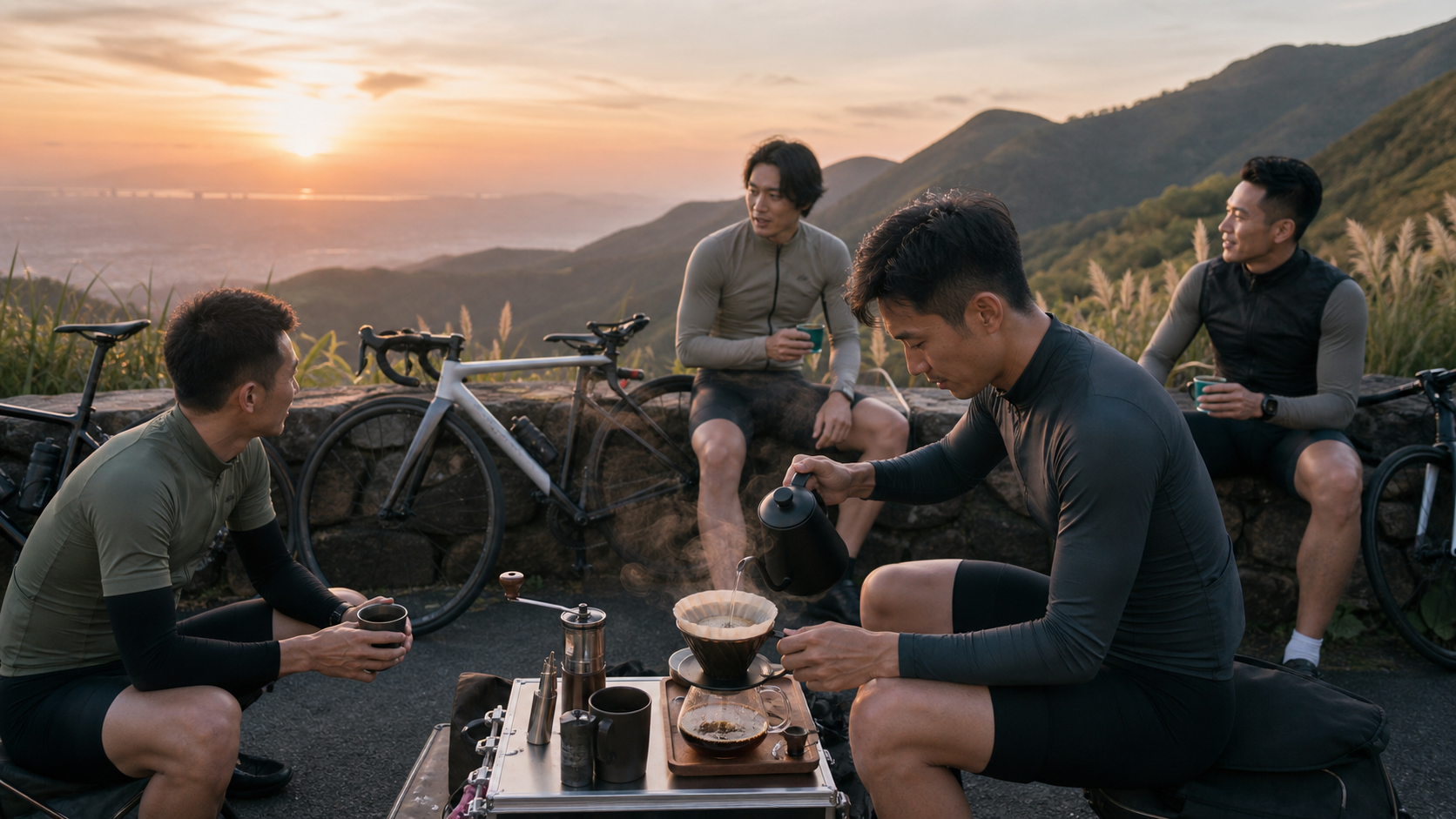
At 5:30 in the morning, at the Xiaoyoukeng parking lot on the summit of Yangmingshan, a dozen road bikes are lined up against the wall. The riders take off their helmets, pull out pour-over coffee kits from their backpacks, boil water with a folding stove, grind beans, and brew coffee as they watch the sunrise rise over the Taipei Basin. This scene is the most typical microcosm of Taiwan’s Café Racer culture.
The term Café Racer originates from European motorcycle culture in the 1960s, referring to young riders who sprinted and raced between cafés. When this concept was transplanted into the cycling world, it evolved into a “riding culture with cafés as the starting or ending point,” emphasizing not speed but the taste and social rituals of the ride. Over the past decade, Taiwan’s road cycling community has created a unique local interpretation.
Three Forms of Café Racer in Taiwan
Form One: Departing from Specialty Coffee Shops
In Taipei’s Dadaocheng, Eastern District, and Xinyi District—hubs of specialty coffee—it’s common to see road bikes parked outside on weekend mornings. Riders gather at the café as a meeting point, set off together after finishing a Flat White, ride along the North Coast or Yangmingshan routes, and wrap up the ride at another café on the way back. The focus of this form lies in the trinity experience of “coffee + socializing + riding.”
Form Two: Mountain-Top Coffee Pilgrimage
The endpoint of Taiwan’s mountain cycling routes is often a well-known scenic café. Restaurants near Wuling, the Sea of Clouds Café on Taipingshan, and high-mountain tea shops on Alishan—these “endpoint rewards” give the climb itself profound meaning. Many riders plan their routes with this logic: “First find the target café, then figure out how to climb up to it.”
Form Three: The Mobile Café
Advanced Café Racers carry pour-over equipment on their bikes and brew coffee at any scenic spot where they stop. This requires extra investment in gear, but in return offers completely free coffee time.
The Equipment Aesthetics of Coffee Riding
| Category | Recommended Option | Weight | Notes |
|---|---|---|---|
| Pour-over dripper | Hario V60 Folding Version | 60g | Can be stored flat in a feed bag |
| Portable stove | Primus Lite+ | 73g | Stable output, suitable for high altitudes |
| Insulated bottle | KINTO Travel Tumbler | 220g | 400ml, can replace a coffee cup |
| Coffee grinder | 1Zpresso JX | 450g | Hand grinder, good grind quality |
Carrying a full pour-over setup adds about 800–1000g, which is indeed not light for road cyclists. Many people’s compromise is to carry a good insulated cup, fill it with coffee at a café before departure, and it’s still hot by the time they reach the summit.
The Social Language of Coffee Riding
Taiwan’s coffee riding community has an unwritten set of social rules:
- The waiting culture: Everyone climbs at their own pace, but upon reaching the finish, everyone waits for all riders to arrive before ordering—no one finishes their drink and leaves on their own
- Gear talk: Conversations at cafés are often more intense than during the ride; frames, components, and where to ride next are standard topics
- The check-in ritual: Taking a photo with the coffee cup and handlebars in the same frame is almost the iconic gesture of this culture, with a considerable number of posts tagged #CafeRacer #公路車咖啡 on Instagram
- Sharing tastings: If someone brings their own pour-over gear, they usually brew extra to share with companions—an important ritual for maintaining riding friendships
Recommended Coffee Riding Routes in Taiwan
The following routes balance riding quality with coffee destinations:
- Taipei → Yangmingshan Zhuzihu: About 500m of climbing; Zhuzihu has several scenic cafés, crowded on weekends but with a great atmosphere
- New Taipei → Pinglin Tea Country: Ride along the Beiyi Highway; Pinglin Old Street has several specialty cafés featuring Baozhong tea
- Taichung → Guguan: The Dongfeng Bike Path connects to Provincial Highway 8, passing through a hot spring area, with mountain-view cafés at the endpoint
- Kaohsiung → Maolin: Tropical scenery paired with Indigenous-style cafés, with pleasant winter temperatures
Practical Advice
For beginners: You don’t need to prepare a full pour-over setup from the start. Begin with “riding to an interesting café for a cup of coffee” to experience the joy of this riding style, then gradually invest in gear.
Café etiquette: Popular scenic cafés are often packed on weekends. If your group exceeds 8 people, it’s advisable to call ahead for reservations or split into smaller groups to avoid taking up space for too long.
Seasonal choices: October through March of the following year is the golden season for coffee riding in Taiwan—cool temperatures and clear air make coffee taste especially aromatic. In summer, it’s recommended to depart before 5 AM to reach the target café before the heat sets in.
Conclusion
The reason Café Racer culture remains enduringly popular in Taiwan’s road cycling community is that it perfectly answers the question, “What is riding for?” When the ride itself becomes the path to a good cup of coffee, every climb has a concrete reward, and every drop of sweat has worthwhile meaning. Taiwan’s mountain-and-sea terrain, combined with its thriving specialty coffee culture, has allowed this cycling philosophy from Europe to bloom into something unique on this island.
Related Reading
- Cycling and Coffee Culture: A Guide to Taiwan’s Café Cycling Routes and Coffee Shop Culture
- Weekend Cycling Outing Culture: Trends in Café Routes and Check-in Spots
- Bike & Coffee Culture: The Rise of Taiwan’s Bike & Coffee Culture and Recommended Shops
- Coffee Ride Culture: The Integration of Taiwan’s Cafés and Cycling Community
太平山單車員工旅遊 | 這樣玩CP值最高!| 公路車
5 年前
12/9 曜越Tomashinii 免費約騎,海倫咖啡 星巴克吃到飽😍 #公路車 #cycling
2 年前
「悲情男車友」創作單曲 爆笑MV / 公路車 / CT Yeh / 4K劇情版
7 個月前
2023自行車展!與環台賽選手一同表演賽 / 全自動AI Fitting?/ TIME新車發表/神秘充電桌等 精華分享 VLOG | CT Yeh | 公路車
3 年前
高雄綠園道鐵路自行車道 / 外地人能輕鬆駕馭 還是整路崩潰? / 2025 全線開通 春節實地探索一次!(附GPS連結)/ 公路車 / CT Yeh
1 年前
藤枝二集團 單車行 Day1 | 南部小武嶺 | 爬坡爬到罵罵叫 | JJSC | 公路車 | CT Yeh
3 年前
日本公路最高登山賽,台灣首位YT挑戰實錄,乘鞍登山賽40週年,賽前篇完整版,請到我的YT收看 #公路車 #cycling
11 個月前
2022 環花東挑戰賽 Day2 搭到特快車 高速真空吸引! 台東一路逆風殺回花蓮! 總排 ??| Feiyu Pocket 2s | 公路車 | CT Yeh
4 年前