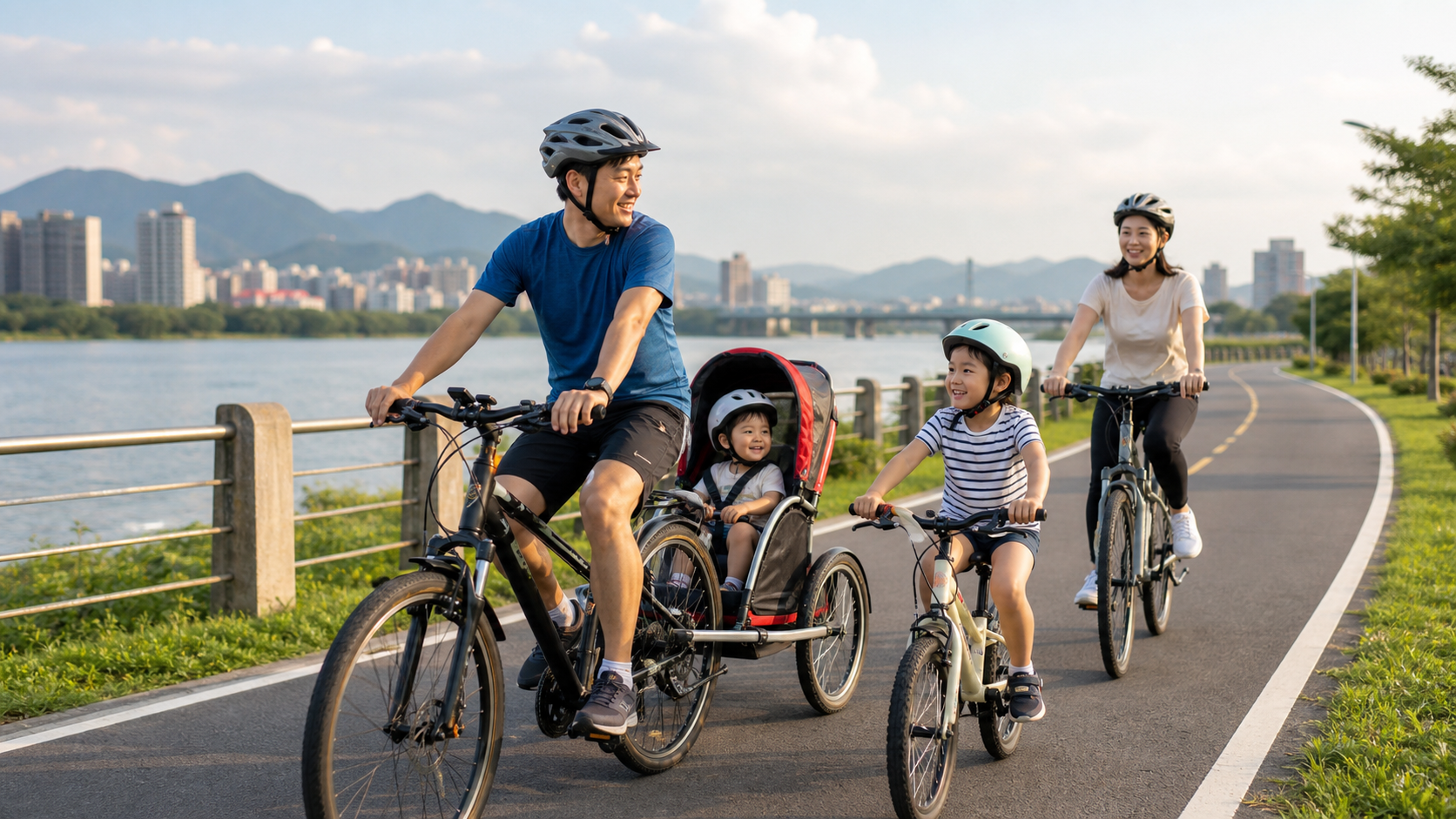
Introduction
Many cycling enthusiasts face a dilemma after becoming parents: should they continue riding alone, or put this important life habit on hold? In fact, there is a third path—making cycling a shared lifestyle for the whole family.
Parent-child cycling culture in Taiwan has developed rapidly in recent years, and bike path facilities across the island have become increasingly complete. From bike trailers during infancy, to balance bikes in the preschool years, to following along on their own bikes in elementary school, and finally tackling mountain roads together as teenagers, every developmental stage has a corresponding form of cycling. This article provides a complete parent-child cycling plan from ages 0 to 15.
Cycling Formats by Age Group
| Age | Recommended Format | Key Safety Points | Suitable Routes |
|---|---|---|---|
| 0–2 years | Bike trailer (rear-mounted) | Infant must wear a helmet, head secured | Flat bike paths |
| 2–4 years | Front-mounted child seat or trailer | Seat must meet CNS standards | Low-traffic flat routes |
| 4–6 years | Balance bike / tandem bike | Knee and elbow pads required | Parks, riverside paths |
| 6–9 years | Children’s bike (16–20 inches) | Helmet mandatory, always stop at intersections | Riverside paths, bike lanes |
| 10–14 years | Youth bike or riding alongside | Learn road rules, hand-signal communication | Can attempt light mountain routes |
The Non-Negotiable Principles of Safety Gear
Proper Helmet Fitting
The most common mistake Taiwanese parents make is letting their child push the helmet back on their head or letting the visor tilt upward—this almost completely eliminates protection for the forehead. The correct way to wear it:
- The visor should sit about two finger-widths above the eyebrows
- Side straps should form a V-shape, with one strap in front of each ear and one behind
- After tightening the chin strap, the helmet should feel like it gives a slight tug when the mouth is opened wide
Purchasing advice: Children’s helmets on the Taiwanese market should be selected from models with CE or CPSC certification, typically priced between NT$500–2000. Uncertified cheap helmets are not recommended. Even if a child dislikes a particular model, proper fitting should still be insisted upon.
Other Protective Gear
- Beginners (ages 4–7) are advised to add knee and elbow pads to reduce the fear of injury from falls
- Cycling gloves: prevent palm abrasions when falling and improve handlebar comfort
The Logic Behind Choosing Parent-Child Routes
Taiwan has many routes suitable for parent-child cycling. The following factors should be considered when choosing:
Surface quality: Prioritize asphalt or compacted gravel paths; avoid loose gravel or uneven surfaces
Traffic volume: Dedicated riverside bike paths are best; urban roads require careful assessment
Distance and elevation: The comfortable riding distance for children aged 6–9 is about 5–10 km, with elevation changes not exceeding 100 meters
Midpoint planning: Set a rest stop every 3–5 km (pavilions, convenience stores, public restrooms) to give children something to look forward to and time to rest
Recommended Parent-Child Routes
- Taipei Riverside Bike Path: Flat, car-free, well-equipped, suitable for all ages
- Dongfeng Bicycle Green Corridor (Taichung): Converted from an old railway, no elevation, 17 km in total length, with multiple rest stops
- Luodong Sports Park Area (Yilan): Child-friendly environment, can be combined with park activities
- Taiping Bike Path (Tainan): Near the city outskirts, good road conditions, with tree shade
Psychological Tips for Helping Kids Fall in Love with Cycling
The biggest challenge in parent-child cycling is often not safety, but how to keep children interested throughout the ride:
- Let children set goals: “Let’s ride to that big tree and then rest” or “Today let’s ride to the convenience store for ice cream”—specific, short-term goals with rewards work best
- Avoid forcing: If a child doesn’t want to ride on a given day, forcing them will only create negative associations. Cycling should be “something we want to do,” not “a task we must complete today”
- Give a sense of autonomy: Let children choose which route to take today, where to stop, and what drink to have. A sense of autonomy greatly increases willingness to participate
- Record achievements: Help children keep a “cycling journal” to record how many kilometers they rode each time and where they went. The accumulated sense of accomplishment is the best fuel for motivation
Practical Advice
Gear doesn’t need to be bought all at once: Children grow quickly, and cycling gear quickly becomes outgrown. It’s recommended to borrow or buy second-hand from parents of similarly aged children to save money. Once a child truly falls in love with cycling, then invest in better equipment.
Parents should also maintain their own fitness: The pace of parent-child cycling is far slower than solo riding. If parents feel frustrated by the lack of exercise effect, it will unconsciously affect the child’s interest in cycling. Schedule separate solo riding time to maintain fitness, and focus parent-child rides on companionship and shared experiences.
Establish a regular family cycling day: A fixed weekly “family cycling day” builds the habit better than going out sporadically, and children will also look forward to this regular family time.
Conclusion
In Taiwan, more and more families are choosing cycling as their primary weekend outdoor activity. Cycling is not just an investment in physical health—it is a special ritual for building parent-child bonds. Those moments of riding side by side along riverside paths and sharing drinks together at pavilions often become a child’s most precious childhood memories. Perhaps the greatest reward for cycling enthusiasts is passing on this love of riding to the next generation.
Related Reading
- Riding with Kids: Gear and Route Recommendations for Family Cycling Trips
- Family Cycling: Gear and Route Choices for Riding with 3–8 Year Olds
- Family Cycling: A Complete Guide to Getting Your Kids Started on Bikes
- Family Cycling Activities: A Guide to Safety Equipment and Route Selection for Riding with Kids
高雄綠園道鐵路自行車道 / 外地人能輕鬆駕馭 還是整路崩潰? / 2025 全線開通 春節實地探索一次!(附GPS連結)/ 公路車 / CT Yeh
1 年前
單車 一日北高 ( 雙城 ) 肥宅雙人瘋狂行 紀錄片 REACTO
10 年前
太平山單車員工旅遊 | 這樣玩CP值最高!| 公路車
5 年前
靠單車減肥35公斤 心得分享與整理
7 年前
車隊介紹) 台北 一年開團365天 車隊 Apollo Ride 晨騎 好選擇 ( 陽明山 風櫃嘴 冷水坑 平等里 聖人 關渡 大稻埕 ) 找人騎車
7 年前
一日北高常見問題大集合 | 攻略 | 路線 | 訓練 | 補給 | 自行車 單車 | 一日雙城 | 雙塔 | TWB北高360 | 屁股痛
6 年前
單車賞雪 裝備準備及注意事項分享 | 公路車
5 年前
碟煞公路車 銑面器 !? 原來銑完差這麼多! 降低蹭碟機率! | TIME 公路車 保養小記錄 | CT Yeh
3 年前