Introduction
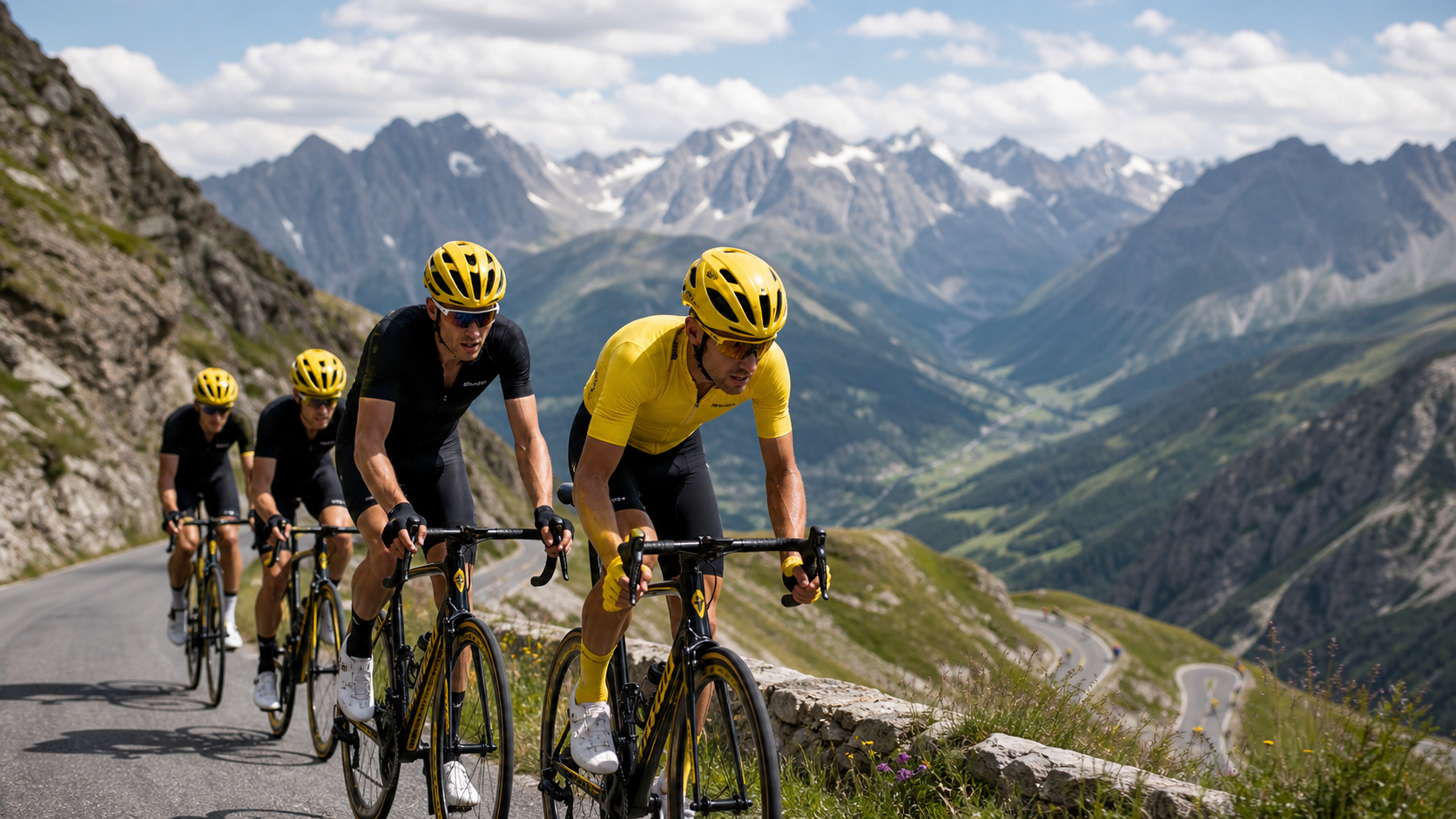
The Tour de France is the most prestigious cycling event in the world, held annually in France every July, spanning three weeks and covering approximately 3,400 kilometers. Among the 21 stages of the race, mountain stages are often the decisive battleground that determines the final outcome. Riders must engage in brutal elimination battles across the Alps, the Pyrenees, and the Massif Central, competing for the yellow jersey (Maillot Jaune) that symbolizes overall victory.
The Categorization System for Mountain Stages
The Tour de France imposes a strict categorization system for mountain climbs, based on gradient, length, and road conditions, divided into the following categories:
| Category | Criteria | Representative Climbs |
|---|---|---|
| Hors Catégorie (HC) | Highest difficulty, steep gradients, long distances | Alpe d’Huez (13.8km, 7.9%), Col du Tourmalet (19km, 7.3%) |
| Category 1 (Cat.1) | High difficulty, requiring significant physical exertion | Col du Galibier, Col d’Aubisque |
| Category 2 (Cat.2) | Moderate difficulty | Col de la Croix de Fer |
| Category 3 (Cat.3) | Easier | Short climbs, low-gradient hills |
| Category 4 (Cat.4) | Lowest difficulty | Slightly rolling sections |
Analysis of Key Tactics
Pacing Control and Pacing Strategy
Professional riders do not go all-out from the start in mountain stages. Taking 2023 Tour de France champion Jonas Vingegaard as an example, the core of his climbing strategy is maintaining a stable power output (Watt/kg), avoiding entering the lactate threshold too early. Generally, professional riders sustain power at 95–105% of their FTP (Functional Threshold Power) during long climbs.
Key pacing principles:
- Conserve energy in the early phase: Maintain the group’s tempo in the early part of a long climb to avoid excessive expenditure
- Accelerate at the critical point: Launch the decisive attack only in the final 3–5 kilometers
- Heart rate monitoring: Use a power meter and heart rate monitor to adjust output in real time
The Role of Domestiques in the Mountains
In mountain stages, the domestiques’ tasks differ completely from those on flat stages. Near the summit, a team leader’s domestiques will one by one raise the group’s pace, exhausting opponents’ energy while shielding the leader from direct headwinds.
- Early-stage tasks: Control the group’s tempo to prevent opponents from escaping too early
- Mid-stage tasks: Take turns pulling at the front, each maintaining high-intensity output for 1–3 minutes
- Final-stage tasks: The strongest mountain domestique stays with the leader until the last 2km, then lets the leader launch a solo attack
Choosing the Timing of Attacks
The timing of attacks in mountain stages is an art. Common attack strategies include:
- Breakaway in the middle of a long climb: Launch 5–8km from the summit to create a time gap over the chasers
- Probing attacks: Briefly accelerate to observe opponents’ reactions and gauge their physical condition
- Successive attacks: Multiple teammates attack in rotation to exhaust opponents’ legs before the leader makes the final move
- All-out sprint in the final 1km: When fitness levels are similar, rely on pure explosive power to decide the outcome
The Influence of Terrain on Tactics
Different mountain terrains call for different tactical considerations:
- A single long climb (e.g., Alpe d’Huez): Pacing is key; collective tactics are harder to execute, and it often comes down to individual ability
- Multiple consecutive climbs: Energy management becomes more important; riders need to replenish food and fluids on the descents between climbs
- A long descent immediately after the summit: Attack timing must be cautious, as a large lead may be neutralized collectively on the descent
Practical Advice
For amateur riders in Taiwan, Tour de France mountain strategies apply equally to local climbing challenges, such as Wuling, Guanwu, and Hehuan Mountain:
- Build your personal power data: Find your FTP through testing and sustain 85–90% of it while climbing
- Don’t wait until you’re hungry to refuel: On long climbs, replenish with an energy bar or gel every 30 minutes
- Be conservative in the early part of a climb: Resist the urge to push hard in the first third of the climb when you feel “surprisingly good”
- Understand your opponents’ condition: Observe your companions’ breathing rate and pedaling rhythm to judge whether an attack is viable
Conclusion
The beauty of Tour de France mountain stage strategy lies in the fact that it is not merely a test of physical strength, but also a battle of wits. Top riders can maintain clear tactical judgment even at oxygen-deprived summits, and this is precisely what makes professional cycling so captivating. For cycling enthusiasts in Taiwan, understanding these strategies not only enhances the enjoyment of watching the race but can also directly improve your own climbing ability.
Related Reading
- In-Depth Tactical Analysis of the Tour de France: The Chess Game for the Yellow Jersey
- Tour de France Tactical Analysis: How Do Teams Devise Strategies to Win the Yellow Jersey?
- The Complete Guide to the Tour de France: Race Format, Four Jerseys, and a Viewing Guide for Taiwanese Fans
- Tour de France Beginner’s Guide: A Complete Breakdown of Stage Format and Points Calculation
2025 乘鞍 KOM 登山賽挑戰實錄 / 日本公路最高 ! 賽前探路篇 / 比富士山厲害,無敵絕景!/ 40週年 / 中文YT首發 / 公路車 / CT Yeh #乘鞍ヒルクライム
11 個月前
超激烈!2025 南庄仙山KOM 賽事精華 / 男菁英A x 女菁英A / 公路車 / CT Yeh
9 個月前
富士山KOM 賽事篇 VLOG!/ 小野田出沒!/ 完整路段分析 / 武嶺要騎多快才能拿環?/ 台灣選手 第20回Mt.富士ヒルクライム 参加!/ 公路車 / CT Yeh
2 年前
2024 春季KOM 賽事精華版 / 太魯閣 / 貓捉老鼠精彩追擊 / 錄影剪輯版 / 東進武嶺 / 公路車 (請開啟字幕)
2 年前
2025 乘鞍岳登山賽 比賽全紀錄篇 / 完整路線攻略介紹 / 日本版武嶺 公路最高點 / 高山空拍絕景 / 明年會開團! / 公路車 / CT Yeh
10 個月前
2025 紫南宮99.9K環縣自行車挑戰賽 直播 / 第一集團跟了20K / CT動態數據直播系統 / 公路車 / CT Yeh
1 年前
如何 搶 #中央山脈 報名 #公路車 #報名 #搶票
7 年前
大武山後門26%歡樂陡坡!JJSC南台灣單車行Day2 / 被颱風追著跑 / 公路車 / CT Yeh
2 年前