The Limits of Aerodynamics: An Analysis of the Differences Between Track Time Trials and Road Time Trials
Introduction
The Time Trial (TT) is known as the “Race of Truth” because, in this format, riders must face the clock alone. With no tactical hiding and no peloton protection, it is a pure test of an individual’s aerobic capacity and aerodynamic optimization. Time trials are divided into two main categories: Track Time Trial and Road Time Trial. While they share the same core, there are vast differences in equipment, technical requirements, and aerodynamic strategies.
Track Time Trial
Race Format
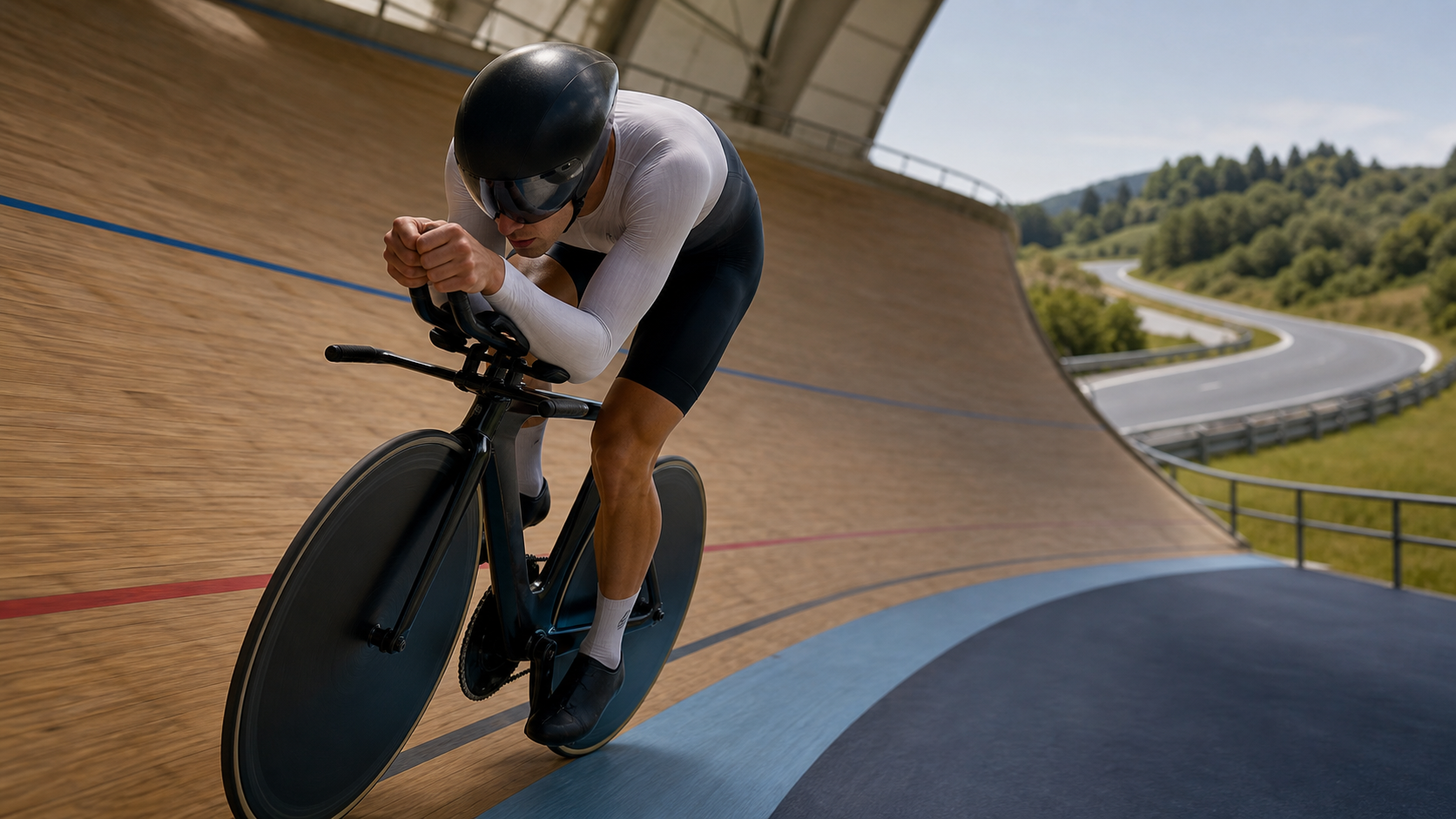
Track time trials are held in a closed velodrome, with an oval track typically 250 meters in length and a banking angle between 28 and 45 degrees. Common formats include:
- Individual Pursuit: Two riders start from opposite sides and compete for the best time over a distance of 4–5 km.
- Kilometre TT: Men start from a standing start to ride 1 km, while women ride 500 meters.
- Flying Lap: A timed lap (250m) measured while the rider is at high speed.
Aerodynamics in Track Cycling
The aerodynamic requirements for track time trials are extremely stringent because riders reach maximum speeds (up to 75–85 km/h) in a closed environment, where air resistance is the only source of drag.
Key Equipment Features:
| Equipment | Track Time Trial Specs | Purpose |
|---|---|---|
| Frame | Fixed gear (no shifting), ultra-streamlined design | Maximize aerodynamic efficiency |
| Helmet | Aero helmet (bullet shape), extended tail design | Reduce head drag |
| Wheels | Disc wheels (front and rear) | Eliminate airflow turbulence from spokes |
| Handlebars | Fixed pursuit bars | Maintain the lowest drag riding position |
| Overshoes | Full-coverage, no exposed laces | Eliminate turbulence around the feet |
The Science of Riding Position
The track time trial position is a masterpiece of aerodynamic engineering:
- Horizontal Back: Allows the body to become a streamlined shape with the lowest frontal area.
- Narrow Elbows: Elbow width does not exceed the shoulders, minimizing the frontal area of the upper body.
- Extended Head: The bullet-shaped tail of the helmet forms a streamline with the spine.
- Horizontal Feet: Ankles remain relatively horizontal to reduce drag variations during the up-and-down motion of the legs.
Road Time Trial
Race Format
Road time trials are usually point-to-point routes of 30–60 km, where riders start at 1–2 minute intervals and are ranked by their completion time. Grand Tours like the Tour de France and Giro d’Italia usually feature 1–2 time trial stages, which are often the decisive stages for the General Classification (GC).
The Complexity of Road Time Trials
Compared to the fixed conditions of track time trials, road time trials face more uncertainties:
- Terrain Changes: Uphills, downhills, and corners require constant adjustments in power output.
- Weather Factors: Wind direction and rain affect tire choice and riding position adjustments.
- Route Familiarity: Riders usually conduct reconnaissance of the route before the race.
Equipment Choice Differences:
| Equipment | Flat Time Trial | Climbing Time Trial |
|---|---|---|
| Frame | TT/Tri bike (aerodynamics priority) | Climbing road bike (weight priority) |
| Wheels | Deep-section front or disc, rear disc | Mid-depth front, mid-depth rear |
| Helmet | Bullet-shaped aero helmet | Standard aero helmet or road helmet |
| Shifting | Electronic shifting (Shimano Di2/SRAM eTap) | Same as left, but with different gear ratios |
Core Comparison: Track vs. Road Time Trials
| Dimension | Track Time Trial | Road Time Trial |
|---|---|---|
| Environment | Indoor closed track | Outdoor open road |
| Distance | 1–5 km | 20–60 km |
| Top Speed | 75–85 km/h | 50–60 km/h |
| Drivetrain | None (fixed gear) | Yes (electronic shifting) |
| Tactics | Power curve management | Power + terrain management |
| Explosive Power Demand | Extremely high (anaerobic burst) | Moderate (aerobic threshold) |
| Primary Energy System | ATP-PCr + Lactic acid system | Aerobic energy system |
Practical Advice
Training recommendations for Taiwanese cyclists participating in time trials:
- Establish a Stable TT Position: Practice your TT position on a trainer, maintaining it for at least 15–20 minutes at a time.
- Power Distribution Strategy: Do not exceed 103% of your FTP in the first half to save capacity for the second half.
- Wind Tunnel Alternatives: Use the CdA estimation features on Garmin/Wahoo devices to evaluate the efficiency of your position on the road.
- Participate in Local Time Trials: Cycling associations across Taiwan regularly host time trials, which is the best way to improve your technique.
Conclusion
While both track and road time trials fall under the category of time trial racing, they represent two distinct philosophies of cycling competition—the former pursues pure physical limits, while the latter tests a rider’s ability to optimize performance under complex, real-world conditions. Regardless of the format, the time trial remains the most honest test of a cyclist’s ability in the sport.
Related Topics
2023自行車展!與環台賽選手一同表演賽 / 全自動AI Fitting?/ TIME新車發表/神秘充電桌等 精華分享 VLOG | CT Yeh | 公路車
3 年前
Zwift跨國線上追逐賽 第二站 台灣 TTR vs. 日本 JETT 第二場 (台灣追日本) | 數百位國內外公路車高手,同場較勁 | 多視角賽事直播
4 年前
一個測試有沒有認真練車的方法😂 #公路車
10 個月前
Live) 備戰2019彰化經典百K 賽前攻略 (已完賽請看新影片
7 年前
崇越盃武嶺冠軍高手 賽前JJSC 群峰會精華!對應大數據分析,會有落差嗎?/ feat. JJSC中部公路車約騎 /公路車 / CT Yeh
2 年前
2024 彰化經典百K 參賽直播 / 黃亭茵集團 / 公路車 / CT Yeh
2 年前
風櫃嘴! 現實與虛擬騎乘 會有誤差嗎? 背著iPad邊騎一趟風櫃嘴實際測試一次 | 公路車 | CT Yeh
3 年前
2026台北自行車展 一日隨意逛小紀錄 / 風櫃嘴16分國手的交流 / 踩台居然刷到季軍🥉 USD150 GET! / ! / CT Yeh
4 個月前