The Tactical Language of Cycling Races: The Art of the Division of Labor Among Domestiques, Sprinters, and All-Rounders
Introduction
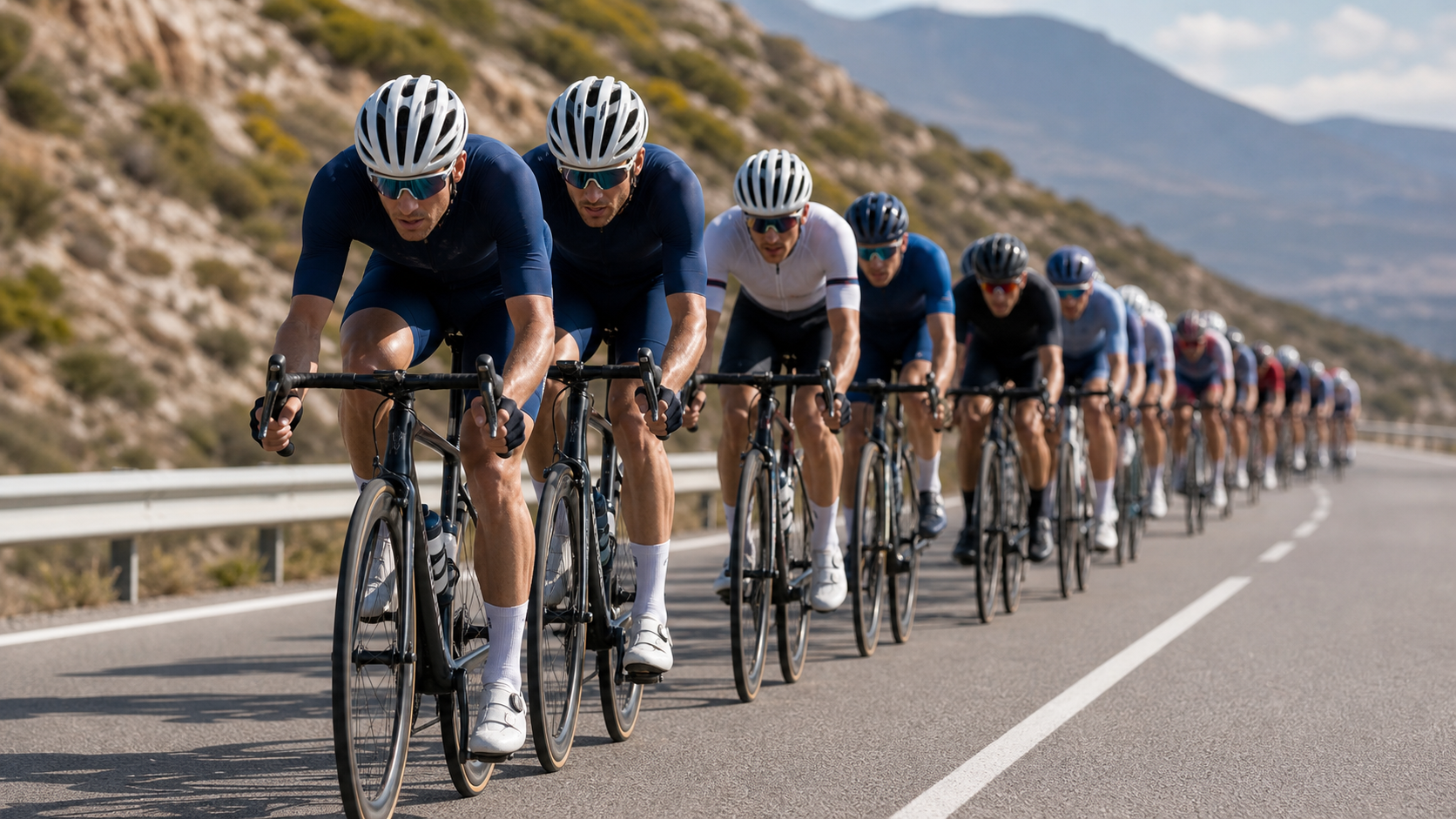
Viewers watching a professional cycling race for the first time are often puzzled by the riders’ behavior within the peloton: why do some riders work themselves to exhaustion at the front, only to let a teammate sprint for the finish? Why doesn’t the peloton simply chase down every breakaway together? In fact, professional cycling is a meticulously designed collective tactical game, in which every rider has a clearly defined role, and the strategy deployed over an entire season resembles a military operation. Understanding this tactical language is the first step to truly appreciating professional racing.
Classifying the Roles of Professional Riders
1. Domestique
The word “domestique” comes from French, meaning “servant.” The domestique is the core backbone of a team’s structure, typically making up 5–7 riders out of a team of about 9.
Main Responsibilities:
- Providing physical protection (a windbreak) for the team leader within the peloton
- Ferrying water bottles and food back from the team car to the leader
- Sacrificing their own wheel to the leader in the event of a puncture
- Driving the pace on key stages to sap the energy of rival teams’ domestiques
- Pacing the leader back to the group after a mechanical issue or crash
Subtypes:
| Domestique Type | Strength | Typical Task |
|---|---|---|
| Climbing Domestique | Strong climbing ability | Escorting the leader on mountain stages |
| Road Domestique | Strong power on flat terrain | Controlling the peloton’s pace on flat roads |
| Utility Player | Well-rounded in all areas | Support on any type of stage |
Notable Domestique: Chris Froome served as a domestique for Wiggins early in his time at Team Sky, before later becoming a team leader himself.
2. Sprinter
The sprinter is the “weapon” deployed in the final 300–500 meters of a flat stage, defined by the ability to produce maximum power output in an extremely short burst.
Physical Characteristics:
- Relatively powerful build (65–80 kg), with strong explosive muscle power
- Peak power output can reach 1,500–2,000 watts (5–8 times that of an average person)
- Sprint speeds of up to 70–80 km/h
Tactical Setup (The Lead-Out Sequence):
A sprinter needs the coordinated support of an entire “lead-out train”:
- 5 km to go: The whole team controls the front of the peloton to prevent other teams from cutting in
- 3 km to go: The first domestique begins driving the pace, shedding weaker riders
- 1.5 km to go: The second domestique takes over and accelerates further
- 1 km to go: The strongest domestique (the Lead-Out Man) sprints at full effort
- 300–500 m to go: The sprinter launches, receiving a final escort
- Final 200 m: The sprinter goes it alone at full effort, with the outcome decided by raw muscle power
Notable Sprinters: Marcel Kittel, Mark Cavendish (the most stage wins in Tour de France history, with 35 victories), André Greipel
3. All-Rounder / Puncheur
All-rounders are the protagonists of the three-week Grand Tours. They perform respectably on climbs, in time trials, and on flat roads, but usually excel particularly in one of these areas.
Sub-categories:
- Climber-All Rounder: Has the advantage on mountain stages, with mid-level time trial ability (e.g., Andy Schleck)
- TT-All Rounder: The time trial is the decisive weapon, with a more defensive approach in the mountains (e.g., Fabian Cancellara)
- Pure GC Rider: Balanced between climbing and time trialing (e.g., Tadej Pogačar, Jonas Vingegaard)
Evaluation Metrics:
- Power-to-weight ratio (W/kg): Elite climbing-oriented all-rounders typically have an FTP in the range of 6.0–6.5 W/kg
- Time trial power: Requires sustaining an even output above threshold for 40–60 minutes
4. Pure Climber
Riders who specialize in mountain climbing, typically with a lightweight build (55–62 kg). Their climbing ability is extreme, but their time trialing and flat-road performance tend to be weaker.
- Representative riders: Marco Pantani (a legendary pure climber), Nairo Quintana
- Strength: Sustaining extreme, continuous power output on very long climbs (20 km or more)
- Weakness: Time trial time gaps can reach 2–3 minutes, which must be made up substantially in the mountains
Tactical Games: The Art of Collective Decision-Making
The Tactical Calculus of the Breakaway
On every race day, riders in the peloton will attempt to break away:
- Conditions for a Successful Breakaway: The combination of riders in the breakaway must pose a low enough threat to the leader’s team, so that the leader’s team feels no need to chase
- The Golden Rule of Breakaway Composition: The riders are usually drawn from different teams and are behind on general classification, which is precisely why the leader’s team is willing to let them go
- Calculating the Time Gap: The leader’s team will wait until the breakaway’s gap becomes reasonable (usually no more than 3–5 minutes) before beginning to chase
Controlling the Peloton’s Pace
Controlling the pace of the peloton is the key to controlling the fate of the race:
- Slowing the pace: Allows the breakaway to gain a greater advantage (usually when a team wants to conserve energy)
- Accelerating in pursuit: Sprint teams’ domestiques clear obstacles for their own sprinter
- Driving the pace in the mountains: The leader’s team accelerates near the top of a climb to force rivals to fall behind
Practical Advice
For Taiwanese amateur cycling teams or club rides:
- Determine the goal of each ride: Are you practicing sprinting? Climbing? Or supporting a teammate?
- Learn the domestique mindset: Taking turns at the front of a group ride and sharing the burden of wind resistance is basic etiquette borrowed from professional teams
- Build a lead-out train: Try coordinating a sprint-support strategy among 2–3 riders in a club race
- Observe bottle hand-offs in professional races: Watching how domestiques pass water bottles while riding is the ultimate demonstration of everyday feeding technique
Conclusion
The tactical division of labor in professional cycling is one of the finest examples of human collective intelligence on display in an extreme sport. A domestique sacrifices their own result for a teammate; a sprinter can only pull ahead of the field with the escort of an entire lead-out train; an all-rounder meticulously manages their energy over three weeks of racing — these seemingly individual victories are, in fact, the crystallization of an entire team’s collective effort. Only once you understand this tactical language do you truly begin to “read” a professional cycling race.
Related Reading
- Tactical Analysis of Pro Team Leadership: How Domestiques and GC Riders Attack and Defend
- Role Division in Pro Teams: How Road Captains, Sprinters, Climbers, and Team Directors Serve One Rider
- A Complete Breakdown of Pro Cycling Team Tactics: Formations, the Draft Effect, and the Final Sprint Lead-Out
- How to Understand Road Cycling Race Broadcasts: A Beginner’s Guide
新屋團體繞圈賽 | 眾多菁英好手賽道奔馳 | 千瓦女子軍團 | 無敵交管狂獲好評 明年你一定不能錯過 | #公路車
5 年前
2024 春季KOM 賽事精華版 / 太魯閣 / 貓捉老鼠精彩追擊 / 錄影剪輯版 / 東進武嶺 / 公路車 (請開啟字幕)
2 年前
2025 海鷗團體繞圈賽 / 前八強賽事精華!/ 環台賽等級拍攝 / 國手菁英隊伍較勁 / CT Yeh #公路車
8 個月前
「悲情男車友」創作單曲 爆笑MV / 公路車 / CT Yeh / 4K劇情版
7 個月前
單車AI教練!全新 ChatGPT4o 幫你分析訓練成果!排武嶺課表,分析騎車姿勢! 太神了! / 公路車 / CT Yeh / feat. 緯緯
2 年前
公路車 | DanCup 繞圈賽 | 馮俊凱 151 林彥君 等大咖同場交流 | 卡丁車場也可以繞!| 4K超高畫質
5 年前
三鉄共購百人風中劍/ feat. 單車小D、Doris 、城希、Ruby、Ada/ 公路車 / CT Yeh
2 年前
JJSC南台灣單車走春三日行 DAY 1 / 強度 x 美食 x 節慶體驗 / 公路車 CT Yeh
5 個月前