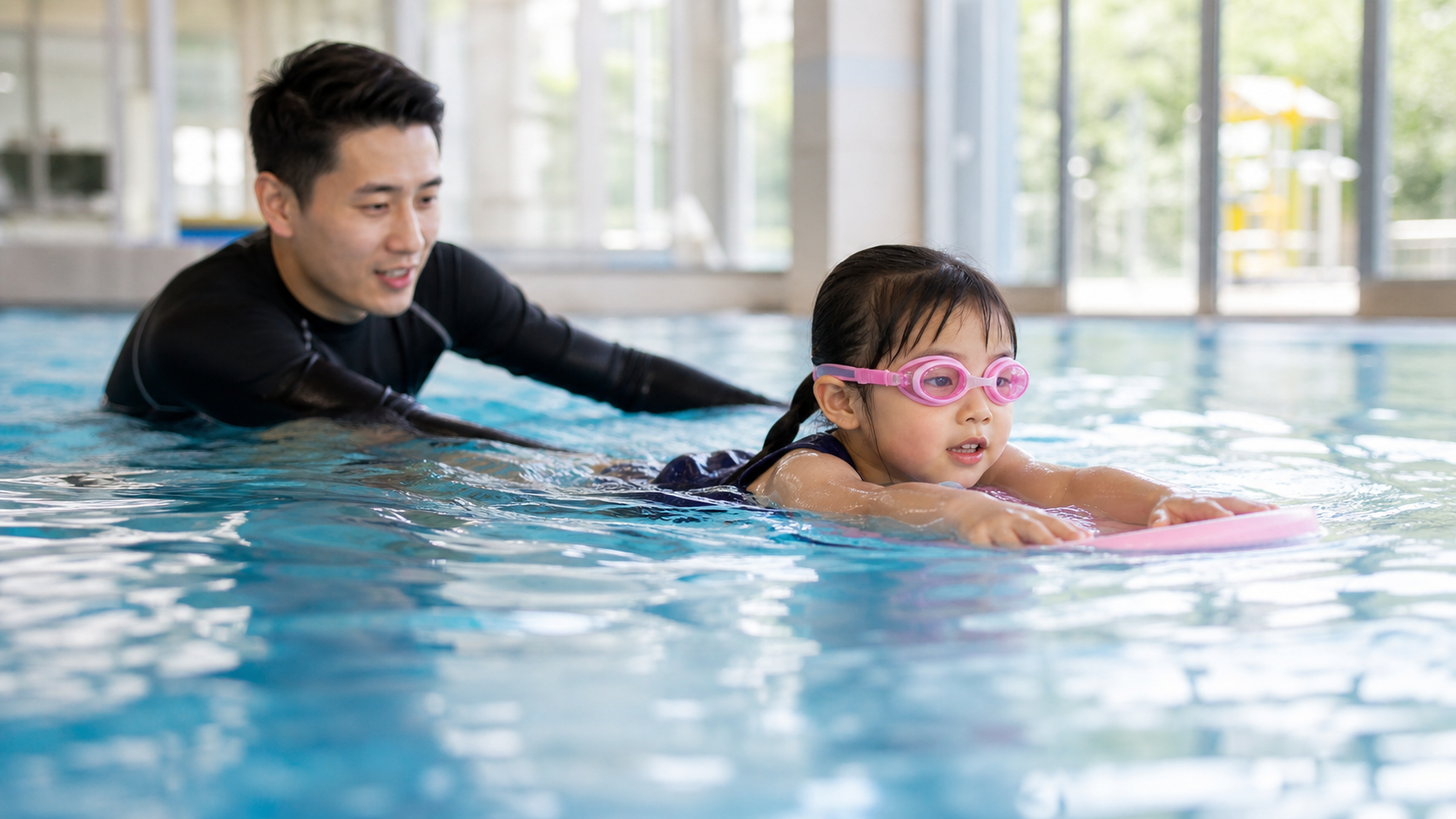
Introduction
Many parents in Taiwan face the same question: “What is the best age for my child to learn to swim?” The answer involves more than just safety considerations — it also touches on neurological development, windows for motor learning, and the cultivation of long-term athletic potential. This article combines sports science and child development research to explain the learning characteristics of each age group, and how to design the most suitable water experience for children at different stages.
Infancy (Ages 0–3): Water Comfort, Not Technical Learning
Infants are born with a “diving reflex” and a “swimming reflex.” In the first few months after birth, when they come into contact with water, they will automatically hold their breath and make paddling motions. These reflexes gradually fade after about 6 months, but parent-child swim classes can help infants and toddlers maintain a sense of closeness with water in a safe environment.
Goals for this stage:
- Build a positive emotional connection with water
- Develop basic water sense (buoyancy awareness, breathing rhythm)
- Strengthen parent-child interaction and trust
Note: This stage should not focus on technical learning — the priority is simply “not being afraid of water.” Many parent-child water programs in Taiwan (such as YMCA classes and parent-child classes offered at county and city swimming pools) are designed around this core principle.
Early Childhood (Ages 3–5): Before the Sensitive Period for Motor Coordination
Children aged 3–5 are in the preoperational stage, with strengthening imitation ability but still limited logical understanding and motor memory. This is the best time to learn the two core skills of “floating and breath exchange.”
| Developmental Indicator | Age 3 | Age 4 | Age 5 |
|---|---|---|---|
| Can exchange breath independently | Some | Most | Vast majority |
| Can perform a back float | Few | About half | Most |
| Understands coach’s instructions | Simple instructions | Moderate instructions | Complex instructions |
| Willingness to enter water independently | Low–Moderate | Moderate | Moderate–High |
At this stage, playful, game-based teaching is recommended, avoiding excessive emphasis on technical correctness, which can easily trigger a child’s resistance to learning.
Preschool Age (Ages 5–7): The Golden Window for Motor Learning
According to numerous studies on athletic development, ages 5–7 mark the peak of children’s sensitive period for motor skills. Neural myelination accelerates during this time, significantly improving the efficiency of motor learning. The movement patterns acquired during this period become the foundation for future competitive development.
Recommended skills to learn:
- Freestyle basics (arm pull combined with kicking)
- Introduction to backstroke basics
- Turning technique (wall-touch turns)
- Continuous swimming of 15 meters or more without stopping
Taiwan’s Sports Administration’s “Survey of Schoolchildren’s Swimming Ability” shows that children who can complete a continuous 15-meter swim before age 6 have a markedly higher rate of reaching regional competitive standards by age 12.
School Age (Ages 7–12): Building Technical Foundations and Introduction to Competition
After age 7, children enter the concrete operational stage, becoming able to understand a coach’s technical requirements and beginning to consciously correct their own movements. This is the best time for laying comprehensive technical foundations across all four strokes.
Recommended introduction ages for each stroke:
| Stroke | Recommended Introduction Age | Reason |
|---|---|---|
| Freestyle | 5–6 years | Intuitive movement, easy to pick up |
| Backstroke | 6–7 years | Natural breathing, relatively simple technique |
| Breaststroke | 7–8 years | Requires high coordination, needs more mature motor control |
| Butterfly | 8–10 years | High demand on core muscle groups; learning too early can easily injure the lower back |
Practical Recommendations
For Parents:
- Before age 3, prioritize “water familiarity” over “swim training,” and choose classes that include parent-child participation.
- Ages 5–7 are the best time to enroll in formal swim classes, as the nervous system can effectively retain movement patterns during this period.
- Avoid forcing children into technical requirements unsuited to their age just to rush progress.
- Look for coaches with a background in child development training, rather than those with only competitive swimming experience.
For Coaches:
- Design lessons that adjust instruction complexity and movement expectations according to age.
- For children under 6, focus mainly on water-sense games without demanding strict technical standards.
- After age 7, begin building correct movement memory, with gradual introduction of technical correction.
- Track each child’s individual developmental progress, avoiding the use of a single standard to measure children of different ages.
Conclusion
The “best time” for a child to learn to swim is not a single age, but a continuous process that follows the pattern of neurological development. From building water sense at age 0 to laying technical foundations after age 7, each stage has its own irreplaceable task. When parents and coaches understand this developmental logic, they can provide the right stimulation at the right time, helping children walk further and more steadily on their swimming journey.
Related Reading
- The Best Age for Children to Learn Swimming and How to Choose a Class: The State of Swim Education in Taiwan
- The Complete Guide to Children’s Swimming Milestones: Technical Development and Safety Instruction from Age 3 to 12
- The Complete Guide to Children Learning to Swim: Curricula for Ages 6, 8, and 12
- Children’s Swimming Development: The Golden Neurological Window and Training Design for Ages 6–12
滑雪新手們慘摔學習全紀錄(請開字幕),滑雪好好玩 | Snowboard + Ski | 岩原 スキー場 | 滑雪APP使用 | GoPro Max
6 年前
近視雷射三個月後悔嗎?單車族/工程師必看,Smart TransPRK 術後血淚史與後遺症全公開 / CT Yeh
4 個月前
#PUSHBIKE 原來這麼好玩! 小朋友 滑步車 初體驗 超可愛
6 年前
西進武嶺 免費訓練分析服務 Intervals | 練不夠還是練過頭?你哪一種類型選手?AI模型告訴你! | 備戰神器 | 公路車 訓練 | CT Yeh
4 年前
教學) 如何做出專業 慢動作 影片 Slow Motion 120fps GoPro 7 ActionCam AX700 A99II
7 年前
2023桃園團體繞圈賽 / 海鷗繞圈賽 | 全程空拍數據版 | 公路車 | CT Yeh
2 年前
一起升級!海鷗盃LSD團練...JJSC Zone2招待 騎到手抖 / 公路車 / CT Yeh
1 天前
CT 喇低賽) 武嶺牽車 才是王道 西進牽車四小時內秘訣 攝手位置 如何判斷 防抽筋小秘訣
7 年前