Training Volume for Adolescent Swimmers During Growth: Training Principles for Epiphyseal Plate Protection
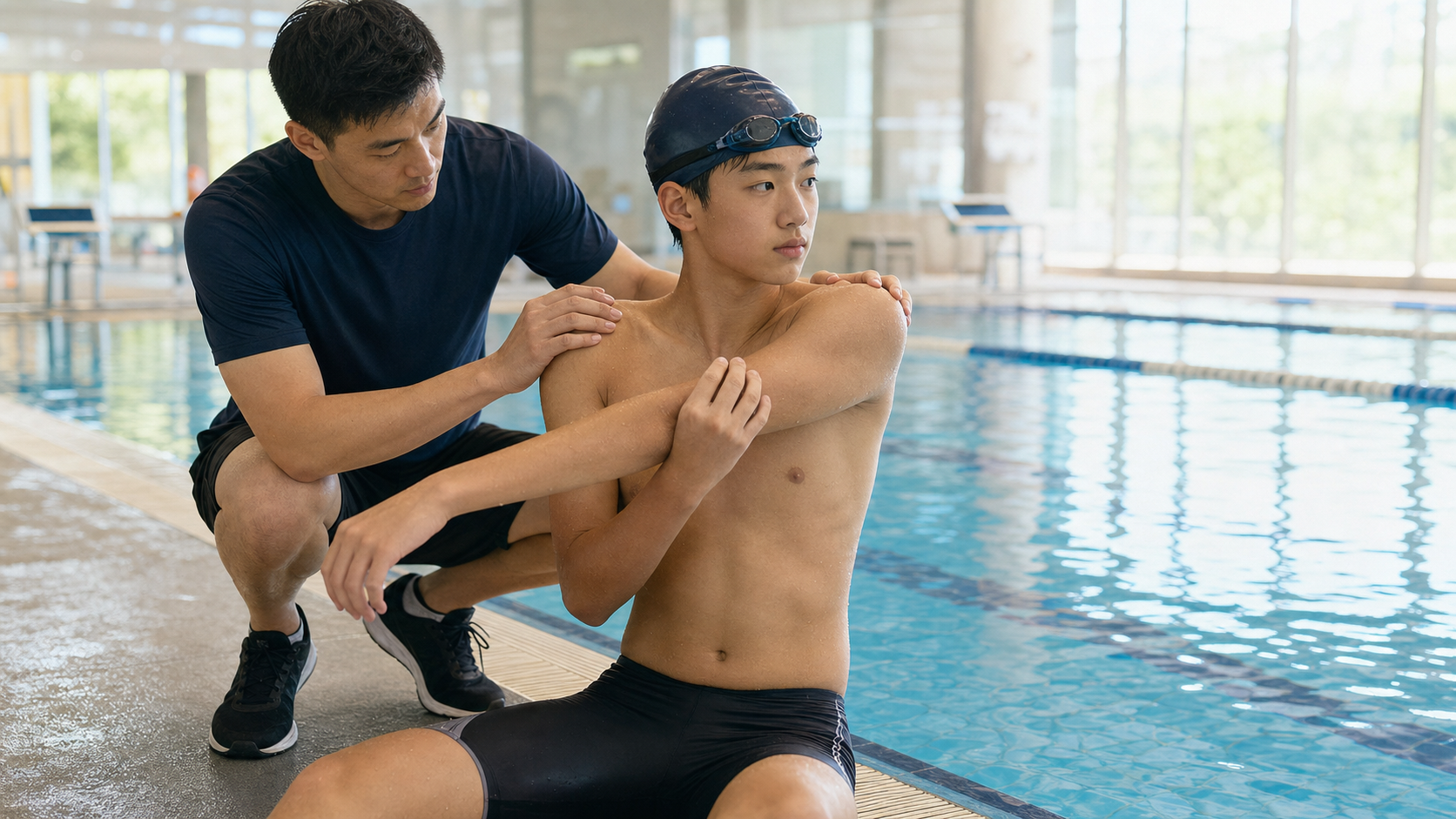
Introduction
Swimming is widely recognized as an aerobic sport that is relatively gentle on bones and joints, but “relatively gentle” does not mean risk-free. For adolescent athletes whose epiphyseal plates (commonly known as growth plates) have not yet closed, managing training volume is a critical discipline that balances both performance and health. This article focuses on the most overlooked bone-protection issue in adolescent swimming training.
What Is the Epiphyseal Plate and Why Does It Matter?
The epiphyseal plate is located at both ends of long bones and is composed of cartilage cells. It is the key region for longitudinal bone growth. Before the end of puberty (typically around ages 14–16 for girls and 16–18 for boys), the epiphyseal plate remains cartilage tissue, making it far more fragile than the surrounding bone.
If subjected to excessive repetitive stress during this stage, it may lead to:
- Growth plate stress fractures (Salter-Harris fractures)
- Epiphysitis (inflammation of the epiphyseal plate)
- If the injury is not treated promptly, it may affect normal bone growth
Although swimming is a non-weight-bearing sport, the high-frequency stroking and kicking movements can still cause cumulative damage to the growth plates in the shoulders, knees, and lumbar spine.
Recommended Training Volume Standards for Adolescent Swimmers
Both World Aquatics (formerly FINA) and the American Swimming Coaches Association (ASCA) provide age-group training volume guidelines for adolescents:
| Age Group | Recommended Weekly Swim Distance | Maximum Daily Training Hours | Maximum Annual Competitions |
|---|---|---|---|
| 10–11 years | 20,000–30,000 meters | 1.5 hours | 6–8 events |
| 12–13 years | 30,000–45,000 meters | 2 hours | 8–12 events |
| 14–15 years | 45,000–65,000 meters | 2.5 hours | 10–15 events |
| 16 years and above | Based on individual plan | Within 3 hours | Individualized |
The above figures are reference ranges and should be adjusted according to the athlete’s maturity, individual recovery capacity, and competition goals.
High-Risk Movements for Epiphyseal Plate Injury
Shoulders (Freestyle, Butterfly, Backstroke)
The 2,000–3,000 repeated strokes per training session are the primary source of cumulative stress on the shoulder growth plates. Athletes who perform large volumes of butterfly training before high school age have a particularly high incidence of shoulder epiphysitis.
Preventive measures:
- For swimmers aged 10–12, butterfly should not exceed 15% of each session
- Strengthen the rotator cuff muscles and scapular stabilizers through supplementary training
- Schedule a reduced-volume recovery week every 6–8 weeks
Knees (Breaststroke)
The breaststroke kick involves external rotation and repeated flexion-extension of the knee joint, placing repetitive traction on the growth plate at the tibial tubercle, which may trigger Osgood-Schlatter disease.
Preventive measures:
- Emphasize that the degree of knee external rotation should not be excessive during breaststroke technique training
- Do not mandate full breaststroke technique for swimmers under 10 years old
- If there is tenderness at the front of the knee, immediately reduce breaststroke training volume
Lumbar Spine (Butterfly)
The full-body undulation of butterfly involves repeated hyperextension of the lumbar spine, making it a high-risk movement for lumbar spondylolysis. Among adolescent swimmers in Taiwan with lumbar injuries, butterfly-related cases account for the highest proportion.
Practical Tools for Monitoring Training Volume
Coaches can monitor the training load of adolescent athletes through the following methods:
- RPE (Rating of Perceived Exertion) Logs: Have athletes rate their fatigue on a scale of 1–10 after each session. If the score exceeds 8 for three consecutive days, reduce volume immediately.
- Weekly Swim Distance Tracking Chart: Use a spreadsheet to record total weekly distance, avoiding weekly increases exceeding 10% over the previous week (the 10% rule).
- Periodic Height Measurements: During rapid growth phases (monthly height increase exceeding 1 cm), proactively reduce training intensity by 15–20%.
Practical Recommendations
Training design principles for coaches:
- Follow the “10% rule”—weekly training volume increases should not exceed 10% of the previous week.
- After every 3 weeks of training, schedule 1 easy recovery week (training volume reduced to 60–70%).
- During the peak height velocity (PHV) phase of adolescence, proactively reduce the proportion of technique-heavy butterfly and breaststroke.
- Incorporate dry-land supplementary training (resistance bands, core training) into the program to reduce the monotonous stress of pure swim distance.
Observation checklist for parents:
- Does your child experience joint pain after training (especially shoulders, knees, and lower back)?
- Does the pain completely subside after resting the following day?
- Is your child’s growth rate noticeably accelerating (entering PHV)?
If any abnormality is found in the first two points, inform the coach immediately and seek sports medicine evaluation.
Conclusion
Protecting the epiphyseal plate is the most overlooked yet most irreversible health issue in adolescent swimming training. In Taiwan’s age-group swimming culture, the myth that “more training is always better” still persists, but scientific evidence tells us that overtraining not only fails to accelerate progress—it may also leave athletes with structural damage that permanently limits their potential before their growth plates even close. Understanding the boundaries of training volume during the growth years is an essential lesson for every responsible adolescent swimming coach and parent.
Related Reading
- Growth Adaptation in Adolescent Swimming Training: Bone Age and Training Volume Adjustments
- Children’s Swimming Development and Prevention of Shoulder Overuse Injuries
- Adolescent Swimming Training: Training Volume Recommendations and Technical Development Priorities by Age Group
- Adolescent Running Training: The Scientific Basis for Growth Plate Protection and Weekly Mileage Limits
滑雪新手們慘摔學習全紀錄(請開字幕),滑雪好好玩 | Snowboard + Ski | 岩原 スキー場 | 滑雪APP使用 | GoPro Max
6 年前
一日北高常見問題大集合 | 攻略 | 路線 | 訓練 | 補給 | 自行車 單車 | 一日雙城 | 雙塔 | TWB北高360 | 屁股痛
6 年前
一日北高/長距離團騎 常見問題補充篇 / 組團或跟團的眉角 / 壯車友容易被瘦車友慢性拉爆 / 原來屁股痛可能是這個原因...? / 風場配速法 / 公路車 / CT Yeh
2 年前
[教學] Premiere 影片 手震 修正 教學 防抖 單眼 影像 GoPro 穩定 Video Stabilization
8 年前
Nepest NOVA 碳條輪組:輕量、空力、舒適一次滿足!/ 公路車 / CT Yeh
7 個月前
西進武嶺 免費訓練分析服務 Intervals | 練不夠還是練過頭?你哪一種類型選手?AI模型告訴你! | 備戰神器 | 公路車 訓練 | CT Yeh
4 年前
教學) 如何做出專業 慢動作 影片 Slow Motion 120fps GoPro 7 ActionCam AX700 A99II
7 年前
CT暗黑廚房) 車友必備 宇宙無敵鮮蚵湯 幫助訓練恢復 天然食補 好市多 超肥鮮蚵 破PR
7 年前