Introduction
“How many kilometers did you swim today?” is one of the most frequently heard questions in Taiwan’s swimming training circles. Swimming distance is often treated as a proxy for training effort, but for youth athletes, this mindset may be the biggest obstacle limiting progress. This article explains, from a sports science perspective, why “technical priority” is the core strategy for youth swimming training.
Why Do Youth Athletes Need a Technical-First Approach?
Adult elite athletes can tolerate large volumes of low-technical-quality “junk yardage” in training because their movement patterns are already automated and won’t degrade significantly under fatigue. However, youth athletes are still building their movement memory—if they repeatedly practice incorrect movements in a fatigued state, the nervous system will “imprint” those faulty patterns into long-term memory.
Key Principles of Neuromuscular Motor Learning:
- Motor automation requires correct repetitions, not just repetitions.
- The youth nervous system is highly plastic, but it also more readily solidifies bad habits.
- The difficulty of correcting technique rises exponentially after age 16—the later the correction, the higher the cost.
Quantity vs. Quality: Optimal Ratios for Different Training Goals
| Training Goal | Technical Training Ratio | Conditioning Training Ratio | Suitable Age |
|---|---|---|---|
| Technical Foundation Phase | 70% | 30% | 8–12 years |
| Balanced Technique + Conditioning | 50% | 50% | 12–14 years |
| Conditioning Emphasis Phase | 35% | 65% | 14–16 years |
| Competitive Peak Phase | 20% | 80% | 16 years and above |
Technical training includes: slow technique swimming, drill sets, kickboard-assisted work, and video analysis feedback.
Technical Quality Monitoring: The Coach’s Core Responsibility
Identifying the “Technical Breakdown Point”
Every athlete has a “technical breakdown point”—beyond a certain distance or intensity, movement quality begins to decline noticeably. Coaches should identify this threshold by observing the following indicators:
- Stroke count per length increases significantly (more than 15% above baseline)
- Body roll becomes excessive or disappears
- Kick rhythm becomes disordered
- Breathing side changes or breathing frequency becomes too high
Once an athlete reaches the technical breakdown point, continuing to swim has near-zero pedagogical benefit—it only accumulates erroneous motor memories.
The Power of Video Feedback
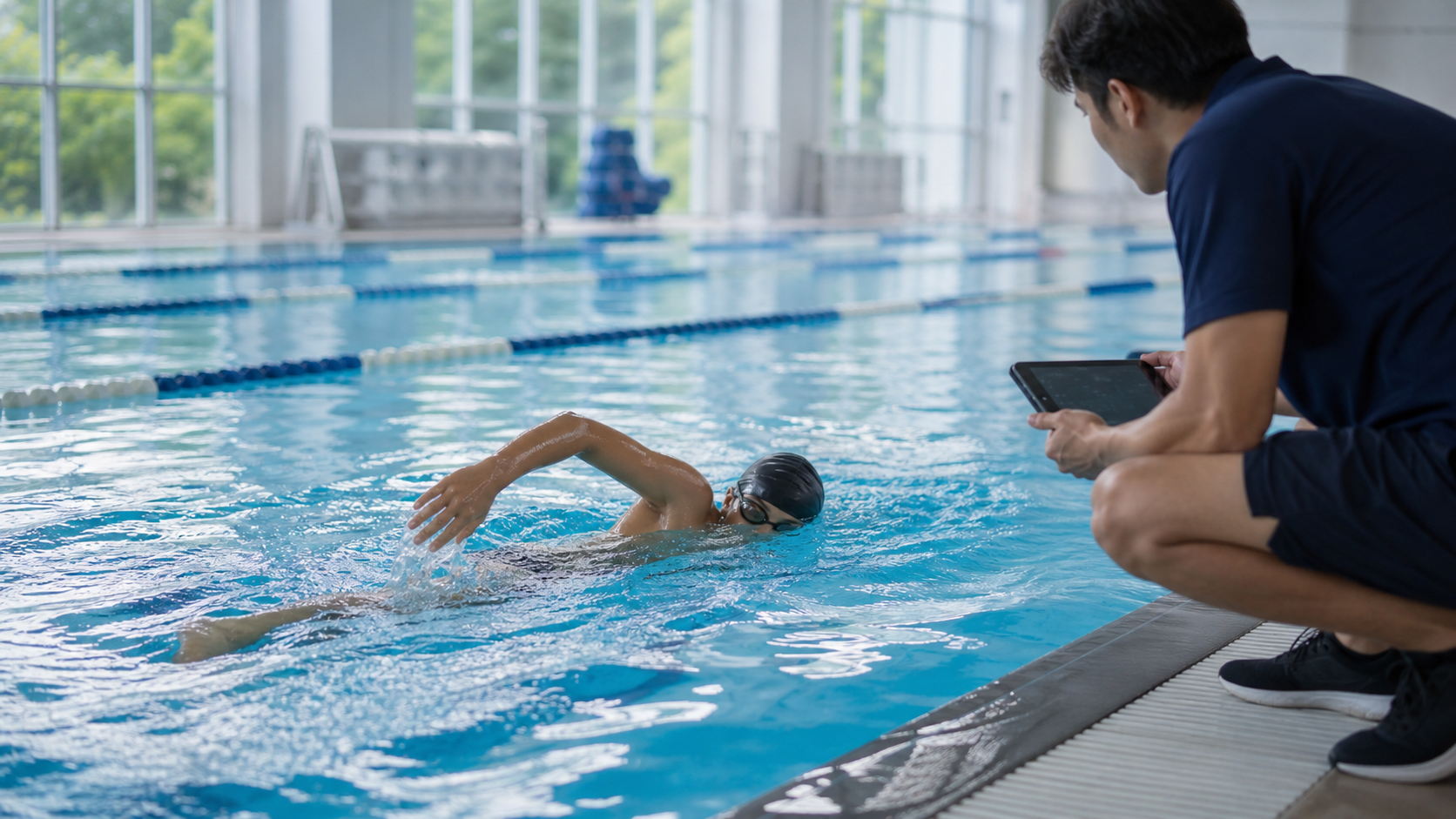
In Taiwan’s youth swimming training, regular video analysis is still not widespread. Research shows that training groups incorporating video feedback improved their technique 1.8 times faster than groups receiving verbal instruction only. It is recommended to record underwater and surface footage at least once per month, allowing athletes to visually see their own movement patterns.
Low-Cost Video Tools:
- Waterproof phone case + tripod (surface filming)
- Waterproof action camera (GoPro, etc.) with a homemade mounting rig (underwater filming)
- Existing poolside camera angles (footage can be requested from pool management)
Example of a Technical-First Training Plan
Using the weekly training plan of a 12-year-old freestyle swimmer as an example:
Monday (Technical Focus Day):
- Warm-up: 400m easy swimming (choice of stroke)
- Main set: 10 × 50m technique swimming (focusing on high-elbow catch position), 30-second rest interval
- Supplementary: 8 × 25m single-arm swimming
- Cool-down: 200m easy swimming
- Total distance: 1,550m, with emphasis on technical awareness for every repeat
Wednesday (Mixed Training Day):
- Warm-up: 600m medley swimming
- Technique set: 6 × 75m (25m technique + 50m normal swimming)
- Conditioning set: 4 × 200m (75% intensity)
- Cool-down: 300m
- Total distance: 3,000m
Friday (Conditioning-Led Day):
- Warm-up: 800m
- Main set: Continuous 2,000m swim (maintaining technical standards)
- Power: 6 × 25m sprints
- Cool-down: 400m
- Total distance: 3,600m
Practical Recommendations
For Athletes:
- Set a technical goal for each repeat before starting (e.g., “focus on body roll this repeat”), rather than just “finish the swim.”
- When you feel your technique falling apart during practice, actively slow down or pause—better to reduce distance than to accumulate bad habits.
- Build a communication habit with your coach for technical feedback, and proactively ask about your technical issues.
For Coaches:
- When designing workouts, clearly label which sets are “technical training” and which are “conditioning training” to ensure appropriate ratios.
- Establish technical evaluation criteria (e.g., scoring sheets for each stroke) and conduct regular technical assessments of athletes.
- When parents ask “how many kilometers did they swim today,” be able to explain the importance of technical quality.
Conclusion
In the long run, swimming performance improvement depends 70% on technical efficiency and 30% on conditioning foundation. This is especially true for youth athletes—their aerobic engine is relatively easy to develop through training, but once technical patterns become entrenched, they are extremely difficult to change. If coaches and athletes can establish the core belief of “technical priority” in the early years of training, laying a solid technical foundation for future high-intensity conditioning work, that is the shortest path to long-term competitive success.
Related Reading
- Youth Swimming Competition: The Impact of Team Training Volume on Academics and Balance Strategies
- Youth Swimming Training: Recommended Training Volumes by Age Group and Technical Development Priorities
- Swimming Technique Training Plan Design: Periodization of Technique Weeks vs. Distance Weeks
- Balancing Academics and Training for Swimmers: Practical Time Management Strategies
西進武嶺 免費訓練分析服務 Intervals | 練不夠還是練過頭?你哪一種類型選手?AI模型告訴你! | 備戰神器 | 公路車 訓練 | CT Yeh
4 年前
Live) 備戰2019彰化經典百K 賽前攻略 (已完賽請看新影片
7 年前
live) 超越北高 之一日北高12小時 策略
7 年前
FTL 與 SYB 車隊專訪 西進武嶺 實用攻略分享! 2小時 如何練?!你不知道的眉角!新手準備武嶺必看 EP1 | 實力派女車友 | 精華版 | 公路車 | CTYeh
4 年前
教學) 如何做出專業 慢動作 影片 Slow Motion 120fps GoPro 7 ActionCam AX700 A99II
7 年前
滑雪新手們慘摔學習全紀錄(請開字幕),滑雪好好玩 | Snowboard + Ski | 岩原 スキー場 | 滑雪APP使用 | GoPro Max
6 年前
CT Talk) 數據面窺看 武嶺大神們 平時的備戰 共通點 (娛樂性質XD)
7 年前
Nepest NOVA 碳條輪組:輕量、空力、舒適一次滿足!/ 公路車 / CT Yeh
7 個月前