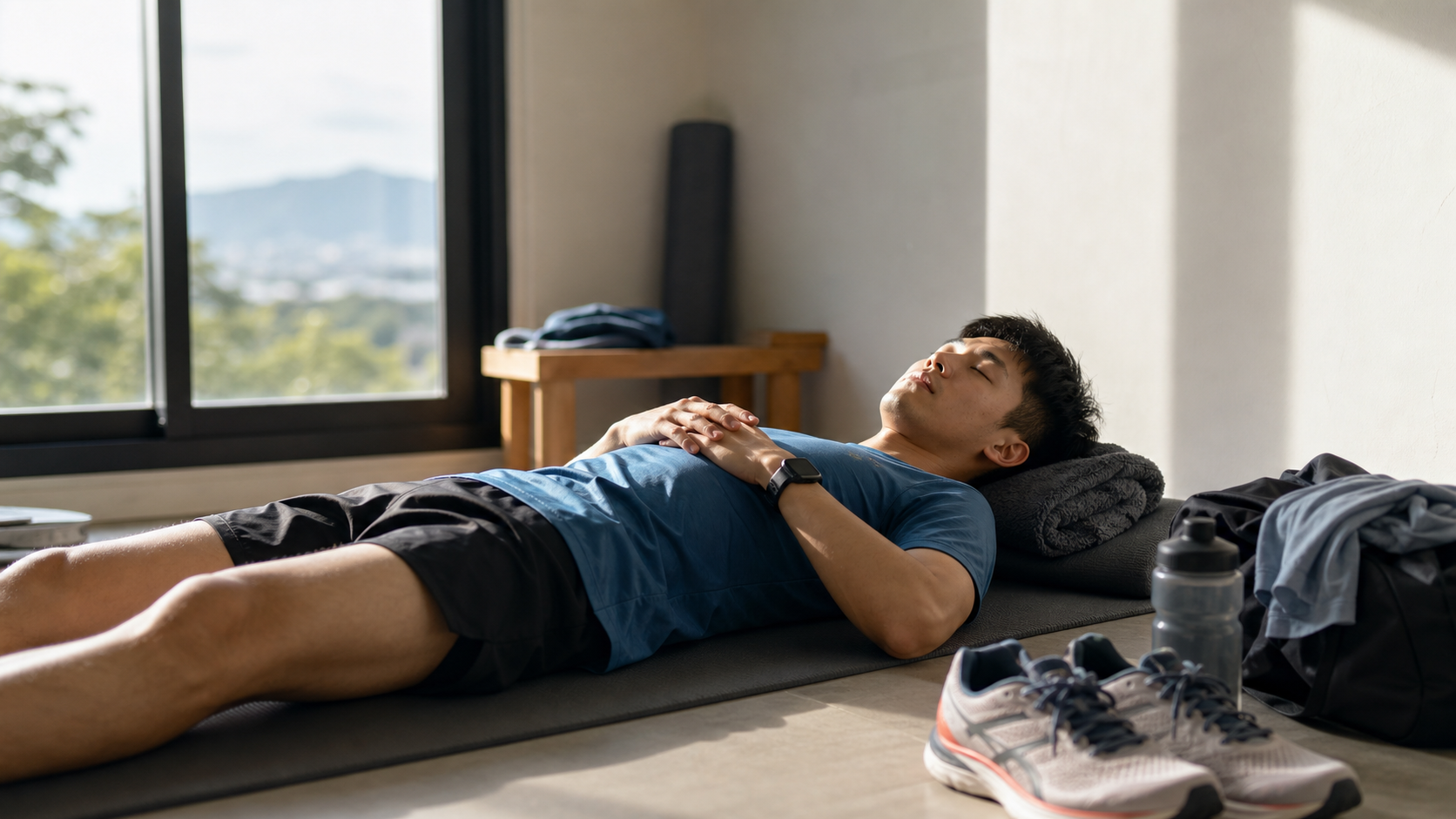
Introduction
In European professional football and cycling, napping is a standard component of training plans, with many world-class athletes even scheduling naps on race day. But for amateur runners in Taiwan, napping is often viewed as “lazy” or “impractical.” However, the accumulated scientific evidence clearly supports: an appropriate nap is a legitimate performance-enhancing tool.
This article analyzes the scientific mechanisms behind napping, provides napping strategies suited for runners, and explains how to avoid the “sleep inertia” problem associated with napping.
The Physiological Benefits of Napping
Napping offers runners a wide range of benefits:
Cognitive Function Recovery
After morning training or work, adenosine—a sleep-promoting substance—gradually accumulates in the brain, causing decreased attention and degraded decision-making ability. Even a 20-minute nap can significantly clear adenosine accumulation in the brain and restore cognitive clarity.
Research shows that alertness, reaction time, and working memory all improve significantly after a nap, with effects lasting 2–3 hours.
Neuromuscular Recovery
Sports scientists have found that napping promotes recovery of the neuromuscular system, which is especially important for runners doing two-a-day training sessions:
- A study from the University of Aix-Marseille in France showed that running speed in afternoon training was approximately 3% higher in the napping group compared to the non-napping group
- Napping can partially reverse the neural fatigue caused by morning training, bringing afternoon training quality close to morning session levels
Hormonal and Immune Repair
Even a short nap can:
- Lower blood cortisol levels (reducing catabolic stress)
- Promote immunoglobulin secretion, enhancing immune protection during periods of high training volume
- Help maintain the testosterone/cortisol ratio during high training loads
Optimal Timing and Duration for Naps
Best Time Window
The optimal time window for napping is between 1 PM and 3 PM, which aligns with the body’s “post-lunch dip”—a natural tendency of the circadian clock that is unrelated to the amount of food consumed at lunch.
Important: Napping after 3 PM can interfere with nighttime sleep, particularly the onset of slow-wave sleep, and should be avoided whenever possible.
The Science of Nap Duration
| Nap Duration | Sleep Stage | Effects | Side Effects |
|---|---|---|---|
| 10–20 minutes | N1/N2 light sleep only | Rapid alertness recovery, immediately ready to move | Almost no sleep inertia |
| 30 minutes | Entering N2 deeper sleep | Better mood and memory recovery | Mild sleep inertia (5–10 minutes) |
| 60 minutes | Partial N3 (deep sleep) | Significant cognitive and muscular recovery | Noticeable sleep inertia (15–20 minutes) |
| 90 minutes | Full sleep cycle (including REM) | Most complete recovery benefits | Minimal sleep inertia, but requires sufficient time |
Most recommended napping strategies for runners:
- Regular training days: 20–25 minute nap
- Two-a-day training days (morning and evening sessions): 30–40 minutes
- Recovery days during high-volume weeks: 60–90 minutes (if time permits)
- Afternoon before a major race: 20 minutes (to avoid affecting that night’s sleep)
How to Avoid Sleep Inertia
“Sleep inertia” is the brief grogginess experienced after waking from a nap, primarily occurring when forced awake from deep sleep. The following strategies can effectively prevent it:
The Coffee Nap (Nappuccino)
This interesting technique combines two effects:
- Quickly drink a cup of coffee (or espresso) 5 minutes before the nap
- Lie down immediately for a 20-minute nap
- Caffeine takes about 20–30 minutes to take effect, so by the time you wake up, the caffeine is just beginning to work
Research shows that the coffee nap method produces significantly better immediate alertness upon waking compared to napping alone or drinking coffee alone, making it especially suitable for runners who need to return to work mode immediately.
Environmental Setup
- Use a light-blocking eye mask and earplugs (or white noise) to create a dark, quiet environment
- Set a precise alarm; don’t rely on waking naturally (which easily leads to deep sleep and inertia)
- After waking, sit up first and remain on the couch for 1–2 minutes before standing, to avoid sudden orthostatic hypotension
Napping Recommendations for Different Types of Runners
Nine-to-Five Office Worker Runners
- Use lunch break to take a 15–20 minute nap in the office or in the car
- If office conditions don’t allow it, lean your head back against the chair and relax during the latter part of the lunch break—even without fully falling asleep, it still helps
Early Morning Training Runners (training between 5–7 AM)
- Most in need of a nap to supplement sleep: early morning training severely compresses total sleep hours, making naps a critical window for repaying sleep debt
- Recommended to schedule a 20–30 minute nap between 1–2 PM
High-Volume Runners During Race Preparation
- Napping between two-a-day sessions is especially critical: research shows that groups napping for 30 minutes between sessions had 4–6% higher pace retention in afternoon training compared to non-napping groups
Race Day Strategy
- If the race is in the afternoon (e.g., starting at 2–4 PM): take a 20-minute nap 2.5–3 hours before the start to enhance alertness during the race
- If the race is in the morning (standard marathons typically start at 6–7 AM): complete your nap before 2 PM the previous day
Practical Recommendations
- Establish a napping routine: fixed time, fixed location, fixed duration—this helps your body form a conditioned response, making it easier to fall asleep quickly
- Don’t nap immediately after a meal: the post-meal rise in blood sugar delays sleep onset; napping 20–30 minutes after eating works better
- Allow 1–2 weeks for adaptation: those new to napping may need a few days before they can fall asleep quickly in a short window—be persistent
- Track training performance: record whether you napped in your training log and observe how napping affects afternoon/next-day training performance
Conclusion
Napping is a severely underrated training aid. A strategic 20–30 minute nap can significantly enhance running performance, accelerate recovery, and improve cognitive function—at the cost of only a brief midday rest. In the busy urban life of Taiwan, this may be one of the most cost-effective performance-enhancing strategies available.
Related Reading
- Napping Strategies for Endurance Athletes: Science-Based Naps to Boost Cycling Performance
- Sleep and Run Recovery: The Scientific Impact of Sleep Quality on Repair
- The Sleep Science of Running: How Deep Sleep Accelerates Muscle Synthesis and Motor Memory Consolidation
- The Impact of Sleep on Running Performance: The Specific Athletic Consequences of Sleep Deprivation
西進武嶺 免費訓練分析服務 Intervals | 練不夠還是練過頭?你哪一種類型選手?AI模型告訴你! | 備戰神器 | 公路車 訓練 | CT Yeh
4 年前
CT暗黑廚房) 車友必備 宇宙無敵鮮蚵湯 幫助訓練恢復 天然食補 好市多 超肥鮮蚵 破PR
7 年前
Live) 備戰2019彰化經典百K 賽前攻略 (已完賽請看新影片
7 年前
[教學] Premiere 影片 手震 修正 教學 防抖 單眼 影像 GoPro 穩定 Video Stabilization
8 年前
FTL 與 SYB 車隊專訪 西進武嶺 實用攻略分享! 2小時 如何練?!你不知道的眉角!新手準備武嶺必看 EP1 | 實力派女車友 | 精華版 | 公路車 | CTYeh
4 年前
一個測試有沒有認真練車的方法😂 #公路車
10 個月前
一日北高前的高裝檢 | 北高 360 | 挑戰11小時的裝備 | 一日雙塔 | 補給
6 年前
大家都在開箱的...單車用藍芽對講耳機真的有幫助嗎? SENA BiKom 20 長距離旅遊 & 海鷗繞圈賽 實際體驗心得 / 公路車 / CT Yeh
9 個月前