Introduction
“A photo is an extension of memory, but a true ride photo isn’t just memory—it’s a poetic expression.” Every ride deserves to be well documented, but on social media, what actually separates those ride photos that make people stop and hit “like” from ordinary snapshots?
The answer isn’t in the equipment—it’s in the way your eyes see the world. This article starts from practical technique, sharing the core skills that elevate ride photos from “documentation” to “story.”
Three Perspectives in Cycling Photography
Perspective One: Tracking Shot
The shooting method that best conveys the sense of riding speed is the “tracking shot”—the photographer moves parallel to the rider at the same speed, blurring the background while keeping the subject sharp.
How to do it:
- Have a partner ride while you shoot from a bike or scooter moving alongside
- Set your phone to burst mode and take several shots while moving
- Set the camera shutter speed to 1/60–1/125 second—appropriate motion blur actually conveys speed better than a crisp, static image
Perspective Two: Environmental Portrait
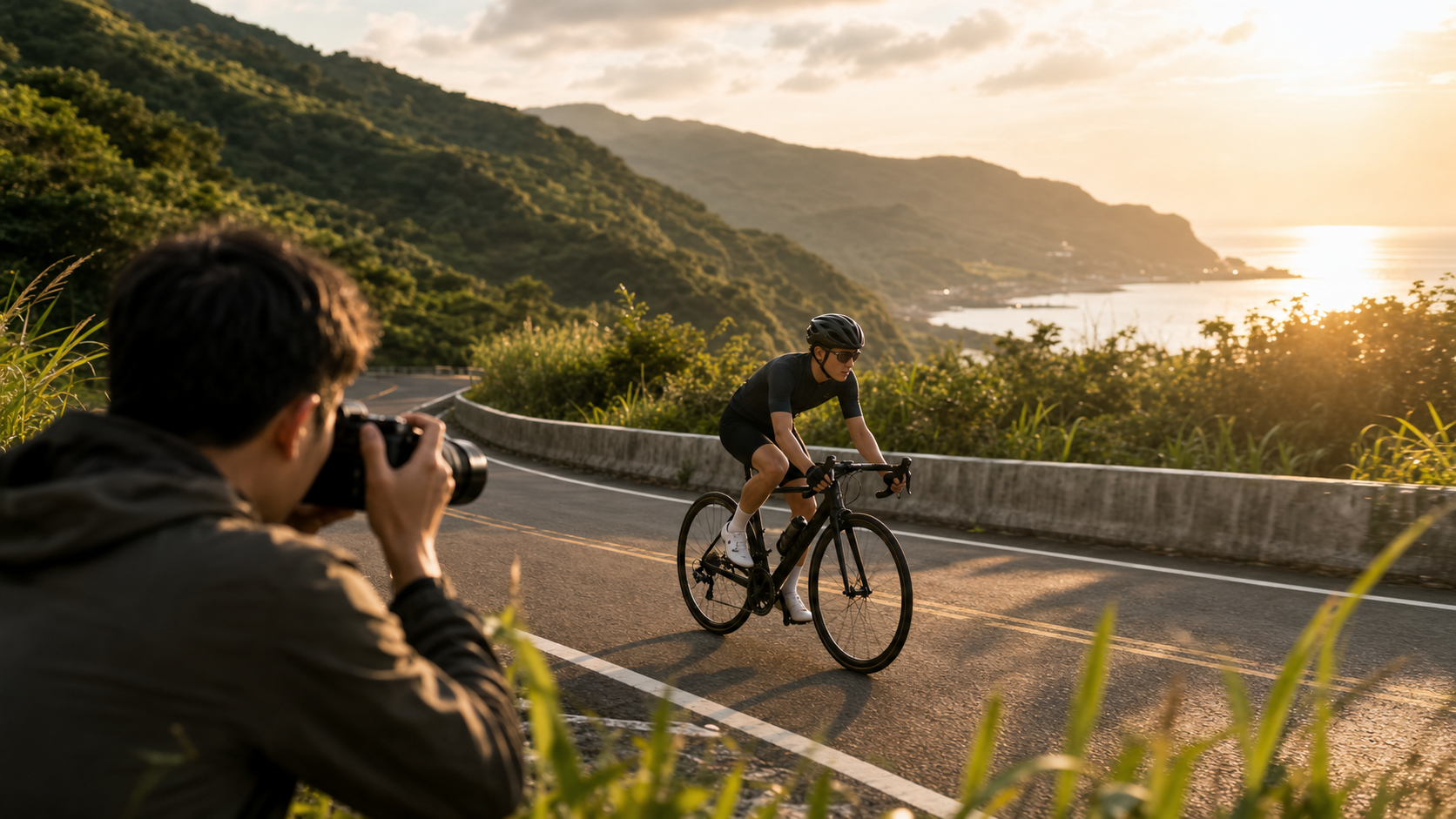
Placing the rider within a sweeping landscape to show “the relationship between person and environment.” This is the composition style best suited to Taiwan’s mountain and coastal backdrops.
Techniques:
- Keep the rider’s proportion of the frame under 30%, letting the environment tell the story
- Choose compositions with leading lines (roads, rivers, ridgelines) that draw the eye into the frame
- Golden hour light (1 hour after sunrise, 1 hour before sunset) gives mountain and ocean colors a saturated, warm quality
Perspective Three: Detail Shot
Sweat marks on the frame, worn brake levers, the reflection of sunset on the wheelset—these details often convey the authenticity of a ride better than a wide shot.
Techniques:
- Get close to the subject so the details fill the frame
- Use a wide aperture (or your phone’s portrait mode) to create shallow depth of field, blurring the background
- Photograph hands, shoes, or parts of the wheelset rather than the whole bike
Light: The Decisive Factor in Cycling Photography
| Time of day | Light characteristics | Suitable subjects | Recommended Taiwan locations |
|---|---|---|---|
| Pre-dawn (magic hour) | Cool blue light | Solitude, departure atmosphere | Wuling, Hehuanshan |
| 1 hour after sunrise | Golden side light | Warm riding imagery | East Coast Highway |
| Noon | Hard overhead light | Avoid portraits, suited to figureless vehicle stills | Urban road geometry |
| 1 hour before sunset | Orange-red warm tones | Long shadows, drama | West coast, riverside |
| Overcast | Even, diffused light | Detail and texture, no harsh shadows | Foggy mountain-road scenery |
Taiwan’s summer noon light is intense and harsh—it’s best to avoid shooting portraits or riding subjects around midday. Overcast light’s evenness is actually friendlier to beginners, since you don’t need to worry about strong shadows.
Applying Composition Rules
Rule of Thirds
Divide the frame into thirds (horizontally and vertically), placing the subject on an intersection point rather than dead center. Position the rider’s eyes or head on the upper third line, and the horizon on the lower third line.
Foreground Elements
Use foreground elements (roadside wildflowers, gravel, the side of the wheel) to create spatial layering in the frame, giving the photo a three-dimensional feel rather than a flat record.
Leading Lines
Taiwan’s winding mountain roads are already the best composition tool. Road lines extending from the foreground into the distance naturally lead the eye deeper into the frame, creating a sense of depth.
Advanced Smartphone Photography Techniques
You don’t need a professional camera:
- ProRAW/RAW format: iPhone and some Android phones support RAW format shooting, giving you more room for post-processing
- Long exposure (Live Photo): converting an iPhone’s Live Photo into a long-exposure effect can create motion blur in a stream or a spinning wheel
- Color correction: use Lightroom Mobile (the free version is sufficient) to adjust white balance for more consistent color tones
- Avoid excessive filters: over-processed HDR or oversaturated photos actually look amateurish in the cycling community—keeping it natural is a sign of photographic maturity
Practical Advice
How to carry your camera: on long rides, mount your phone on a stem-mounted phone holder so you can stop immediately when a good scene appears. It’s not recommended to take photos while riding—it’s unsafe and rarely produces good shots.
Etiquette around shooting permission: when photographing other riders, especially close-up portraits, ask beforehand and get their consent. Before posting photos to social media, confirm whether the other person is willing to be tagged or made public.
Build your own visual language: every photographer has their own visual preferences. Take time to find Taiwanese cycling photographers you like (there’s no shortage of quality creators on Instagram), analyze their composition habits and color choices, and internalize them into your own visual language.
Conclusion
Cycling photography isn’t documentation—it’s interpretation. The same mountain road, the same bicycle, seen through different eyes, can become a solitary epic journey, a testament to friendship, or an ode to nature. Learning photography isn’t just about making your photos look better—it’s training yourself to stay sensitive to beauty while riding. That sensitivity turns every ride into a richer journey of perception.
Related Reading
- Cycling Photography Technique: In-Ride Shooting Skills, Gear Selection, and Post-Processing Tips
- Photography Tips for Bike Touring: Documenting Your Riding Story
- Instagram Photography for Cyclists: Framing and Gear Techniques for Beautiful In-Ride Shots
- Getting Started with Cycling Photography: Composition Techniques for Documenting Scenery with Your Phone While Riding
CT 喇低賽) 單車 比賽總是沒照片? 攝影師的觀點大公開 姿勢就是力量! 請加速1.25倍收看
7 年前
多機位拍片神器 DJI Action 2 拍出速度張力感 | 類空拍機視角 4陣列麥克風超強降風噪 實測! | 公路車 | CT Yeh
3 年前
DJI Osmo Action 6 / 單車運動拍攝實用技巧 公路車 CT Yeh
7 個月前
Insta360 Ace Pro 2 適合單車拍攝嗎?/ 萊卡色彩直出有夠狂 / GoPro 13 & DJI OM 5 夜間對比 / 公路車 / CT Yeh
1 年前
[教學] Dashware 教學 如何製作有 速度 功率 心律的 騎車影片 Guages Video
8 年前
Insta360 X3 單車YT界的拍攝神器! 首發實測 | 超強AI後製! 超強夜拍實測! 帥氣騎車錄影自己來! | 公路車 |CT Yeh
3 年前
實錄) 車隊中 攝影師 是如何用感情拍片的呢? 單車 移動攝影 攝影師的視角 米粉坡 手持 DJI OSMO POCKET Ft. Team Neko
7 年前
iPhone 13 Pro 電影級 VLOG 實拍測試!優缺點 原理分析! 夜間效果對決 GoPro10!蘋果沒有說的超強錄影體驗!? | CT Yeh
4 年前