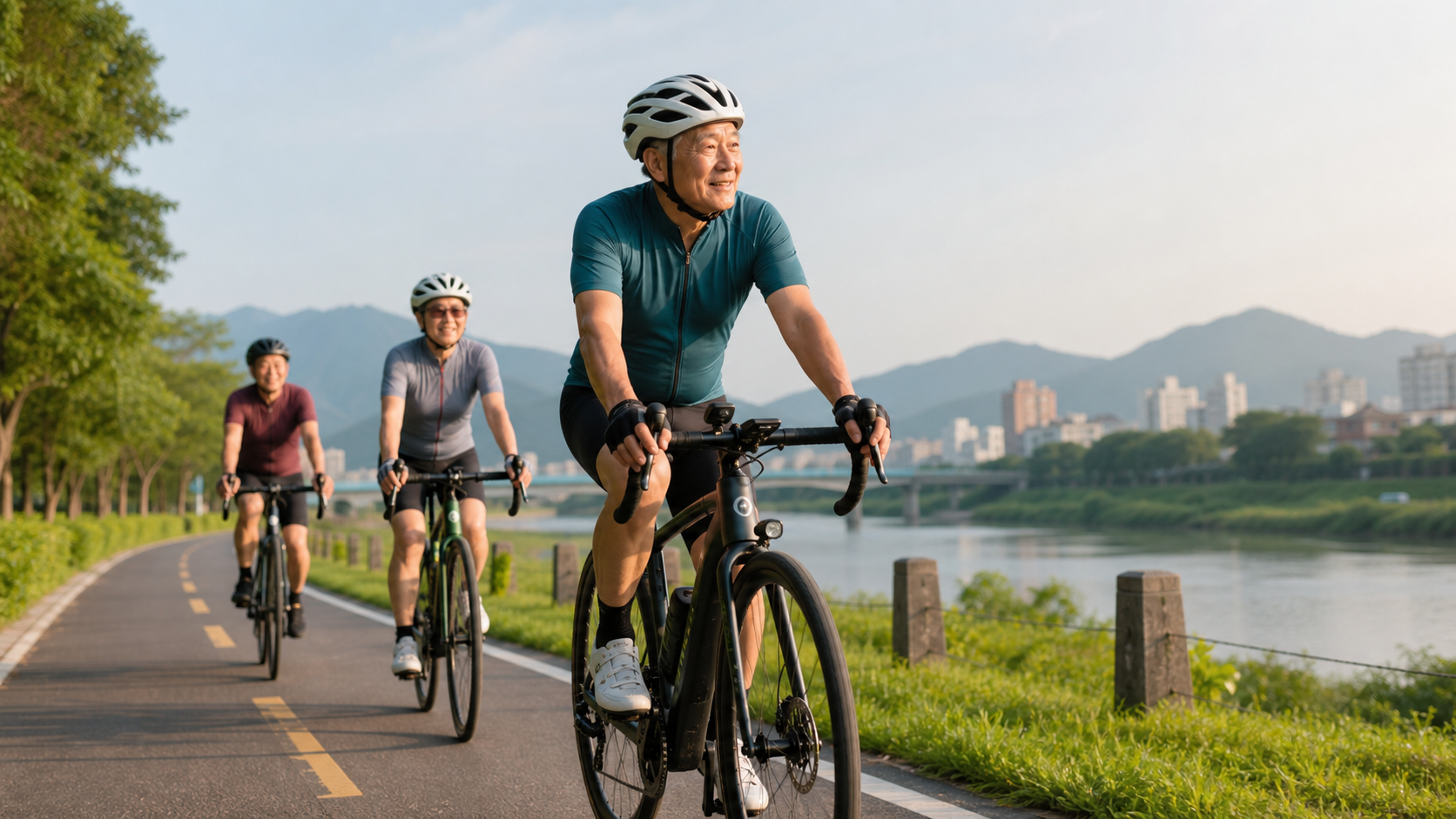
Introduction
There is a saying widely circulated in the cycling world: “Old riders never die, they just switch to a more comfortable bike.” Beneath the humor lies a real phenomenon: cycling is one of the few sports that can accompany a person throughout their entire life—from intense training in youth, to maintaining fitness in middle age, to low-impact aerobic activity in old age. Cycling has a suitable form at every stage of life.
Taiwan is rapidly entering an aging society, with the population over 50 continuing to grow. “How to maintain an active life in old age” has become an increasingly important concern for more and more people. This article focuses on riders over 50, providing a science-based, Taiwan-specific guide to staying active with cycling in later life.
Physical Changes After 50 and Coping Strategies
Understanding how your body changes is the first step to making the right adjustments to your riding:
| Physiological Changes | Impact | Cycling Coping Strategies |
|---|---|---|
| VO₂max declines by about 1% per year | Reduced maximum oxygen uptake, decline in high-intensity endurance | Increase low-intensity long-distance rides, reduce high-intensity intervals |
| Muscle loss (sarcopenia) | Decline in explosive power and support strength | Add resistance training; incorporate squats and other exercises beyond cycling |
| Decreased bone density | Increased risk of falls and fractures | Choose flat routes, avoid technically demanding descents |
| Reduced recovery capacity | Longer recovery time needed after the same training load | Reduce training frequency, increase rest days and sleep quality |
| Diminished thermoregulation | More prone to heatstroke or chills | Avoid midday heat in Taiwan’s summers, pay attention to layering in winter |
Smart Equipment Upgrades
After 50, the logic of equipment selection shifts from “maximizing performance” to “prioritizing comfort and safety”:
Bike Selection
- Electric-assist bikes (E-Bikes): More and more riders over 50 are choosing electric-assist, especially for routes with climbing. Electric assist is not “cheating”—it allows you to ride farther, more often, and for longer. Research shows that E-Bike riding can still achieve moderate-intensity cardiovascular training with real aerobic benefits.
- Comfort-geometry frames: Choose a taller head tube and shorter top tube to keep your upper body more upright, reducing strain on the cervical spine and lower back.
- Gravel bikes: Combining road speed with off-road comfort, wider tires absorb vibration, making them suitable for Taiwan’s varied road conditions.
The Importance of Accessories
- High-quality saddle: At this age, numbness or pain from an ill-fitting saddle is more noticeable. Investing in a saddle matched to your sit-bone width is well worth it.
- Vibration-damping handlebar tape: Adds cushioning to the handlebars, reducing hand numbness after long rides.
- Larger pedals: A bigger contact area distributes pressure on the ankles and knees more evenly.
Adjusting Training Principles
The training mindset after 50 should undergo a fundamental shift:
From “how hard can I train” to “how long can I keep going”
- Riding 3–4 times a week for 1–2 hours each session offers greater health benefits than two high-intensity sessions per week.
- Keep your heart rate at 60–75% of maximum heart rate (easy to moderate intensity)—this zone provides the most sustainable aerobic benefits.
- Reserve 1–2 longer rides (3–4 hours) per month to maintain your base aerobic capacity.
Supplement with non-cycling training
Cycling alone has its limitations. After 50, it is recommended to add:
- Strength training twice a week (squats, deadlifts, and other lower-body exercises) to prevent sarcopenia.
- Yoga or stretching: maintain hip flexibility and prevent lower back pain (a cyclist’s nemesis).
- Swimming: low-impact full-body aerobic exercise that adds variety beyond cycling.
The Importance of Community
After 50, the health benefits of social connection through cycling may be no less significant than the physical training itself. Research shows that older adults with rich social engagement experience significantly slower cognitive decline. Cycling communities provide:
- Regular social interaction (weekend group rides are a consistent source of human connection).
- Positive peer pressure (when someone is waiting for you to ride, you are less likely to give up).
- Cross-generational connections (many cycling communities have diverse age ranges, and 50+ riders often become mentors to newcomers).
Across Taiwan, there are dedicated cycling communities for middle-aged and older riders, and many local bike shops organize rides suitable for all levels. It is worth actively seeking them out and joining.
Practical Advice
Regular health check-ups: If you are starting or resuming cycling after 50, it is recommended to first undergo a cardiac function assessment (ECG, stress test), especially for those who have been sedentary for a long time. Taiwan’s National Health Insurance provides adult preventive health services—make good use of them.
Don’t compare yourself to your younger self: Comparing your climbing speed at 50 to yourself at 30 is a comparison destined for frustration. More meaningful metrics are: How many times did you ride this week? How did you feel after today’s ride? When will you ride next?
Track health indicators: Use a smartwatch to monitor resting heart rate, heart rate variability (HRV), and other data. This allows you to objectively assess whether your training load is appropriate and adjust in time to avoid overtraining.
Conclusion
Cycling is a sport that can truly accompany you into old age. When many high-impact sports become difficult or even impossible with age, cycling—with its low-impact nature—remains accessible to riders in their 80s. More and more older adults in Taiwan are using cycling to maintain an active body and mind. They are not fighting aging; they are using cycling to write a dignified, vibrant second half of life. Choose a bike that suits the person you are today, and set out today.
Related Reading
- Health Guidelines for Senior Cyclists: A Complete Guide to Safe Training After 50
- Training Adaptation for Senior Riders: How to Maintain and Improve Riding Ability After 50
- Special Considerations for Middle-Aged and Older Cyclists: Training Adjustments and Health Maintenance After 50
- Cycling Retirement Life: How Seniors Use Cycling to Maintain an Active Quality of Life
靠單車減肥35公斤 心得分享與整理
7 年前
2025 自行車錶排行榜 兩萬車友大數據 / Garmin Bryton 排名會大洗牌嗎? / 全新的碼表前身分析 /公路車 / CT Yeh
1 年前
#公路車 #Fitting 靠人工智慧APP 幫你調整單車
6 年前
高雄綠園道鐵路自行車道 / 外地人能輕鬆駕馭 還是整路崩潰? / 2025 全線開通 春節實地探索一次!(附GPS連結)/ 公路車 / CT Yeh
1 年前
單車 一日北高 ( 雙城 ) 肥宅雙人瘋狂行 紀錄片 REACTO
10 年前
太平山單車員工旅遊 | 這樣玩CP值最高!| 公路車
5 年前
2026 車錶排行榜!誰是最多車友正在使用?練家子最愛哪款?🏆 (2萬名車友數據) / 公路車 / CT Yeh
5 個月前
再一組! 全碳幅條 碟煞/無內胎輪組 開箱! 到底好騎嗎? UNAAS X40 | 公路車 | CT Yeh
4 年前