Introduction
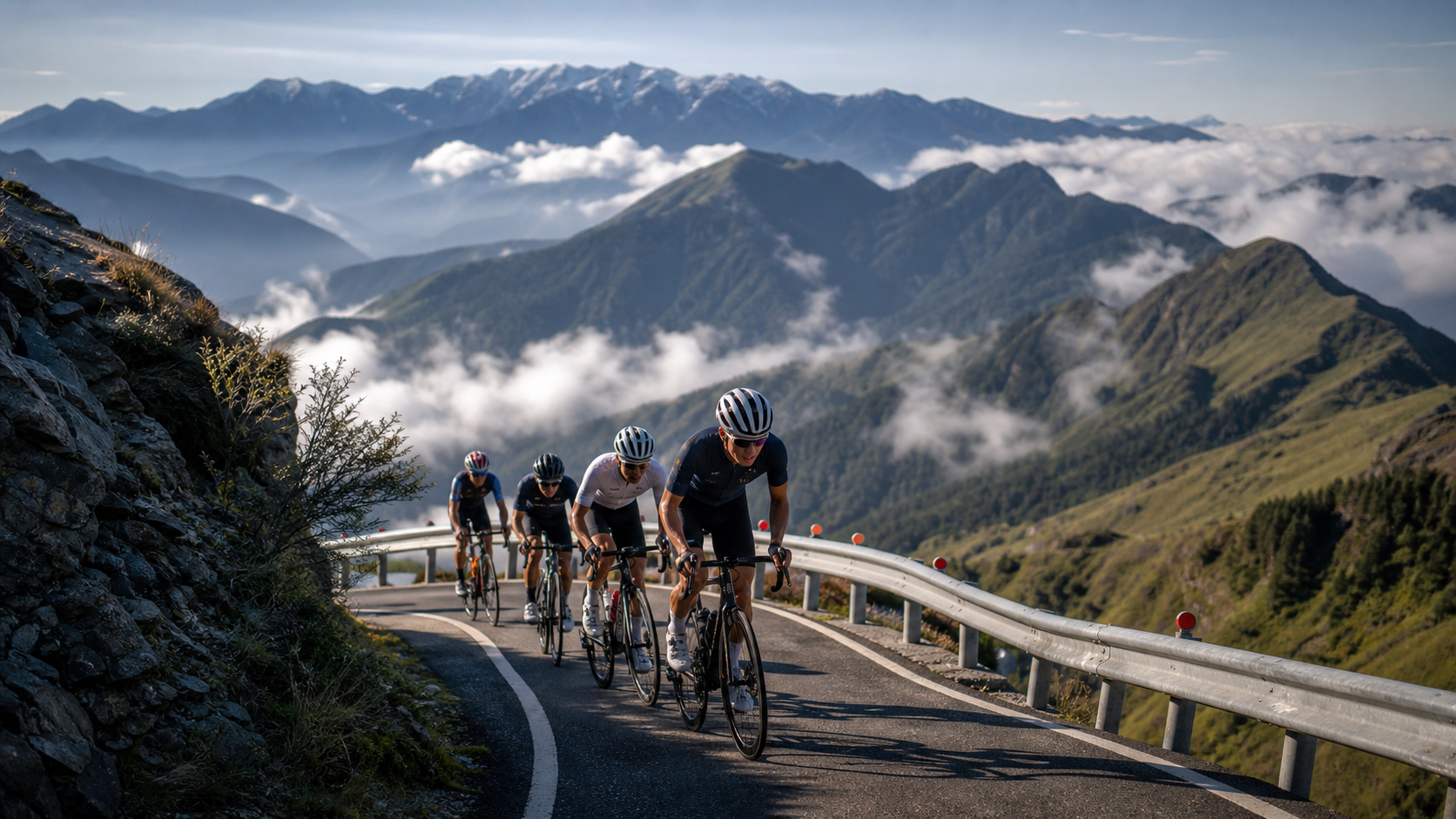
In the cycling landscape of Asia, Taiwan holds a unique position—it is both a global hub for bicycle manufacturing and one of Asia’s most iconic cycling challenge destinations. Among its highlights, the Taiwan KOM Challenge and Tour de Taiwan stand out as the two most prominent international calling cards, attracting professional riders and amateur enthusiasts from around the world.
Taiwan KOM Challenge: Asia’s Toughest Climbing Race
Race Overview
The Taiwan KOM Challenge is a climbing time trial centered on “reaching the summit of Wuling.” The route starts at the entrance of the Hehuan Mountain Tunnel at approximately 700 meters above sea level and climbs to Wuling at 3,275 meters, covering roughly 105 kilometers with an elevation gain of about 2,600 meters.
| Data | Specification |
|---|---|
| Start | Dayuling (entrance section at approx. 2,565m elevation) |
| Finish | Wuling (3,275 meters elevation) |
| Total Elevation Gain | Approx. 2,700–3,000 meters (depending on route calculation) |
| Difficulty | Asia’s highest-finish road time trial |
| Finish Time (Pro Level) | Approx. 3.5–4 hours |
International Standing
Taiwan KOM holds a special position among global climbing races:
- Asia’s highest-finish road time trial: The 3,275-meter finish line is the highest among major climbing races in Asia
- UCI-recognized event: Attracts international professional riders and carries official ranking points
- Taiwan’s tourism showcase: Live race broadcasts introduce the magnificent scenery of Taiwan’s Central Mountain Range to cycling fans worldwide
Race Culture and Appeal
Each autumn, the KOM Challenge draws professional and amateur riders from Europe, Japan, Australia, and beyond. The amateur category is extremely demanding, and finishers generally regard it as a major personal achievement. Local Taiwanese cyclists also view “conquering Wuling” as a pilgrimage for every cyclist.
Tour de Taiwan: Taiwan’s UCI ProSeries Event
Race History
Tour de Taiwan was founded in 2006, initially as a UCI 2.2 event. After years of upgrades, it has now become a UCI ProSeries race—the second-highest tier after the WorldTour—demonstrating that Taiwan has reached the top level in Asia in professional cycling event organization.
Race Features
| Feature | Description |
|---|---|
| Race Level | UCI ProSeries |
| Duration | Approx. 5–7 days |
| Route Highlights | Covers Taiwan’s western plains, central mountains, and eastern coastline |
| Climbing Challenges | Includes high-difficulty climbing stages such as Wuling and Hehuan Mountain |
| Participating Teams | Primarily Asian teams, with invited WorldTeam squads |
International Riders’ Feedback
European and American professional riders who have competed in past editions generally give Tour de Taiwan high praise:
- Taiwan’s passionate spectators: Enthusiastic roadside cheering provides riders with a mental boost
- Route diversity: A week combining flat sprints, mountain climbs, and time trials tests all-around ability
- Organizational standards: Event organization improves year after year, with support and traffic control meeting international standards
Comparison with Other Major Asian Cycling Races
| Race | Country | Level | Highlights |
|---|---|---|---|
| Tour of Japan | Japan | UCI ProSeries | Lasts up to 8 days, combining city time trials and mountain stages |
| Tour de Langkawi | Malaysia | UCI ProSeries | Tropical climate, primarily flat sprint stages |
| Tour of Hainan | China | UCI 2.1 | China’s highest-level stage race |
| Tour of Korea | South Korea | UCI 2.Pro | South Korea’s domestic race |
| Taiwan KOM Challenge | Taiwan | UCI 1.1 | The world’s highest-finish climbing race |
Challenges and Opportunities for Taiwan’s Cycling Events
Challenges
- Limited appeal to WorldTeams: Asian races carry relatively lower ranking points, resulting in low attendance from top WorldTeams
- Brand awareness needs improvement: Coverage of Asian races in mainstream Western media is far lower than that of Europe’s three Grand Tours
- Weather constraints: Taiwan’s summer heat and typhoon season affect race planning
Opportunities
- Cycling tourism potential: Events can attract international riders and enthusiasts to Taiwan for cycling tourism
- Industry connections: The global influence of Giant and Merida can bring more international team support to Taiwan’s races
- KOM’s uniqueness: Wuling’s natural challenge is an unrivaled competitive advantage worldwide
Practical Advice
For riders who want to experience Taiwan’s events firsthand:
- KOM Challenge registration: Registration typically opens between August and October each year; applications must be submitted months in advance, and slots are limited
- Wuling training tips: Aim for a monthly riding volume of 1,500 kilometers or more, and dedicated climbing training is essential
- Watching Tour de Taiwan: Once the race schedule is announced, all route sections are free to spectate, with the Hehuan Mountain section being the most recommended viewing spot
Conclusion
Taiwan KOM and Tour de Taiwan are the two most important calling cards for Taiwan on the international cycling stage. The former stuns riders worldwide with its pure natural challenge, while the latter showcases Taiwan’s organizational capabilities on a professional racing platform. Together, they build the international image of Taiwan’s cycling culture and stand as local assets that every Taiwanese cyclist can be proud of.
Related Reading
台灣登山王之路 KOM 全程參賽4K臨空錄影 PART1 穿越峽谷地形! #東進武嶺 太魯閣 / 燕子口 / 天祥 / 西寶 PART1 (公路車 / CT Yeh)
3 年前
2019 夏季KOM 5小 完賽心得 準備攻略 東進武嶺 夏季登山王之路 Taiwan KOM Challenge
7 年前
2023 夏季KOM 參賽實況 / 穿越空拍視角 / 整車都凸台 / 太魯閣峽谷x合歡山絕美大景 / 東進武嶺 / Taiwan KOM Challenge / 公路車 / CT Yeh
3 年前
大禹嶺 到 武嶺牌樓 全程前後實況錄影 | 北進武嶺 | 東進武嶺 | KOM | 訓練台 | 坡度分析 | Taiwan KOM Last 10 km HARD | 公路車
6 年前
一日KOM直播攝影師 / 東進武嶺Live有多困難? / 2023 台灣登山王挑戰 / Taiwan KOM Challenge / 公路車 / CT Yeh
2 年前
#東進武嶺 全程實況錄影 5小時半 #夏季KOM #太魯閣 Taiwan KOM Challenge Reality Video Taroko scenery
7 年前
2023 台灣KOM自行車登山王挑戰 (AI修復版) / Taiwan KOM Challenge / Live 實況直播 / 班傑明刷破大會成績全記錄
2 年前
2025 乘鞍 KOM 登山賽挑戰實錄 / 日本公路最高 ! 賽前探路篇 / 比富士山厲害,無敵絕景!/ 40週年 / 中文YT首發 / 公路車 / CT Yeh #乘鞍ヒルクライム
10 個月前