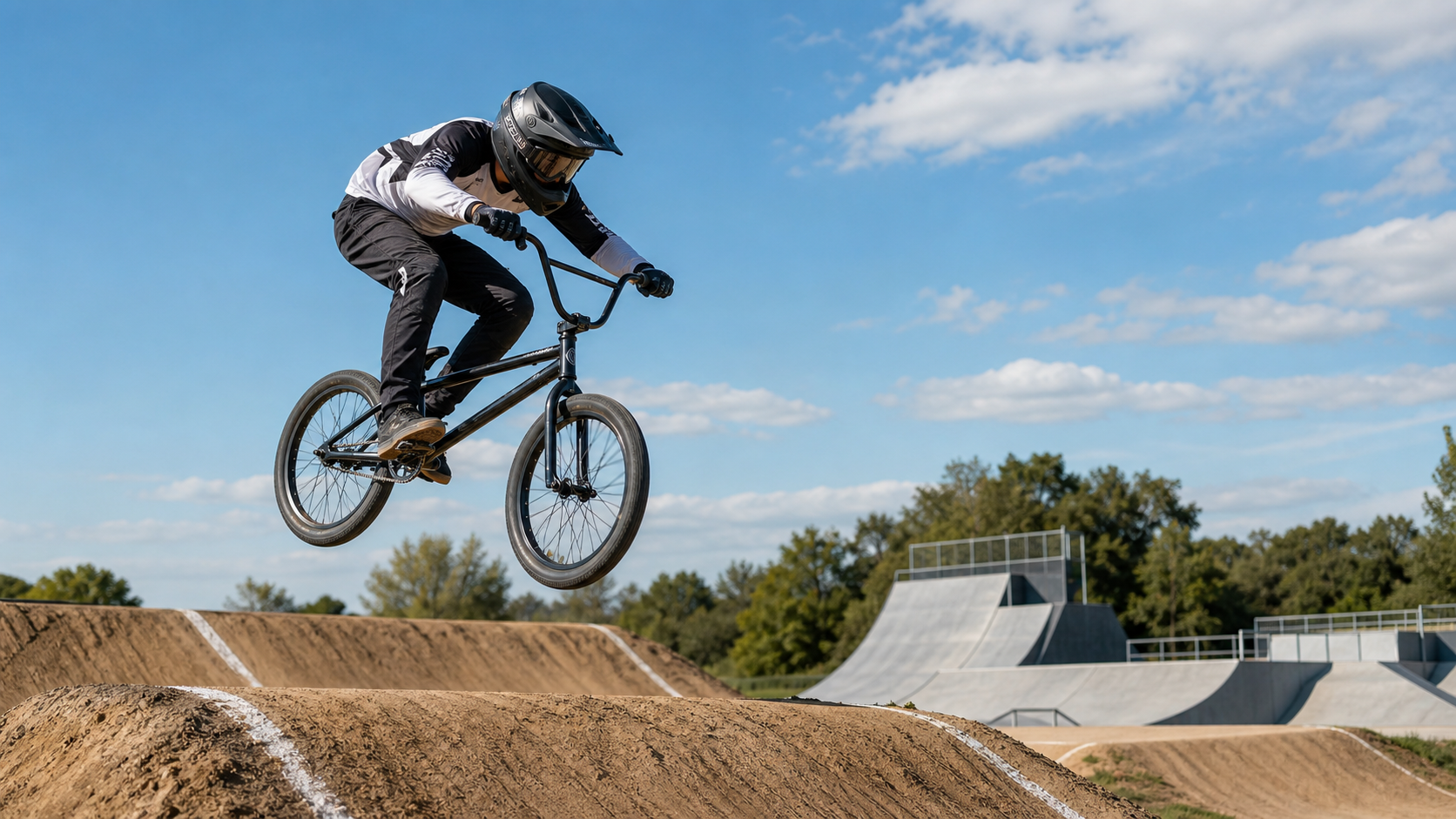
Introduction
BMX (Bicycle Motocross) originated in the street culture of California, USA, in the 1970s. A group of young people mimicking motorcycle motocross riders flew over dirt slopes on small bicycles, creating this dynamic sport. Half a century later, BMX has not only become a symbol of global youth street culture but also officially entered the Olympic arena at the 2008 Beijing Olympics with the BMX Racing event. The 2020 Tokyo Olympics added the BMX Freestyle event, completing its full transformation from the streets to the Olympics.
The Two Major BMX Disciplines
BMX Racing (High-Speed Competition)
BMX Racing is a track race that involves a high-speed descent from a starting ramp, passing through multiple jumps and banked turns:
Track Specifications:
- Start: A wooden starting ramp 6–8 meters high
- Total length: 350–400 meters
- Obstacles: Berms, Doubles, and tabletops
- Race time: Approximately 40–60 seconds per lap
Race Format:
- Qualifying: Timed runs to determine groups
- Quarterfinals: 8 riders race; top finishers advance
- Semifinals → Finals: Final 8-rider race; top 3 receive medals
Key Technical Requirements:
| Technique | Description |
|---|---|
| Gate Start | Achieve maximum acceleration within 0.5 seconds after the gate drops |
| Pumping | Use terrain undulations, absorbing and releasing energy through body movements |
| Cornering | Maintain an outside line through high-speed turns to preserve speed |
| Jump Judgment | Decide whether “Manualing through the jump” or “Jumping” is faster |
BMX Freestyle (Freestyle Tricks)
BMX Freestyle made its Olympic debut at the 2020 Tokyo Olympics, held in a park course filled with various obstacles:
Competition Format:
- Riders perform freely for 60 seconds
- Scored by 5 judges on a 0–10 scale; the highest and lowest scores are dropped and the rest averaged
- Two runs are performed; the highest score counts toward the final result
Scoring Dimensions:
- Difficulty: Assessment of the physical difficulty of the tricks
- Execution: The cleanliness and fluidity of the tricks
- Originality: The uniqueness of the rider’s personal style
- Run Flow: The line planning and coherence of the entire 60-second run
Physical Training Demands of Competitive BMX
BMX Racing Training Focus
| Training Type | Purpose |
|---|---|
| Explosive Power | Maximum power output during the starting acceleration |
| Coordination and Reaction Training | Quickly read terrain and adjust movements in real time |
| Riding Position Stability | Maintaining an optimal aerodynamic position at high speed over rough terrain |
| Strength Training | Squats and deadlifts to strengthen lower-body pushing power |
BMX Freestyle Training Focus
- Gymnastics Foundation: Aerial flip tricks require a solid gymnastics training background
- Repetitive Technique Practice: Each high-difficulty trick requires hundreds to thousands of repetitions
- Flexibility and Core Strength: Maintaining balance during aerial maneuvers requires extremely strong core muscles
Olympic BMX Highlights Through the Years
| Year/Venue | Men’s Champion | Women’s Champion | Notes |
|---|---|---|---|
| 2008 Beijing (Racing) | Māris Štrombergs (Latvia) | Anne-Caroline Chausson (France) | First Olympic BMX |
| 2012 London (Racing) | Māris Štrombergs (Back-to-back) | Mariana Pajón (Colombia) | Colombia’s first BMX gold medal |
| 2016 Rio (Racing) | Connor Fields (USA) | Mariana Pajón (Title defense) | - |
| 2020 Tokyo (Racing) | Niek Kimmann (Netherlands) | Bethany Shriever (Great Britain) | - |
| 2020 Tokyo (Freestyle) | Logan Martin (Australia) | Charlotte Worthington (Great Britain) | First Olympic Freestyle event |
Current BMX Development in Taiwan
BMX development in Taiwan has been gradually gaining momentum in recent years:
- Multiple Pump Track venues exist in Taipei’s Xinyi District, New Taipei City, and elsewhere, serving as entry-level training grounds
- Some bicycle parks in Taichung feature BMX jump sections
- UCI Asian Series events are occasionally held in Taiwan, or Taiwanese riders participate
- The popularity of Pump Tracks is an important step in promoting BMX culture
Practical Advice
For Taiwanese cyclists interested in getting into BMX:
- Start with a Pump Track: Safer than a full BMX race track, ideal for learning pumping technique and terrain reading
- Protective Gear is Essential: Full-face helmet, elbow pads, and knee pads are essential basic BMX equipment
- Watch Olympic Freestyle Videos: YouTube has plenty of Olympic BMX Freestyle highlight reels
- Find a Local Club: Although BMX culture in Taiwan is not as widespread as in Europe or the US, the community is steadily growing
Conclusion
BMX’s journey from street play to the Olympic stage is a fascinating microcosm of sports culture evolution. Whether it’s the pure speed pursued in BMX Racing or the artistic dialogue with gravity showcased in BMX Freestyle, BMX consistently represents the youngest and most vibrant side of cycling. In Taiwan, the seeds of BMX culture are quietly sprouting—perhaps the next Olympic athlete is out there practicing jumps on a slope in some city right now.
Related Reading
- BMX: The Extreme Cycling Legend from Dirt Tracks to Street Culture
- BMX World Championships: Jump Techniques, Competition Rules, and Training Methods of Top Riders
- The Olympic History of Cycling: Evolution of Olympic Cycling Events from 1896 to Today
- Olympic Road Cycling History and the Participation Journey of Taiwanese Riders
#PUSHBIKE 原來這麼好玩! 小朋友 滑步車 初體驗 超可愛
6 年前
一日北高常見問題大集合 | 攻略 | 路線 | 訓練 | 補給 | 自行車 單車 | 一日雙城 | 雙塔 | TWB北高360 | 屁股痛
6 年前
2024 春季KOM 賽事精華版 / 太魯閣 / 貓捉老鼠精彩追擊 / 錄影剪輯版 / 東進武嶺 / 公路車 (請開啟字幕)
2 年前
單車 一日北高 ( 雙城 ) 肥宅雙人瘋狂行 紀錄片 REACTO
10 年前
4K 東眼山 x 水蜜桃冰沙 百人單車約騎! 操完再吃冰 多爽快
7 年前
城市繞圈賽 直擊! 日本 前橋市 Maemashi Criterium 2017
8 年前
入門車錶王者 iGPSPORT BSC100S 一千元的售價! 超大螢幕、連續兩趟北高的續航、藝術般的APP! Bryton Garmin 兩王地位撼動? | 公路車 | CT Yeh
3 年前
2023自行車展!與環台賽選手一同表演賽 / 全自動AI Fitting?/ TIME新車發表/神秘充電桌等 精華分享 VLOG | CT Yeh | 公路車
3 年前