The Developmental Order of the Four Competitive Swimming Strokes for Young Swimmers: Which Stroke Should Be Mastered First
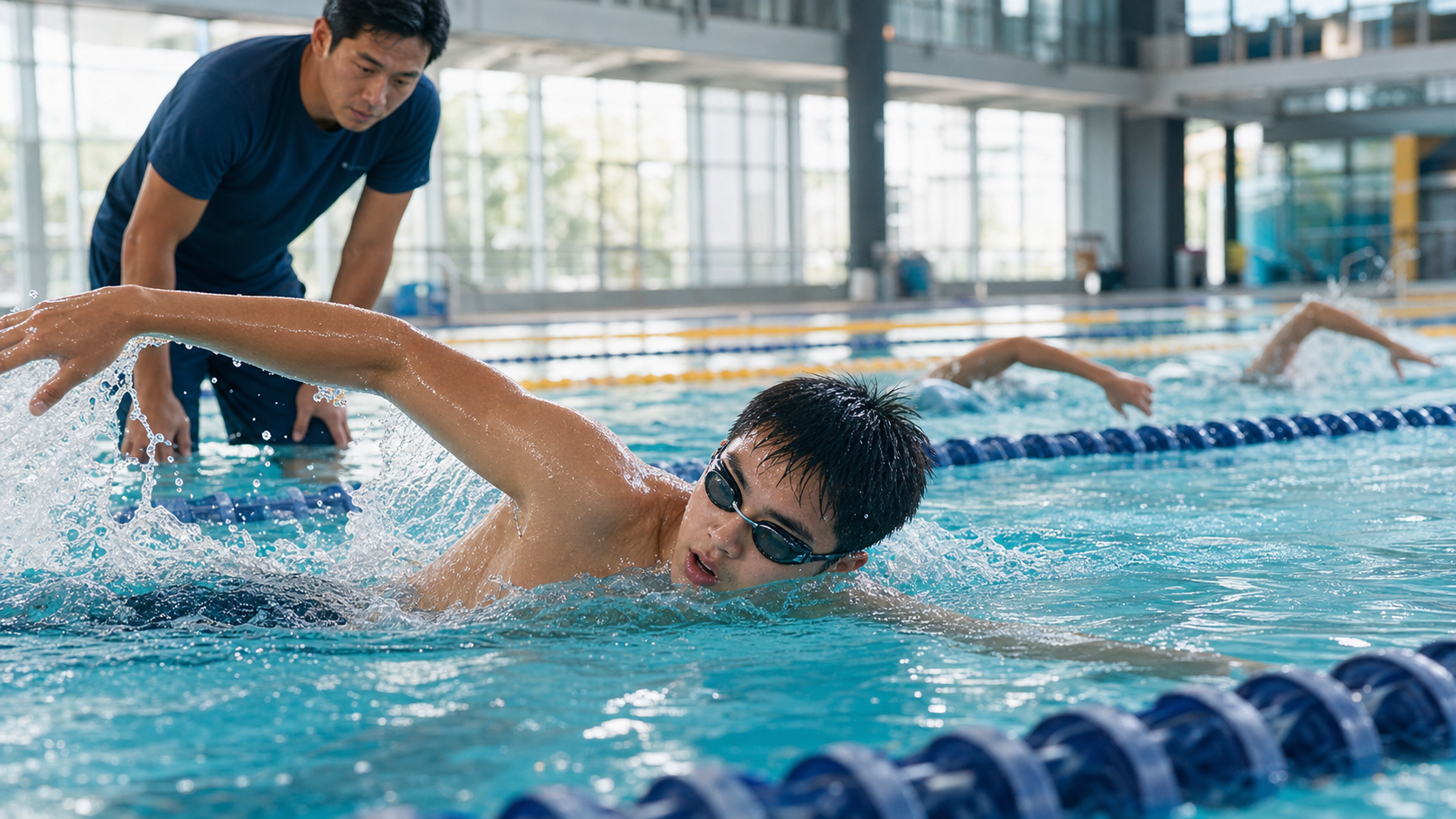
Introduction
The technical complexity of the four competitive swimming strokes differs, and so does the age at which each is best learned. Many swimming coaches in Taiwan still follow the traditional, intuitive order (freestyle → breaststroke → backstroke → butterfly), but research on motor skill development offers a more evidence-based sequencing logic that helps maximize skill acquisition during a young swimmer’s sensitive learning periods. This article explains the optimal order for acquiring the four strokes, and the focus at each stage, from a biomechanical and neurodevelopmental perspective.
Dimensions for Assessing the Technical Difficulty of the Four Strokes
The technical difficulty of each stroke can be analyzed along the following five dimensions:
| Technical Dimension | Description |
|---|---|
| Breathing Coordination | The difficulty of coordinating the breathing rhythm with the arm stroke |
| Body Coordination | The complexity of synchronizing upper- and lower-body movement |
| Strength Requirement | The minimum strength needed to perform the standard movement |
| Water-Feel Dependency | The degree of fine proprioceptive sensitivity required in the water |
| Neurocognitive Load | The cognitive demand of simultaneously monitoring multiple movement cues |
Comparison of the Four Strokes’ Difficulty and Recommended Acquisition Order
| Stroke | Breathing Coordination | Body Coordination | Strength Requirement | Water-Feel Dependency | Neurocognitive Load | Overall Difficulty | Recommended Age to Learn |
|---|---|---|---|---|---|---|---|
| Backstroke | ★☆☆ | ★★☆ | ★☆☆ | ★★☆ | ★☆☆ | Low | 5–7 years |
| Freestyle | ★★☆ | ★★☆ | ★☆☆ | ★★☆ | ★★☆ | Low-Medium | 5–7 years |
| Breaststroke | ★★☆ | ★★★ | ★★☆ | ★★★ | ★★★ | Medium-High | 7–9 years |
| Butterfly | ★★★ | ★★★ | ★★★ | ★★★ | ★★★ | High | 9–11 years |
Recommended Acquisition Order: Backstroke → Freestyle → Breaststroke → Butterfly
This order differs from traditional teaching in Taiwan in one key respect: backstroke comes before freestyle. The reasons are as follows:
- Breathing in backstroke does not require learning the coordination of “turning the head to breathe while the face is in the water,” so it poses the least breathing-related obstacle for beginners.
- The supine position lets children feel buoyancy directly, building a basic sense of relaxation in the water.
- The supine flutter kick used in backstroke is a preparatory movement for learning the freestyle kick.
- Learning backstroke early alongside freestyle helps prevent the breathing-rhythm anxiety that can arise later when learning to rotate the body for a freestyle breath.
Core Technical Points and Common Errors for Each Stroke
Backstroke (5–7 years)
Core Technique:
- Keep the body horizontal, without letting the hips sink
- Initiate the kick from the hip, with a slight but not excessive knee bend
- Enter the water directly above the shoulder (not crossing the midline over the head)
- Breathe naturally, without deliberately holding the breath
Common Errors: Sinking hips (usually caused by lifting the head), and hand entry crossing the body’s midline (causing excessive body roll).
Freestyle (5–7 years, learned alongside backstroke)
Core Technique:
- Body roll coordinated with breathing — this is the most important technical concept
- High-elbow entry and high-elbow catch
- Kick initiated from the hip (as with backstroke)
- Turn the head to breathe, with just one eye needing to clear the surface
Common Errors: Lifting the head fully out of the water to breathe (only the head should rotate, keeping one ear in the water), and an overly large kick (heels breaking the surface).
Breaststroke (7–9 years)
Breaststroke has the most complex movement coordination of the four strokes, because the timing of the arm and leg movements is “asynchronous,” and the breaststroke kick involves an outward rotation of the feet that requires sufficient flexibility and proprioception.
Core Technique:
- The four-phase rhythm of “pull → recover the legs → kick → glide”
- Rotate the feet outward during the kick, pushing water with the outer edge of the feet
- A brief glide (streamline) at the end of each stroke cycle
- Lift the head to breathe as the pull is completed (not earlier)
Common Errors: Knees splaying too wide during the kick (increasing drag), skipping the glide phase (a rushed rhythm), and breathing too early.
Butterfly (after age 9–11)
Butterfly demands the highest level of technique and physical conditioning among the four strokes. Requiring a full butterfly motion too early is one of the common causes of lower-back injuries among young swimmers in Taiwan.
Recommended Learning Path (staged):
- First learn the “dolphin kick” — kicking with both legs together to feel the whole-body undulation rhythm
- Add the arms — a large simultaneous double-arm stroke combined with the dolphin kick
- Establish the full stroke rhythm — “one arm pull plus two dolphin kicks”
- Add breathing — breathing is introduced last, to avoid disrupting the body’s rhythm through premature breath-taking
Common Errors: Substituting a whole-body undulation with lower-back-only movement (high risk of lumbar injury), kicking only once per stroke instead of twice, and lifting the head too high to breathe.
Individual Medley Training to Integrate the Four Strokes
Once a swimmer has learned the basic movements of all four strokes, individual medley (IM) training is the best tool for integrating the four techniques:
- The 100m IM requires a swimmer to fully express the technique of each stroke within a 25m distance
- IM training lets swimmers feel the technical differences as they transition between strokes, deepening the motor memory of each stroke
- Taiwan’s National Intercollegiate Athletic Games and the National High School Games both include 200m/400m individual medley events, so early IM training directly benefits competitive advancement
Practical Recommendations
- Avoid the “good enough to swim” standard — every stroke should reach a baseline of technical quality before moving on to accumulating training volume.
- Before age 7, do not require formal breaststroke technique; kicking games in the water can be used first to build a feel for the legs.
- Before age 10, butterfly should focus on “feeling the dolphin kick,” without requiring the full butterfly motion.
- Conduct a 4×50m four-stroke technique assessment once a month, recording the main issues with each stroke as the training focus for the following month.
Conclusion
The order in which the four strokes are acquired is not arbitrary — it follows the patterns of children’s neurodevelopment and a scientific assessment of each stroke’s technical difficulty. When coaches introduce the right stroke at the right time, paired with a gradual progression of technical requirements, they not only reduce the risk of injury but also help swimmers build a solid technical foundation across all four strokes, equipping them with well-rounded competitive ability for their future athletic careers.
Related Reading
- Swimming for Lower-Grade Elementary Students (Ages 6–9): A Complete Guide to Building a Foundation in the Four Strokes
- Individual Medley Training in Swimming: Energy Distribution and Technical Challenges Across Four 25m Strokes
- The Complete Guide to Adult Swimming Lessons: Overcoming Fear of Water and Mastering the Four Strokes
- Youth Swimming Training: Recommended Training Volume and Technical Development Focus by Age Group
CT 喇低賽) 武嶺牽車 才是王道 西進牽車四小時內秘訣 攝手位置 如何判斷 防抽筋小秘訣
7 年前
滑雪新手們慘摔學習全紀錄(請開字幕),滑雪好好玩 | Snowboard + Ski | 岩原 スキー場 | 滑雪APP使用 | GoPro Max
6 年前
西進武嶺 免費訓練分析服務 Intervals | 練不夠還是練過頭?你哪一種類型選手?AI模型告訴你! | 備戰神器 | 公路車 訓練 | CT Yeh
4 年前
教學) 如何做出專業 慢動作 影片 Slow Motion 120fps GoPro 7 ActionCam AX700 A99II
7 年前
[教學] Premiere 影片 手震 修正 教學 防抖 單眼 影像 GoPro 穩定 Video Stabilization
8 年前
FTL 與 SYB 車隊專訪 西進武嶺 實用攻略分享! 2小時 如何練?!你不知道的眉角!新手準備武嶺必看 EP1 | 實力派女車友 | 精華版 | 公路車 | CTYeh
4 年前
一日北高常見問題大集合 | 攻略 | 路線 | 訓練 | 補給 | 自行車 單車 | 一日雙城 | 雙塔 | TWB北高360 | 屁股痛
6 年前
2024桃園團體自由車邀請賽!4K環台賽等級拍攝 全賽事精華!/ 集團大摔車 / 60隊菁英好手衝線 / 公路車 CT Yeh
1 年前