The Science of Talent Identification in Competitive Swimming: Physical Attributes and Giftedness Recognition
Introduction
In Taiwan’s youth swimming community, coaches often say a child is “born to swim.” What scientific basis lies behind this intuitive judgment? Talent identification in competitive swimming has developed into a rigorous sports science discipline, encompassing anthropometry, physiology, psychology, and neuroscience. This article compiles existing scientific research to provide a more objective framework for swimming talent selection.
Body Morphology Indicators: Measurable Physiological Advantages
Height and Body Proportions
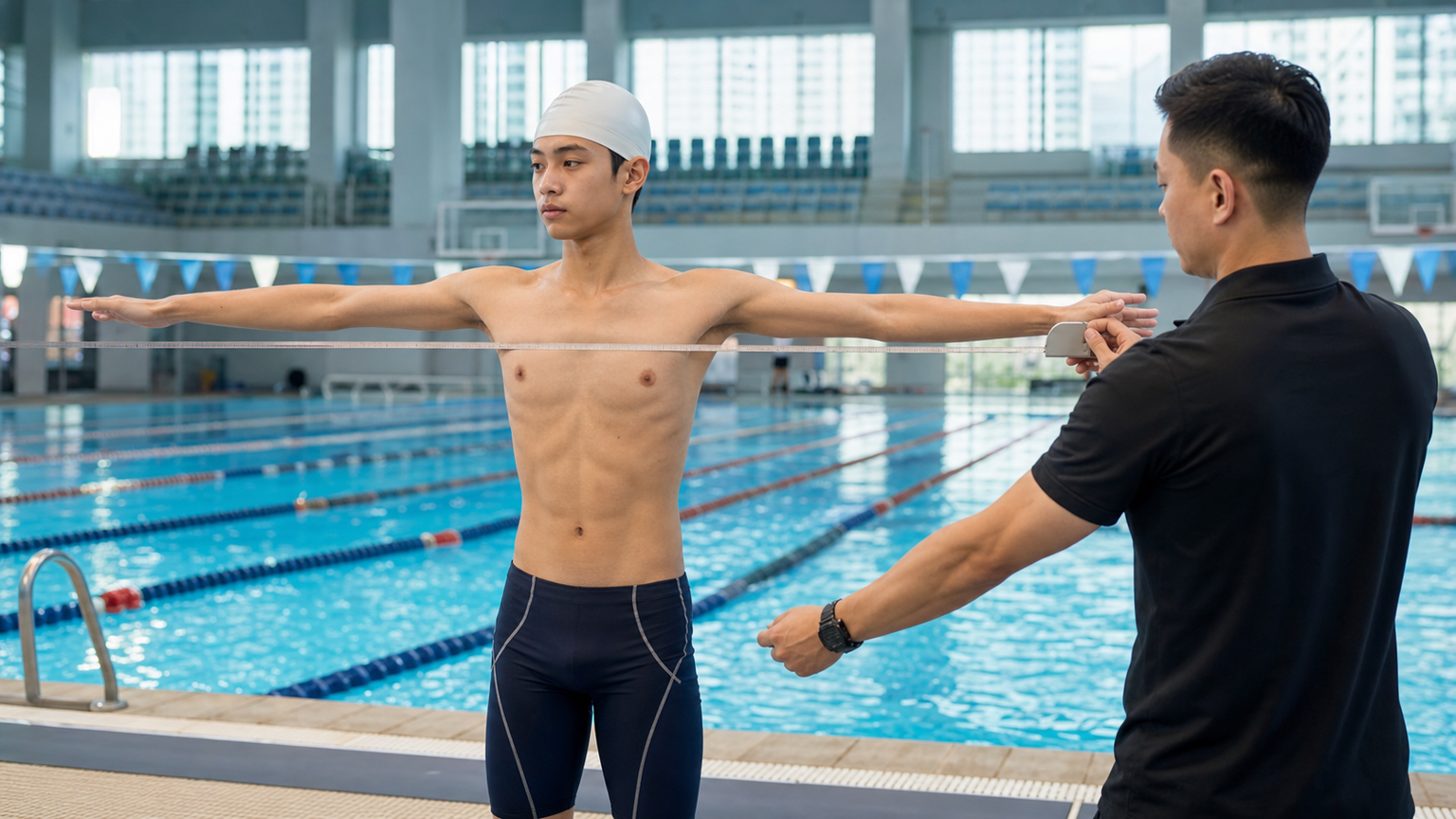
Elite swimmers generally possess the following physical characteristics, which show significant correlation with competitive performance:
| Indicator | Elite Male | Elite Female | Importance |
|---|---|---|---|
| Height | 188–200 cm | 172–182 cm | High (longer “swimming engine”) |
| Arm span/Height ratio | > 1.03 | > 1.02 | High (arm span exceeding height is a key advantage) |
| Upper body/Height ratio | Longer | Longer | Medium (propulsive efficiency in water) |
| Ankle flexibility (plantar flexion) | > 60° | > 60° | High (key to kicking efficiency) |
| Palm size | Large palms | Large palms | Medium (surface area for water catch) |
Important note: Physical assessment during adolescence should consider biological age (bone age) rather than chronological age. Short-term advantages of early-maturing athletes in youth competitions do not represent long-term talent.
Ankle Flexibility: The Most Overlooked Selection Indicator
Ankle plantar flexion ability directly affects kicking efficiency. Research shows that elite swimmers have an average ankle plantar flexion angle 15–20° greater than the general population. This indicator has good early identification value at ages 10–12 and offers some room for improvement through training (via systematic stretching).
Ankle plantar flexion measurement method: Lie prone on the ground with the foot naturally hanging, and measure the maximum plantar flexion angle of the ankle (normal range approximately 45–50°; excellent swimmers can reach 65–75°).
Physiological Capacity Indicators
Aerobic Capacity (VO₂max)
Aerobic capacity is the physiological foundation for middle- and long-distance swimming, but at the youth selection stage, the trainability of VO₂max often matters more than current levels. Research shows that some athletes with relatively average VO₂max during adolescence can reach elite levels after systematic training.
Lactate Metabolism Characteristics
Some athletes possess inherently higher lactate clearance rates or higher lactate thresholds, meaning they have greater fatigue resistance during high-intensity swimming. Lactate testing generally only yields stable measurements after age 14.
Heart Rate Recovery
The speed of post-exercise heart rate recovery (e.g., the magnitude of heart rate drop one minute after a sprint) is an indicator of cardiac efficiency. Adolescents with fast heart rate recovery typically have better autonomic nervous system regulation and adapt more efficiently to high-intensity training.
Psychological Trait Indicators
Sports science increasingly emphasizes the critical role of “psychological giftedness” in long-term competitive success:
Psychological traits highly correlated with long-term competitive success:
- Achievement motivation: Intrinsic drive to actively pursue improvement, rather than being driven solely by external rewards
- Mental resilience: Ability to recover from failure and setbacks
- Coachability: Ability to accept technical corrections and apply them quickly
- Attention control: Ability to maintain focus during training and competition
- Competitive enjoyment: A psychological framework that views competition as a challenge rather than a threat
Research finds that psychological traits may have greater predictive power for long-term athletic success than early physiological and technical indicators.
Common Pitfalls in Taiwan’s Talent Selection
Pitfall One: Using Early-Maturing Athletes as the Selection Standard
In age-group competitions for ages 10–13, athletes who possess physical advantages due to early biological maturation (advanced bone age) often do not perform as expected in adulthood. Taiwan’s youth swimming selection should place greater emphasis on correcting the bias of the “relative age effect.”
Pitfall Two: Overemphasizing Absolute Swim Speed
A 12-year-old who can swim 100m freestyle in 1:05 does not necessarily have more potential than one who swims 1:10 but with more solid technique. Technical efficiency (distance per stroke, stroke index) should be considered alongside performance metrics.
Pitfall Three: Ignoring Coachability
When identifying talent, coaches should observe not only what a child “can do now” but also “how quickly the child can improve their movements after receiving technical guidance”—this “learning rate” is one of the most valuable dynamic indicators in talent identification.
Practical Recommendations
Assessment framework for coaches (athletes aged 10–12):
- Body morphology: height, arm span/height ratio, ankle plantar flexion angle
- Water feel indicators: stability in back float, speed of returning to still water after breathing
- Trainability: degree of movement improvement after receiving 3 technical instructions
- Motivational traits: training attendance rate, attitude toward difficult training sessions
- Heart rate recovery: magnitude of heart rate drop one minute after a 200m sprint
Reminders for parents:
- A child’s ranking in age-group competitions has low correlation with adult competitive potential.
- The indicator truly worth tracking is the child’s rate of improvement under equivalent training, not absolute performance.
- Physical conditions are only part of talent; psychological traits (especially a love for training) are equally decisive in the long run.
Conclusion
Swimming talent selection is both a science and an art. Science provides a systematic assessment framework, but experienced coaches must remain sensitive to “hard-to-quantify signals of potential.” If Taiwan’s youth swimming development can more broadly adopt scientific selection tools and reduce over-reliance on early-maturation advantages and short-term results, it will help uncover more swimming talents overlooked by traditional approaches.
Related Reading
- Swimming Gifted Class Selection Standards: Scientific Assessment Systems and Athlete Potential Identification
- Studying Opponents in Swimming Competitions: How to Analyze Competitors’ Technical Characteristics
- Race Strategy Analysis for Swimmers: How to Study Opponents and Develop a Plan
- The Buoyancy Principle in Swimming: How Body Fat Percentage and Lung Capacity Affect Floating Ability in Water
崇越盃武嶺冠軍高手 賽前JJSC 群峰會精華!對應大數據分析,會有落差嗎?/ feat. JJSC中部公路車約騎 /公路車 / CT Yeh
2 年前
CT Talk) 數據面窺看 武嶺大神們 平時的備戰 共通點 (娛樂性質XD)
7 年前
3D 列印車褲墊 / 舒適改善? / 無痕 x 分區壓縮 / ATK & Decider系列 / JE22黑科技 / #公路車 #CTYEH
11 個月前
西進武嶺 免費訓練分析服務 Intervals | 練不夠還是練過頭?你哪一種類型選手?AI模型告訴你! | 備戰神器 | 公路車 訓練 | CT Yeh
4 年前
西進武嶺 自製新版AI配速表產生器 x 賽前攻略 抱佛腳! 沒有功率計也可以產生配速表嗎?有什麼其他眉角賽前要注意的呢? | 西進武嶺 / 東進武嶺 KOM 攻略 | 公路車 | CT Yeh
4 年前
#公路車 #Vo2Max #最大攝氧量 測驗 體驗 | 心肺測試
6 年前
一日北高/長距離團騎 常見問題補充篇 / 組團或跟團的眉角 / 壯車友容易被瘦車友慢性拉爆 / 原來屁股痛可能是這個原因...? / 風場配速法 / 公路車 / CT Yeh
2 年前
#PUSHBIKE 原來這麼好玩! 小朋友 滑步車 初體驗 超可愛
6 年前