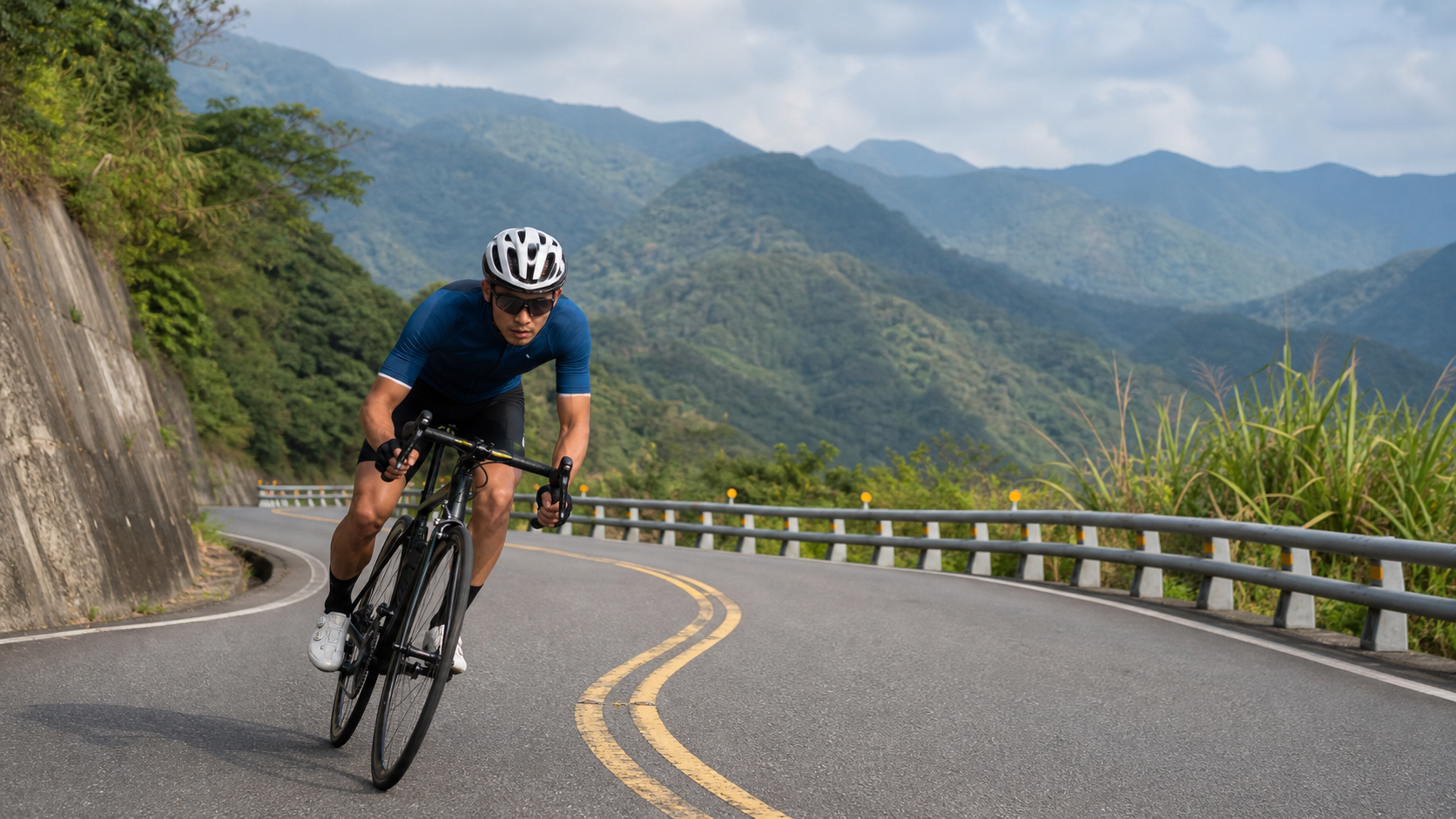
Introduction
Many riders devote all their attention to climbing training while neglecting descending technique. However, statistics show that a significant proportion of road bike accidents occur on descents, especially on Taiwan’s mountainous continuous switchbacks. Descending is not as simple as “letting go and letting gravity take over”—proper brake modulation, cornering line selection, and weight control are the key techniques that determine whether you reach the bottom of the mountain safely. This article will systematically explain the core techniques of road bike descending.
The Basic Physics of Descending
Understanding a few basic physics concepts helps build a correct foundation for descending technique:
- Gravitational acceleration: Gravity continuously accelerates you on descents; without braking, speed will keep increasing
- The square relationship between kinetic energy and braking distance: Doubling speed quadruples stopping distance. The braking distance at 60 km/h is four times that at 30 km/h
- Centrifugal force: The higher your speed and the tighter the corner, the greater the centrifugal force, making it easier to reach the limits of tire grip
- Brake heat fade: Continuous braking on long descents overheats brake pads and rims; hydraulic disc brakes especially require attention to fade issues
| Speed | Emergency braking distance (dry asphalt) |
|---|---|
| 30 km/h | approx. 8–10m |
| 50 km/h | approx. 22–28m |
| 60 km/h | approx. 33–40m |
| 80 km/h | approx. 60–75m |
Using the Brakes Correctly
Front and Rear Brake Force Distribution
The braking power of a road bike comes primarily from the front brake (about 70–75% of braking force), because weight shifts forward during deceleration, increasing front wheel grip. However, overusing the front brake can cause the front wheel to lock up and flip the bike, while applying the rear brake forcefully will only cause the rear wheel to skid.
Correct distribution:
- Gentle slopes and straight lines: 60–70% front brake, 30–40% rear brake
- Before entering a sharp corner: Increase front brake application to ensure speed drops to a safe range
- Through the corner: Avoid braking as much as possible; rely on speed reduction completed before entering the corner
- Steep, long descents: Use the “feathering” technique to prevent continuous brake heat buildup
Feathering Technique
The most important technique for long descents is feathering, not holding the brakes continuously:
- Squeeze the brakes for 2–3 seconds to reduce speed
- Release the brakes for 3–5 seconds to let them cool
- Repeat this cycle
Continuously holding the brakes not only overheats them but also fatigues the hand muscles (commonly called “numb hands”), potentially leaving your hands unable to control the bike properly after a long descent.
The Importance of the Drop Position
You should switch to the “drop” hand position (the curved part of the drop bars) when descending, because:
- Lower center of gravity improves bike stability
- Fingers can apply force to the brakes more easily
- Less aerodynamic drag aids in speed control
- Quicker reaction in unexpected situations
Cornering Technique
Braking Before the Corner
“Complete your braking before entering the corner, and accelerate when exiting” is the golden rule of cornering. Braking through a corner is very dangerous because braking causes the tires to lose lateral grip, greatly increasing the risk of a skid.
Cornering sequence:
- Judge the corner’s curvature in advance (look at the guardrail or road edge on the inside of the corner)
- Complete braking 20–30 meters before the turn-in point, reducing to a safe cornering speed
- Begin steering only after releasing the brakes
- During the corner, push the outside pedal down to the bottom (apply force with the outside leg), shifting your weight toward the inside
- After the apex (the lowest point of the corner), gradually straighten up and accelerate
Vision and Line Selection
When cornering, your eyes should look toward the corner exit, not at the ground right in front of you:
- Racing Line: Enter wide → cut to the inside apex → exit wide
- Safety Line: Slightly more conservative than the racing line; cut inside a bit later on entry, giving yourself more room for correction
- Recommendation for Taiwan’s mountains: Most mountain roads have oncoming traffic—using the racing line that crosses into the oncoming lane is not recommended; prioritize safety
| Road conditions | Recommended cornering strategy |
|---|---|
| Dry asphalt, no oncoming traffic | The racing line can be used moderately |
| Oncoming traffic present | Stay within your own lane at all times |
| Wet or with gravel/sand | Reduce speed significantly, ride straight through the corner |
| Blind corners with obstructed vision | Slow to a speed that allows an immediate stop |
Weight Control
- Straight-line descending: Shift your hips slightly rearward (slightly behind the saddle) to lower your center of gravity
- Cornering: Push the outside foot down, press your weight onto the outside pedal, and slightly angle the outside knee outward
- Steep descents: Slightly tighten your core, keep your arms relaxed rather than stiff, and let the bike absorb bumps naturally
- Rough surfaces: Lift your hips slightly off the saddle and use your knees as shock absorbers
Practical Advice
- Before descending, check brake pad wear and tire pressure (too-low pressure can cause blowouts at high speed)
- Taiwan’s mountain roads often have fallen leaves, gravel, and wet surfaces—brake conservatively before corners
- On long descents (such as the 56 km descent from Wuling), stop midway to let the brakes cool and replenish fluids
- When descending a mountain road for the first time, ride at a lower speed to learn the corner characteristics before increasing pace
- Wear full-finger gloves to protect your palms—they are the first part of the body to hit the ground in a fall
Conclusion
Descending technique is the other side of climbing training and deserves equal attention. Safety first, feathering as the primary braking method, and completing braking before entering corners—these three principles will let you enjoy the thrill of speed on Taiwan’s mountain descents while ensuring you return home safely. Technique takes time to build; starting with gentle slopes and small corners, gradually building confidence and skill, is the most reliable path to improvement.
Related Reading
- Advanced Descending Technique: Body Control for High-Speed Cornering on Road Bikes
- Descending and Braking After Climbing: Making Descents as Worth Training as Climbs
- The Complete Guide to Descending: The Physics of Weight Control, Vision Guidance, and Brake Timing, with Progressive Practice Methods
- Descending Technique Training: Braking Point Judgment and Weight Transfer
公路車 爬坡 破PR 紀錄 小技巧 分享
6 年前
大禹嶺 到 武嶺牌樓 全程前後實況錄影 | 北進武嶺 | 東進武嶺 | KOM | 訓練台 | 坡度分析 | Taiwan KOM Last 10 km HARD | 公路車
6 年前
碟煞公路車 銑面器 !? 原來銑完差這麼多! 降低蹭碟機率! | TIME 公路車 保養小記錄 | CT Yeh
3 年前
CT 喇低賽) 武嶺牽車 才是王道 西進牽車四小時內秘訣 攝手位置 如何判斷 防抽筋小秘訣
7 年前
碟煞公路車 優缺點?換車一年半實際經驗分享 / 公路車 / CT Yeh
2 年前
大武山後門26%歡樂陡坡!JJSC南台灣單車行Day2 / 被颱風追著跑 / 公路車 / CT Yeh
2 年前
單車 梅山36灣 坡度介紹 路段介紹 空拍 (相關遊記影片,請參考說明或我的頻道喔,歡迎訂閱)
6 年前
靠單車減肥35公斤 心得分享與整理
7 年前