The Complete Guide to Road Bike Chain Maintenance: Cleaning, Lubrication, and Replacement Timing
Introduction
The chain is one of the fastest-wearing components in a road bike’s drivetrain, and it is also one of the most neglected maintenance items. Many riders only think about adding lubricant when the chain starts “making a rattling noise,” unaware that by then the chain may already be excessively worn, which in turn accelerates wear on the cassette and chainrings. Taiwan’s humid, rainy climate means chains require more frequent maintenance than in drier regions. This article will walk you through a complete chain maintenance routine, from cleaning tools to replacement timing.
Chain Cleaning Tools and Materials
Proper cleaning starts with having the right tools on hand.
| Tool/Material | Purpose | Recommended Specification |
|---|---|---|
| Chain cleaner | Circulates and scrubs chain grime | Park Tool CM-5.3 or equivalent |
| Degreaser | Dissolves old grease and grit | Biodegradable formula to avoid damaging seals |
| Old toothbrush | Scrubbing cassette and chainring gaps | Stiff bristles work better |
| Clean rag | Drying the chain | Lint-free cotton or microfiber cloth |
| Chain lubricant | Reduces wear and prevents rust | Choose wet or dry lube based on weather |
Cleaning Steps
- Remove the rear wheel (optional): Cleaning is possible without removing the wheel, but removing it allows for a more thorough job on the cassette.
- Apply degreaser: Clip the chain cleaner onto the chain, pour in the degreaser, and slowly turn the cranks for 20–30 revolutions.
- Rinse with water: Flush away degreaser residue with clean water, paying special attention to the gaps between links. In Taiwan’s summer, a shower head works fine; in winter, soaking in a bucket of warm water before scrubbing is recommended.
- Dry the chain: Clamp a dry cloth around the chain and slowly rotate it to ensure all moisture is removed—otherwise, lubricant cannot adhere effectively.
- Scrub the cassette and chainrings: Use an old toothbrush with degreaser to clean the teeth of the cassette. The grime that accumulates there will re-contaminate the chain.
Choosing and Applying Chain Lubricant
Wet vs. Dry Lubricant
- Wet Lube: High viscosity and excellent water resistance, ideal for Taiwan’s plum rain season and long mountainous rides. The downside is that it attracts dust easily and requires more frequent cleaning.
- Dry Lube / Wax Lube: Wax-based formula that leaves a dry film after application, which does not pick up dust—suitable for training days in dry weather. The chain stays clean, but the lube washes off quickly in rain and needs reapplication.
- All-weather Lube: A compromise option, suitable for riders who do not want to switch lubricants frequently.
Proper Application Steps
- Make sure the chain is completely dry before applying lubricant.
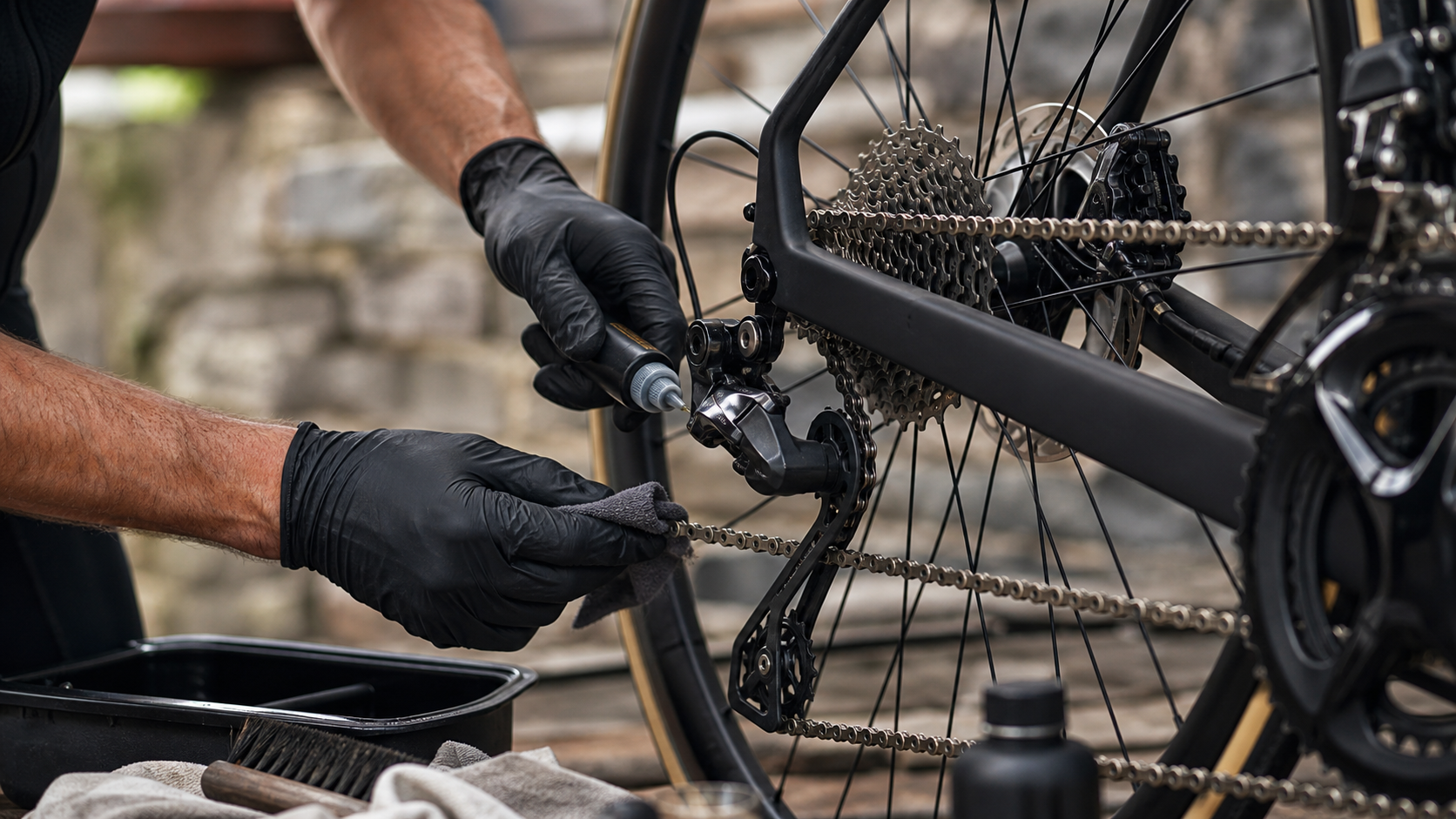
- Hold the lubricant nozzle close to the inside of the chain, dripping oil while slowly turning the cranks so every link receives oil.
- Let it sit for 5–10 minutes to allow the oil to penetrate the links.
- Use a dry cloth to lightly wipe off excess oil from the outside of the chain—this step is critical. Excess oil left on the outside of the chain only attracts dirt; what actually needs lubrication is the inside of the links where they pivot.
Chain Wear Assessment and Replacement Timing
After extended use, the spacing between chain links stretches due to wear (commonly called “chain stretch”), which directly affects the meshing precision with the cassette and chainrings, accelerating wear on the cassette teeth.
Using a Chain Wear Indicator
The most accurate way to assess wear is with a chain wear indicator, such as the Park Tool CC-3.2:
- The gauge drops into the 0.5 mark: Light chain wear; start planning a replacement.
- The gauge drops into the 0.75 mark: Moderate chain wear; replace immediately, otherwise the cassette will be damaged.
- The gauge drops into the 1.0 mark: Severe wear; the cassette may need replacement as well.
Mileage Benchmarks
- General 11-speed chains: Replace at approximately 2,000–3,000 km (shorter for high-intensity riders)
- 12-speed chains (e.g., Shimano Dura-Ace, SRAM Red AXS): Thinner chains wear faster, around 1,500–2,500 km
- Riders in Taiwan who tackle many hills and high climbing ratios will see wear accelerate by 20–30%
Practical Tips
- Keep a mileage log: Use the equipment management features in Strava or Garmin Connect to set chain mileage reminders.
- Buy two chains at once: Alternating between them extends the life of each chain and ensures you always have a spare on hand.
- Always maintain after riding in rain: If you do not dry and re-lubricate promptly after rain in Taiwan, rust spots can begin to appear on the chain within 12 hours.
- Inspect the cassette when replacing the chain: If the cassette teeth show obvious “hooked” wear, a new chain may skip teeth on it, and the cassette will need to be replaced as well.
- Tool recommendations: The Park Tool CT-3.2 chain tool and KMC Missing Link (matching your speed count) make chain replacement much easier.
Conclusion
Chain maintenance may be the most basic of all maintenance tasks, but it is the most critical action affecting ride quality and the overall lifespan of the drivetrain. Developing the habit of “cleaning every 200–300 km and re-lubricating after every ride” will not only make shifting smoother but also prevent expensive cassettes and chainrings from wearing out prematurely. Given Taiwan’s climate conditions, chain maintenance is an essential routine that every serious rider cannot afford to overlook.
Related Reading
- The Complete Guide to Road Bike Chain Maintenance and Lubrication: Secrets to Extending Drivetrain Life
- Chain Cleaning and Lubrication Guide: Restoring Your Drivetrain to Factory Condition
- The Complete Road Bike Chain Cleaning Guide: Making Your Drivetrain Run Like New
- Bicycle Chain Maintenance Guide: The Complete Process of Cleaning, Lubrication, and Replacement Timing
洗單車神器 吹水機! 實際洗車用用看 暴力洗鍊條大法 | 公路車 | CT Yeh
4 年前
自助洗車場 洗單車 50元有找 清鍊條大法 居然還有小小兵
7 年前
碟煞公路車 銑面器 !? 原來銑完差這麼多! 降低蹭碟機率! | TIME 公路車 保養小記錄 | CT Yeh
3 年前
Canyon 公路車斷把手 五年老車特規還能修嗎? 維修保養全記錄 feat. 501單車監理站 | 公路車 | CT Yeh
4 年前
把帶被我推爛,換新的防推爛款💪 #cycling #公路車 #曜越單車
2 年前
FTL 與 SYB 車隊專訪 西進武嶺 實用攻略分享! 2小時 如何練?!你不知道的眉角!新手準備武嶺必看 EP1 | 實力派女車友 | 精華版 | 公路車 | CTYeh
4 年前
公路車 BB培林大升級! / 備戰海鷗繞圈賽 Canyon Aerod & TIME 一起改 / MIT大廠 CEMA對鎖式陶瓷培林BB & 導輪 / 公路車 / CT Yeh
2 年前
碟煞公路車 優缺點?換車一年半實際經驗分享 / 公路車 / CT Yeh
2 年前