Introduction
Taiwan’s climate is a serious test for bicycles: hot, humid summers, days of continuous rain during the plum rain season, salt spray corrosion when riding along the coast, and heavy rainfall brought by the winter northeast monsoon. In this environment, a bike that isn’t properly maintained can show rusted screws within three months, white rust spots (aluminum oxide) on aluminum alloy parts, and rapid corrosion of steel components — all common sights. This article provides a complete cleaning routine and rust-prevention strategy so that riders in Taiwan can keep their bikes in good condition over the long term under local climate conditions.
Major Threats Taiwan’s Climate Poses to Bicycles
| Threat Factor | Parts Affected | Severity |
|---|---|---|
| High humidity (annual average relative humidity 75–80%) | Steel screws, chain, bearings | High |
| Rain washing | Drivetrain, bottom bracket bearings | High |
| Salt spray (coastal riding) | All metal parts, especially aluminum alloy | Extreme |
| UV rays | Carbon fiber paint, plastic housings | Medium |
| Sweat | Top tube paint, seatpost clamp area | Medium |
Daily Cleaning Routine
After Every Ride (10-Minute Quick Maintenance)
After riding in rain or heavy sweat, the following steps should never be skipped:
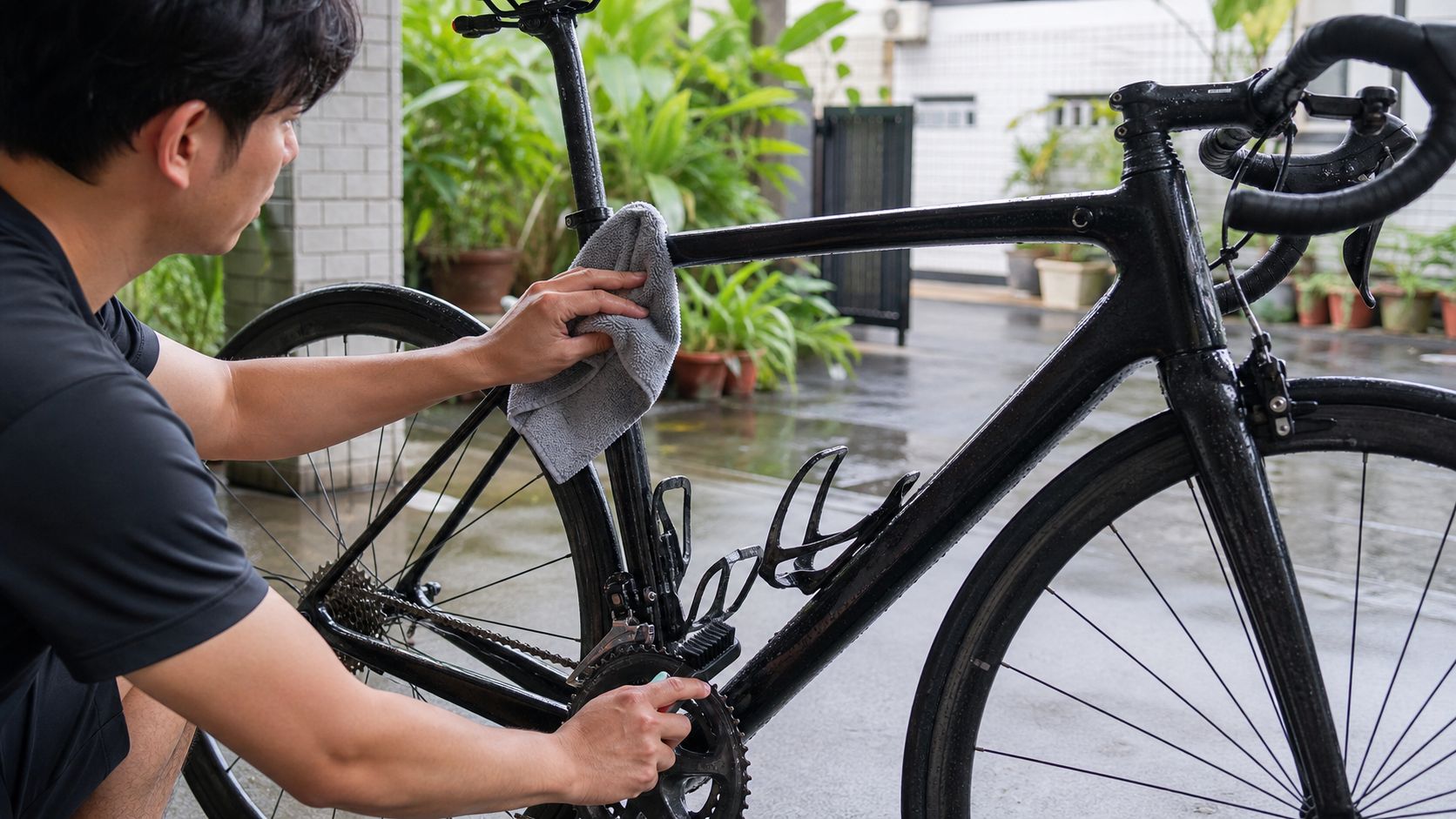
- Dry the frame: Use a dry microfiber cloth to wipe away water droplets, paying special attention to part joints, screw heads, the head tube, and the bottom bracket area.
- Dry the chain and reapply lubricant: As mentioned in previous articles, oiling the chain is the first line of defense against rust in wet conditions.
- Clean the brake contact surfaces: If there is mud or sand on the sidewalls of V-brake rims, wipe it off with a damp cloth — otherwise it will accelerate wear the next time you brake.
Monthly Deep Cleaning (60-Minute Full Maintenance)
Cleaning order: top to bottom, outside to inside
- Pre-rinse treatment: Use a brush to remove large clumps of dirt and grit first, to avoid grit scratching the paint when rinsing directly with water.
- Wash the frame with a bicycle-specific cleaner: Spray on the cleaner, gently scrub with a sponge, then rinse clean with water. Avoid using a high-pressure water gun — high-pressure water flow can force water into bearings, the bottom bracket, the headset, and other sealed areas, accelerating wear.
- Clean the chain: Use a chain cleaning tool (see the chain maintenance article for reference).
- Brush the cassette and chainrings: Toothbrush + degreaser to clean oil grime from between the teeth.
- Rinse thoroughly and dry: Use an air gun or a hairdryer’s cool setting to blow away trapped water, especially at frame tube joints and screw holes.
- Apply wax or protective coating: Once the frame is clean and dry, apply a thin layer of automotive detailing wax (non-silicone type) to the frame surface to provide a hydrophobic protective layer.
Rust Prevention Strategy: Protection Methods by Part
Screw Rust Prevention
Taiwan’s most common screw corrosion problem can be prevented as follows:
- Periodically remove screws and apply anti-rust grease: At least once a year, remove the seatpost clamp, bottle cage screws, and all frame screws, wipe off any rust, apply a thin layer of copper anti-seize compound or rust-preventive grease, then reinstall.
- Upgrade to titanium alloy screws: For stainless steel or iron screws prone to rusting, consider switching to titanium alloy screws, which offer significantly better rust resistance and lighter weight.
- Choose stainless steel screws: Switching to 316 stainless steel (marine grade) screws is especially recommended for coastal riding environments.
Frame Tube Interior Rust Prevention (Essential for Steel Frames)
Steel frames (chromoly, high-carbon steel) have hollow tube interiors, and moisture can easily enter through cable ports and other openings and cause rust:
- Once a year, spray CorrosionX or JP Weld rust-preventive spray into the frame tubes through cable ports or specific access holes, allowing the liquid to distribute evenly inside the tube and form a protective film.
- After spraying, rotate the frame in various directions so the rust-preventive liquid coats every corner.
Bearing Rust Prevention (Headset, Bottom Bracket, Hubs)
- Disassembling, cleaning, and regreasing on schedule (recommended once a year) is the most effective form of protection.
- If maintenance cannot be done right away, apply WD-40 Specialist or Triflow from the outside to let it penetrate around the seals and displace moisture (but this is only a temporary measure and cannot replace proper regreasing maintenance).
Aluminum Alloy Oxidation Protection
Aluminum alloy doesn’t “rust,” but it can develop a white powdery oxide layer, which is especially noticeable in coastal environments:
- Light oxidation can be removed with metal polish and fine sandpaper (800 grit or finer), then protected with oil or wax.
- Severe oxidation (deep pitting corrosion) should be sent for metal sandblasting followed by repainting for protection.
Special Care After Coastal Riding
Salt spray corrosion along Taiwan’s east coast and north coast is remarkably fast. After riding there:
- Rinse the bike from top to bottom with fresh water immediately — don’t let salt dry and crystallize on the bike.
- After drying, spray a thin layer of rust-preventive spray especially on all metal joints and screw heads.
- Perform a full cleaning routine once you get home.
Indoor vs. Outdoor Storage
| Storage Method | Advantages | Disadvantages | Suitable Situations |
|—|—|—|
|—|
| Indoor wall mount | Best rust protection, shielded from sun and rain | Requires space | First choice for apartment/building residents |
| Indoor floor | Convenient, no special equipment needed | Takes up floor space | Those with ample storage space |
| Under a rain shelter | Protects from rain, good ventilation | No protection from salt spray or dust | Interim solution |
| Open outdoor parking | None | Fastest corrosion, poor security | Avoid whenever possible |
Practical Tips
- Don’t cover rust spots with store-bought spray paint: Rust keeps spreading underneath the paint film, making the problem worse over time. Sand down the rust to the base material first, then repaint.
- Know the correct use of WD-40: WD-40 is a water-displacing rust preventive, not a lubricant. It can be used to displace trapped water in parts and provide temporary rust protection, but it cannot replace chain oil or bearing grease.
- Storage issues in Taiwan’s summer: Hot, humid parking spaces (such as under a rain canopy in an underground parking garage) with poor ventilation can rust just as fast as outdoor storage — special attention is needed.
- Use a dust cover: If the bike won’t be ridden for an extended period (more than a month), covering it with a bicycle dust cover can effectively reduce dust buildup and oxidation.
Conclusion
Although Taiwan’s climate is unfriendly to bicycles, any bike made of any material can stay in good condition for over a decade with the right cleaning habits and regular rust-prevention care. The time and cost invested in maintenance is far less than the cost of replacing corroded parts — and a well-maintained bike rewards every pedal stroke with an intangible but very real sense of satisfaction.
Related Reading
洗單車神器 吹水機! 實際洗車用用看 暴力洗鍊條大法 | 公路車 | CT Yeh
4 年前
碟煞公路車 銑面器 !? 原來銑完差這麼多! 降低蹭碟機率! | TIME 公路車 保養小記錄 | CT Yeh
3 年前
自助洗車場 洗單車 50元有找 清鍊條大法 居然還有小小兵
7 年前
2025 自行車錶排行榜 兩萬車友大數據 / Garmin Bryton 排名會大洗牌嗎? / 全新的碼表前身分析 /公路車 / CT Yeh
1 年前
5 ℃ 櫻花之旅 / 75萬單車直接雨中洗車.../ 平菁街 / 北迴歸小隊 / 公路車 / CT Yeh
5 個月前
高雄綠園道鐵路自行車道 / 外地人能輕鬆駕馭 還是整路崩潰? / 2025 全線開通 春節實地探索一次!(附GPS連結)/ 公路車 / CT Yeh
1 年前
單車 一日北高 ( 雙城 ) 肥宅雙人瘋狂行 紀錄片 REACTO
10 年前
太平山單車員工旅遊 | 這樣玩CP值最高!| 公路車
5 年前