Introduction
With the growing popularity of smart trainers, more and more Taiwanese cyclists are simulating climbing workouts at home through Zwift, RGT, or TrainerRoad. Indoor trainers offer irreplaceable advantages—unaffected by weather, precise intensity control, and complete data—but there are several key differences between them and real mountain climbing. If you don’t understand these, you may encounter unexpected gaps between your indoor training and outdoor performance.
How Indoor Trainers Simulate Climbing
Modern smart trainers simulate the climbing feel through electromagnetic resistance, primarily in two modes:
- ERG Mode: Fixed power output. Regardless of cadence, the trainer automatically adjusts resistance to maintain the target wattage.
- Gradient Simulation Mode (SIM Mode): After inputting a gradient, the trainer simulates the corresponding resistance to mimic the real climbing feel.
Most smart trainers support 0–20% gradient simulation, with some high-end models reaching 24%. The physics formula used for gradient simulation is based on: Resistance = Rider Weight × g × sin(Gradient Angle) × Efficiency Coefficient.
Key Differences Between Indoor and Outdoor Climbing
Difference 1: Heat Management Issues from Stationary vs. Moving
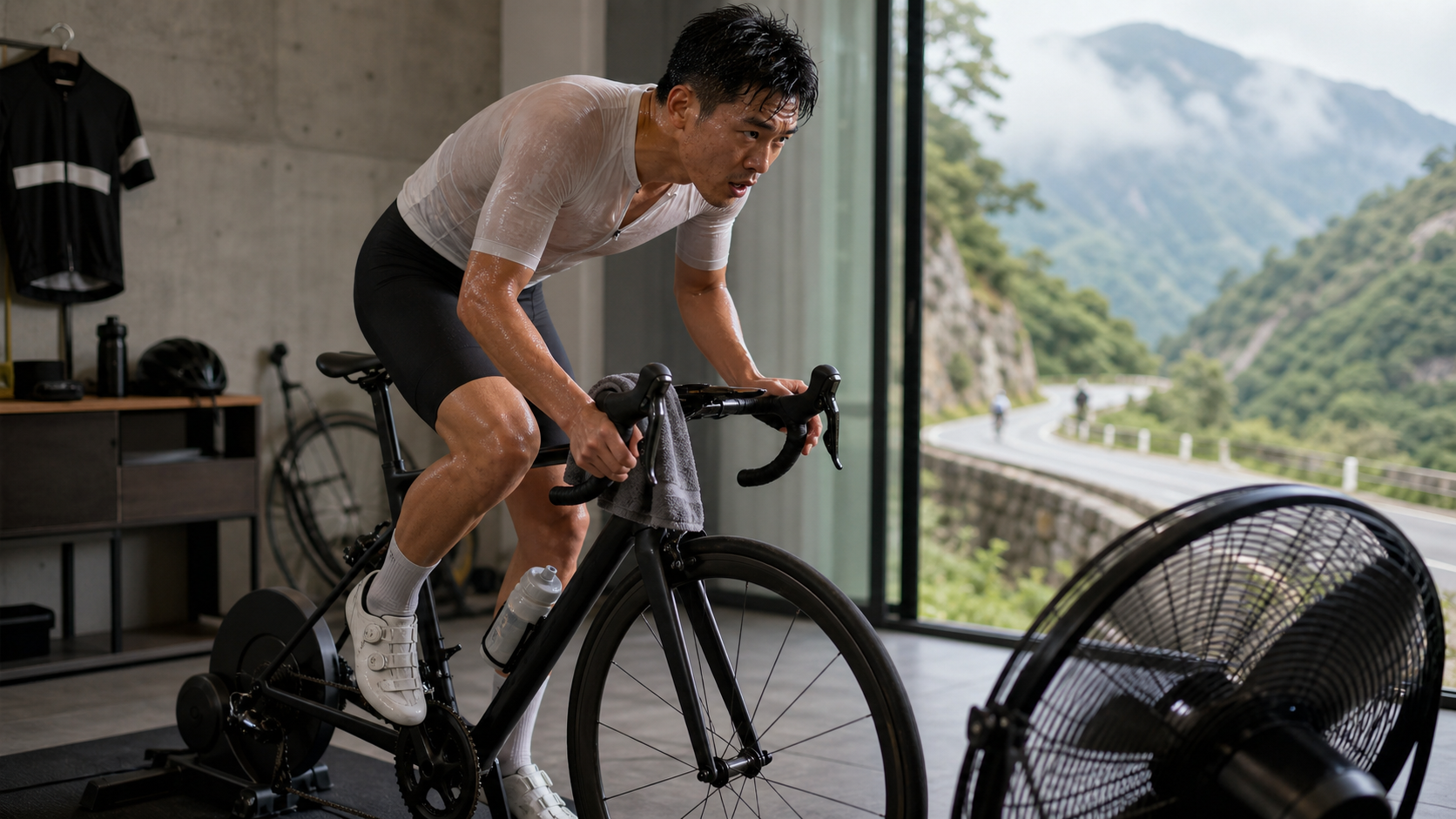
Outdoor riding benefits from natural airflow cooling from forward motion. At 20 km/h, the heat carried away by airflow is significant. Indoor trainers have almost no natural airflow, so core body temperature rises much faster.
| Scenario | Core Temperature Rise Rate | Heart Rate Deviation | Corresponding Adjustment |
|---|---|---|---|
| Outdoor Climbing (mountain temp 22°C) | Baseline | Baseline | — |
| Indoor Trainer (no fan) | +50% faster | +10–15 bpm | A large fan is mandatory |
| Indoor Trainer (with large fan) | +20% faster | +5–8 bpm | Acceptable |
Practical impact: If you complete a 1-hour climbing simulation on an indoor trainer at the same power, your average heart rate will be 8–15 bpm higher than outdoors, mainly due to overheating rather than genuinely higher intensity. This means heart rate data from indoor training cannot be directly compared to outdoor data.
Recommendation: A powerful electric fan (industrial floor fans work far better than desk fans) is essential for indoor climbing training. Point it at your face and chest to simulate riding wind.
Difference 2: Bike Dynamics and Balance
When climbing outdoors, the bike sways slightly with each pedal stroke (especially when standing), and your body must continuously make fine balance adjustments. Indoor trainers (especially wheel-on types) keep the bike completely stationary, engaging a slightly different combination of muscle groups:
- Gluteal fatigue is usually greater after indoor training (due to prolonged lack of movement)
- Standing pedaling feels more unnatural on a trainer because the bike cannot sway
- Dynamic core stabilization training effects are weaker
Solution: Purchase a rocker plate (such as Wahoo Kickr Climb + Axis Feet) to allow the trainer to rock front-to-back and side-to-side, bringing it closer to real riding dynamics.
Difference 3: Gradient Simulation Accuracy
The trainer’s gradient simulation is based on an average weight setting. If your weight input is inaccurate, the resistance will be off. Additionally, different trainer brands interpret gradient resistance slightly differently:
- Some riders report that 6% on the Wahoo Kickr feels “heavier” than 6% on the Tacx Neo
- Wheel-on trainers are slightly less accurate than direct-drive trainers due to differences in tire friction coefficients
Recommendation: Evaluate the trainer’s gradient simulation effectiveness using “power” rather than “feel,” and ensure the trainer is regularly calibrated.
Difference 4: Psychological Factors
Outdoor climbing offers scenery, fresh air, and interaction with other riders—rich psychological stimulation. Indoors, staring at a screen, monotony can lower effort levels more quickly (research shows that at the same RPE during indoor riding, power output averages 5–10% lower).
Solution: Use platforms with social features like Zwift; set clear power targets rather than relying on feel; listen to high-energy music or podcasts.
Best Practices for Indoor Trainer Climbing Workouts
Climbing-Specific Training Recommendations (ERG Mode):
- Sweet Spot Intervals: 3 × 20 minutes at 88–93% FTP, with 5-minute recoveries. This is the most direct way to improve climbing threshold power.
- VO₂max Intervals: 5 × 3–5 minutes at 110–120% FTP, with recovery equal to work time. Improves maximal oxygen uptake.
- Climbing Endurance: 90–120 minutes at 65–75% FTP, simulating the aerobic base for long climbs.
Gradient Simulation Mode Recommendations:
- Set the average gradient of Wuling (5–7%) and ride continuously for 60–90 minutes
- Pair with climbing routes on Zwift (such as Alpe du Zwift, simulating Europe’s L’Alpe d’Huez)
Conversion Factor from Indoor Training to Outdoor Performance
Based on most riders’ experience, outdoor climbing power is typically 3–8% lower than indoor trainer test power, because:
- Outdoor conditions offer better heat dissipation
- But also require more energy for stability
- Gradient changes require constant pacing adjustments
Overall, indoor trainers are highly effective tools for improving climbing power, but you should perform at least 2–4 outdoor climbing sessions per month to maintain the technical feel and psychological adaptation of real mountain riding.
Practical Recommendations
- A large electric fan is essential; otherwise, indoor training heart rate and RPE data will be severely distorted
- Direct-drive trainers are more accurate than wheel-on trainers, providing more realistic climbing simulation
- If you schedule an outdoor climb after indoor training, rest the day before to let your body adapt to the different environment
- Using the Wahoo Kickr Climb front-and-rear gradient adjustment device can effectively reduce gluteal discomfort
- Remember to hydrate every 20 minutes during indoor climbing training—you sweat far more than you think
Conclusion
Indoor trainers are indispensable training tools for modern cyclists, especially for urban riders in Taiwan who cannot get out during the week. Understanding the differences between indoor and outdoor climbing and leveraging the strengths of both training environments will allow your climbing ability to improve comprehensively, so you can showcase your training results on the real mountains of Wuling or Taiping Mountain.
Related Reading
- Indoor Trainer Climbing Simulation: Applications of ERG Mode and Slope Mode for Climbing Training
- The Physics of Smart Trainers: Differences Between Flywheel Inertia, Gradient Simulation, and Power Matching Modes
- The Complete Guide to Indoor Trainers and Virtual Platforms: Power Accuracy, Gradient Simulation, and the Causes of Indoor-Outdoor Power Gaps
- Complete Bike Trainer Review: Wahoo KICKR vs Tacx NEO vs Garmin Tacx
RAMP FTP Test 直播 究竟能撐到幾瓦 訓練台 Gravat Zwift
6 年前
ThinkRider 智騎 XXPRO 訓練台,高階機種功能 只要 1/3價格!? 實測功率對比、噪音實測 / 公路車 / CT Yeh
1 年前
風櫃嘴! 現實與虛擬騎乘 會有誤差嗎? 背著iPad邊騎一趟風櫃嘴實際測試一次 | 公路車 | CT Yeh
3 年前
訓練台體驗) 2019台北自行車展 三大家 訓練台體驗 Tacx Neo Flux 2 Xepdo Apx Wahoo Kickr
7 年前
邁金 T500 訓練台開箱!有下坡輔助、路感模擬、不用插電、直驅電機 !兩萬級距頂規享受新選擇!/ 公路車 / 室內訓練 / CT Yeh
1 年前
大禹嶺 到 武嶺牌樓 全程前後實況錄影 | 北進武嶺 | 東進武嶺 | KOM | 訓練台 | 坡度分析 | Taiwan KOM Last 10 km HARD | 公路車
6 年前
Stages功率計 和 智騎 X7 Pro 訓練檯同時騎兩個 Rouvy 角色會一起進終點嗎?最後來點數據分析 | 公路車
5 年前
單車AI教練!全新 ChatGPT4o 幫你分析訓練成果!排武嶺課表,分析騎車姿勢! 太神了! / 公路車 / CT Yeh / feat. 緯緯
2 年前