The Complementarity of Swimming and Yoga: The Impact of Flexibility Training on Swimming Technique
Introduction
When serious swimming enthusiasts hit a plateau in their technical progress, they often think only of increasing training volume or adjusting their stroke mechanics, overlooking a fundamental limiting factor: flexibility. Freestyle requires over 180 degrees of rotation in the shoulder joint; the butterfly’s dolphin kick demands undulation across the entire spine; the breaststroke’s frog kick requires substantial external rotation and abduction of the hip and knee joints. If joint range of motion is insufficient, even the best technical coaching cannot bring the movement to an ideal state. Yoga, as the world’s most mature system for flexibility and body awareness training, is precisely the missing piece for swimmers.
What Flexibility Does Swimming Require?
The flexibility demands vary significantly across different strokes:
| Stroke | Key Flexibility Requirements | Common Limitations |
|---|---|---|
| Freestyle | Shoulder flexion and rotation, ankle dorsiflexion | Sedentary lifestyle causing stiff neck and shoulders, restricted ankle mobility |
| Breaststroke | Hip external rotation, knee flexion, ankle eversion | Insufficient hip external rotation is common in modern populations |
| Butterfly | Full spinal undulation, shoulder and chest extension, ankles | Insufficient thoracic extension is the most common issue |
| Backstroke | Posterior shoulder rotation, thoracic extension | Thoracic stiffness in those with rounded backs |
How Yoga Targets Swimming’s Flexibility Needs
Improving Shoulder Joint Mobility
The most important movement qualities in freestyle are “high-elbow catch” and “complete rotation over the shoulder joint,” which require a high degree of shoulder mobility and elasticity in the rotator cuff muscles. The following yoga poses target this need:
Threading the Needle: Starting on all fours, thread one arm underneath the body to stretch thoracic rotation and the shoulder joint. Hold for 30–60 seconds per side; this is extremely effective for improving body roll in freestyle.
Cow Face Pose (Gomukhasana): Bring the hands together behind the back to train the maximum rotational range of the shoulder joint. Many swimmers cannot perform this pose initially, but with consistent practice over six to eight weeks, significant improvement can be achieved.
Downward-Facing Dog (Adho Mukha Svanasana): A full-body stretch, particularly targeting the combined flexibility of the shoulder girdle, back, and ankles. This is the most worthwhile foundational yoga pose for swimmers to practice daily.
Improving Hip Joint Mobility (Breaststroke Optimization)
The frog kick technique in breaststroke relies heavily on the hip’s external rotation capacity. Modern sedentary lifestyles cause the hip external rotators (piriformis, obturator muscles, etc.) to remain chronically tight in many people, resulting in a “narrow” frog kick with poor efficiency.
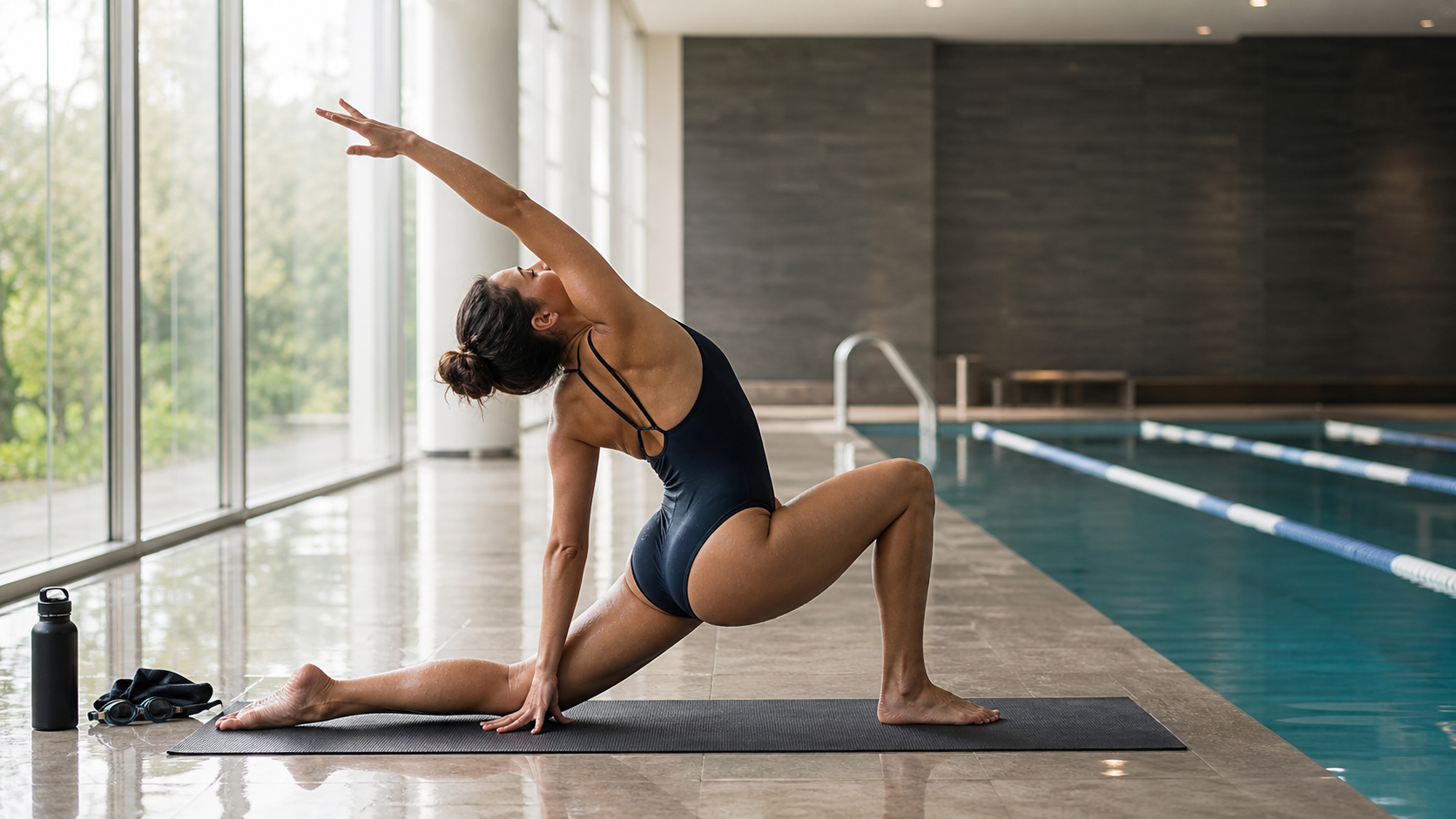
Pigeon Pose: A deep hip external rotation stretch and the single most effective yoga pose for improving breaststroke efficiency. It is recommended to hold for 2–3 minutes per side after every breaststroke session.
Frog Pose (Mandukasana): Directly mimics the leg-opening motion of the breaststroke kick, with knees opening out to the sides and the pelvis slowly sinking toward the floor. This pose is quite uncomfortable initially, but after two months of persistence, the opening angle of the frog kick will show remarkable improvement.
Improving Spinal Flexibility (Butterfly Undulation Optimization)
The most captivating technical element of butterfly is the full-body dolphin undulation, which requires smooth, wave-like mobility along the entire spine from the cervical to the sacral vertebrae.
Cobra Pose (Bhujangasana) and Upward-Facing Dog (Urdhva Mukha Svanasana): Strengthen thoracic extension, the spinal direction most people lack the most.
Bridge Pose (Setu Bandha Sarvangasana): Strengthens the coordinated undulation of the glutes and spine, directly corresponding to the core movement pattern of butterfly.
A Weekly Yoga Plan for Swimmers
Below is a weekly yoga schedule designed specifically for swimmers. No need to attend extra yoga classes—it can be done at home with just a yoga mat:
Before Swimming (10 minutes of dynamic yoga):
- Cat-Cow Pose 10 times (spinal warm-up)
- Dynamic hip rotations 10 times (hip activation)
- Shoulder circles 10 times (shoulder joint warm-up)
After Swimming (20 minutes of static stretching):
- Pigeon Pose, 2 minutes per side
- Threading the Needle, 1 minute per side
- Downward-Facing Dog, 2 minutes
- Supine twist, 1 minute per side
- Corpse Pose (Savasana), 3 minutes
Weekend Deep Yoga Day (30–45 minutes):
- A complete Yin Yoga sequence, holding each pose for 3–5 minutes
- Focus on the hip joints and shoulder girdle
The Body Awareness Complementarity of Swimming and Yoga
Another key benefit of yoga training is the enhancement of “proprioception”—the ability to perceive your body’s position and movement. Technical improvement in swimming relies heavily on proprioception: Is your hand actually in a high position? Is your body truly horizontal? Is your frog kick symmetrical?
The static holds in yoga practice (such as the single-leg balance in Tree Pose or the body awareness in Downward-Facing Dog) systematically improve proprioception, making swimmers more acutely aware of their body movements in the water, and thereby enabling them to absorb coaching feedback more quickly.
Practical Recommendations
- Start with 20 minutes of post-swim yoga twice a week: No need for dedicated yoga classes; YouTube offers a wealth of free “swimmer’s yoga” sessions
- Focus on the hips and shoulders, not leg flexibility: The flexibility most critical for swimming technique improvement lies in the upper body and hip joints; overemphasizing hamstring stretches (such as forward folds touching the toes) offers limited direct benefit to swimming
- Yin yoga is better suited for swimming recovery than Yang yoga: Yin yoga’s long static holds (3–5 minutes per pose) target deep connective tissue, making it more appropriate for post-swim recovery than flow-based yoga
- Film your swimming stroke: After one month of yoga flexibility practice, record yourself again and compare the changes in shoulder entry position and hip rotation
Conclusion
The combination of swimming and yoga is a training pairing where “1 + 1 > 2.” Swimming provides cardiovascular fitness and strength; yoga provides flexibility and body awareness. Swimming is dynamic power; yoga is static wisdom. The two complement each other, making your movements in the water not just powerful propulsion, but fluid artistry.
Related Reading
- The Relationship Between Flexibility Training and Swimming Speed for Competitive Swimmers
- The Flexibility Advantage in Swimming: How Water-Based Exercise Improves Whole-Body Joint Mobility
- Flexibility Training for Swimmers: Ankle, Shoulder, and Thoracic Spine Mobility
- Mobility Training for Swimming: The Impact of Ankle and Shoulder Range of Motion on Kicking and Pulling
[教學] Premiere 影片 手震 修正 教學 防抖 單眼 影像 GoPro 穩定 Video Stabilization
8 年前
抖肩舞 台灣x日本交流版 (台灣 vs 前橋) 赤城山登山賽 coincidance
8 年前
西進武嶺 免費訓練分析服務 Intervals | 練不夠還是練過頭?你哪一種類型選手?AI模型告訴你! | 備戰神器 | 公路車 訓練 | CT Yeh
4 年前
一起升級!海鷗盃LSD團練...JJSC Zone2招待 騎到手抖 / 公路車 / CT Yeh
2 天前
白沙屯媽祖進香在家走!UREVO 坡度自調走步機 / 可連接訓練遊戲APP MyWhoosh / 邊看直播邊走起來 / CT Yeh
11 個月前
訓練台體驗) 2019台北自行車展 三大家 訓練台體驗 Tacx Neo Flux 2 Xepdo Apx Wahoo Kickr
7 年前
抖肩舞 APOLLO RIDE 生日趴 搖滾混音無尺度版 Coincidance 甩肩舞
8 年前
實景訓練台) 彰化經典百K 高強度喵團 90分鐘 跟著一起練功 2019 Indoor workout Changhua Classic 100 Taiwan
7 年前