Swimming Resistance Training: Training Design with Ankle Bands, Drag Parachutes, and Resistance Bands
Introduction
In the swimming training system, resistance training is a key method for improving propulsion and technical stability. Unlike weight-room training, in-water resistance training works directly in the competitive environment, strengthening specific muscle groups, improving stroke efficiency, and allowing athletes to maintain technical form under increased load. The pull buoy, drag chute, and resistance band are currently the three most widely used tools, each with its own training logic and applicable scenarios.
Characteristics and Principles of the Three Resistance Tools
Pull Buoy
The pull buoy is clamped between the thighs, eliminating leg kick and forcing the swimmer to rely entirely on the upper body for propulsion. This method can:
- Isolate upper-body training to improve catch feel
- Strengthen core stability, as trunk rotation relies more on the abdominal muscles once the legs are fixed
- Increase stroke muscle strength, simulating the upper-body-dominant swimming state in the late stages of fatigue
- Reduce energy expenditure, making it suitable for technique-correction sessions
The limitation of the pull buoy is that it artificially increases buoyancy and alters the body’s balance point; long-term reliance may lead to insufficient kick training. It is recommended that its weekly usage not exceed 25% of total training volume.
Drag Chute
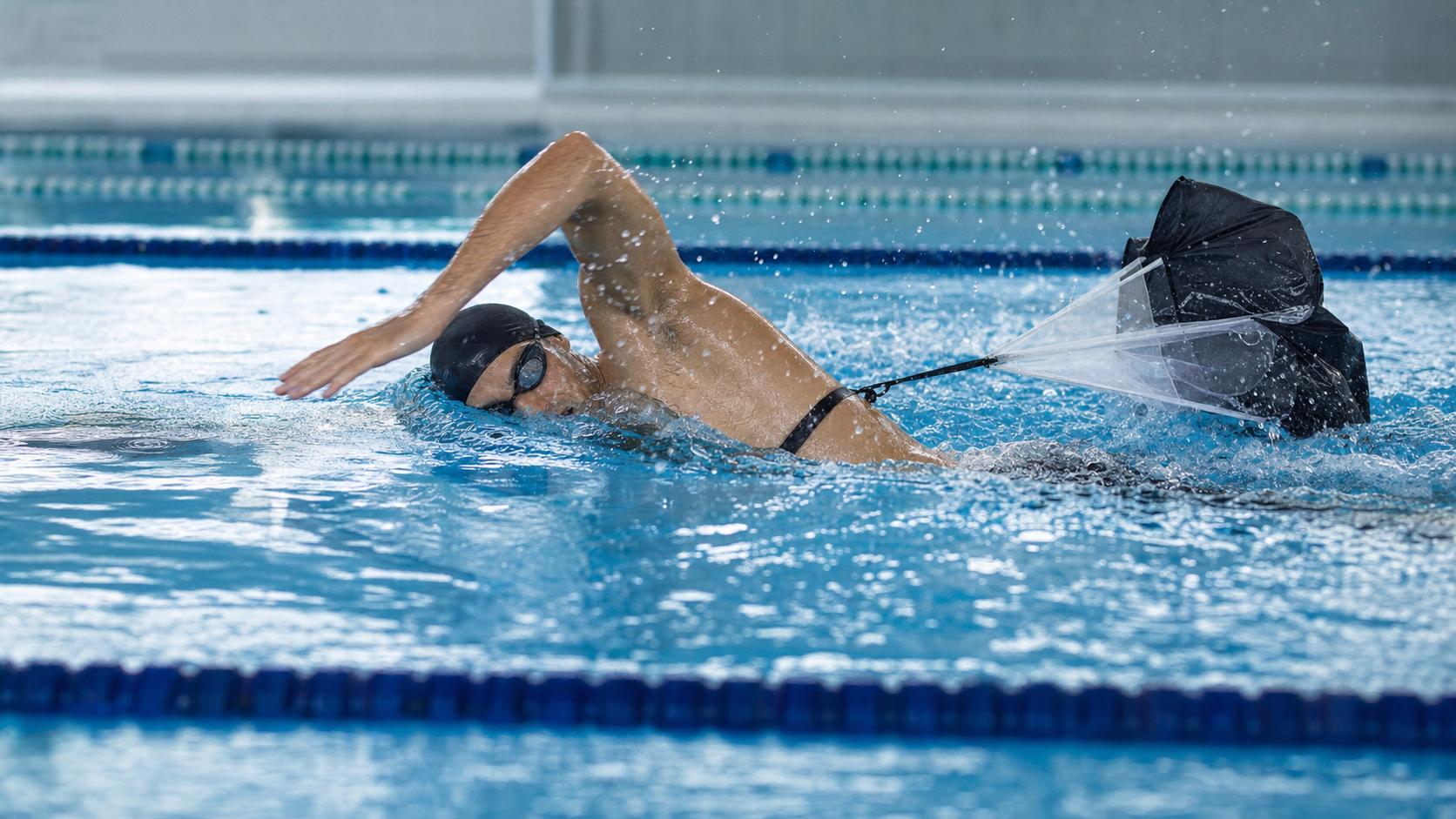
The drag chute is attached to the waist, and when swimming, the chute opens to create water resistance, increasing forward resistance by 20–40% (depending on the chute size). Its training effects include:
- Enhancing whole-body propulsion, as the resistance is evenly distributed to the upper and lower limbs
- Increasing stroke power output, similar to hill training on land
- The “unloading sensation” after removing the resistance post-training helps improve stroke efficiency awareness
When using a drag chute, technique can easily break down due to excessive resistance. Beginners are advised to start with a small chute (low drag coefficient), and each set distance should not exceed 100 meters.
Resistance Band
The resistance band (elastic cord) is tied around both ankles. It provides no buoyancy, allowing swimmers to train with restricted natural kicking motion. Compared to the pull buoy, the resistance band:
- Forces the swimmer to maintain a proper kick rhythm rather than stopping the kick entirely
- Provides lower-limb resistance closer to natural race conditions
- Can diagnose kicking problems: swimmers with asymmetric kicks will show noticeable deviation due to the band
Comparison Table of the Three Tools
| Tool | Primary Training Area | Difficulty | Recommended Use Scenario |
|---|---|---|---|
| Pull Buoy | Upper body, core | Low | Technique sessions, recovery sessions |
| Drag Chute | Whole-body explosive power | High | Speed-building phase |
| Resistance Band | Lower-limb rhythm, whole-body coordination | Medium | Kick technique diagnosis |
Periodized Training Design Recommendations
The periodization of resistance training should align with the intensity cycles of the overall training plan:
Base Phase (3–4 sessions per week)
- Pull buoy: 1,000–1,500 meters per session, focusing on technique correction
- Resistance band: 1–2 times per week, 6×50 meters each time, observing kick symmetry
- Drag chute: not used yet; build the technical foundation first
Strength Phase (4–5 sessions per week)
- Pull buoy: maintain 1,000 meters per session, adding stroke count (SPL) monitoring
- Resistance band: 2 times per week, 8×75 meters each time
- Drag chute: once per week, 4×100 meters, intensity near the aerobic threshold
Sprint Phase (4–6 weeks before competition)
- Contrast training with and without the drag chute: 2×(3×50 meters with chute) + 2×50 meters without chute
- Resistance band: maintain once per week to preserve kick feel
- Stop all resistance training 2 weeks before competition to allow the body to adapt to race conditions
Practical Recommendations
- First-time resistance band use: Test the resistance level while standing in shallow water first, and make sure the ankles are not injured from overtightening
- Before using a drag chute: Check that the strap is secure to prevent it from coming loose during training and affecting other lanes
- Pull buoy dependency: If you notice a significant drop in speed after removing the pull buoy, it means your kick training needs to be strengthened
- Record pace differences: The pace difference between using resistance tools and normal swimming can serve as a quantitative indicator of training progress
- Consult your coach: The usage volume of each tool should be adjusted based on individual technical condition; beginners are advised to have coach guidance first
Conclusion
Resistance training tools are the “leverage amplifiers” of swimming training—used correctly, they accelerate progress; over-relied upon, they may mask technical issues. The pull buoy is suited for strengthening upper-body feel, the drag chute for boosting power output, and the resistance band for diagnosing kick rhythm. When combined with periodized design, the three can effectively translate training gains into race speed.
Related Reading
- Swimming Drag Chutes and Resistance Bands: An Analysis of Professional Assistive Tools for High-Intensity Training
- Swimming Resistance Training: Integrating Paddles, Drag Chutes, and Pull Buoys into Workouts
- The Complete Guide to Swimming Resistance Tools: Application Strategies for Hand Paddles, Drag Chutes, and Resistance Cords
- Swimming Drag Chutes and Drag Socks: A Comparison of Equipment for Adding Resistance Training
訓練台體驗) 2019台北自行車展 三大家 訓練台體驗 Tacx Neo Flux 2 Xepdo Apx Wahoo Kickr
7 年前
西進武嶺 免費訓練分析服務 Intervals | 練不夠還是練過頭?你哪一種類型選手?AI模型告訴你! | 備戰神器 | 公路車 訓練 | CT Yeh
4 年前
CT 喇低賽) 武嶺牽車 才是王道 西進牽車四小時內秘訣 攝手位置 如何判斷 防抽筋小秘訣
7 年前
一日北高 實用 單車手機架!Bone蹦克磁吸單車手機綁 //環島/室內訓練 / 導航的APP推薦 / 日本島波海道取景 / 公路車 / CT Yeh
2 年前
[教學] Premiere 影片 手震 修正 教學 防抖 單眼 影像 GoPro 穩定 Video Stabilization
8 年前
3D 列印車褲墊 / 舒適改善? / 無痕 x 分區壓縮 / ATK & Decider系列 / JE22黑科技 / #公路車 #CTYEH
11 個月前
單車AI教練!全新 ChatGPT4o 幫你分析訓練成果!排武嶺課表,分析騎車姿勢! 太神了! / 公路車 / CT Yeh / feat. 緯緯
2 年前
一日北高前的西濱集訓 | 跟著11小時軍團 | 300W踩不動的大逆風 | 輪車破風差幾瓦?
6 年前