Introduction
Swimming speed = Distance Per Stroke (DPS) × Stroke Rate (SR). This formula looks simple, yet it reveals the core dilemma of swim training: increasing stroke rate often shortens distance per stroke, while increasing distance per stroke tends to lower the rate. Elite swimmers can drive a high stroke rate while maintaining a long distance per stroke—this ability is not innate but developed through systematic stroke rate training.
The Aqua Metronome (commonly known as a waterproof metronome or stroke rate timer) is one of the most effective training tools for this problem. It allows swimmers to hear precise beats in the water, forcing the brain and muscles to coordinate with an external rhythm, thereby establishing new stroke rate habits.
Fundamentals of Stroke Rate
What Is Stroke Rate (SR)
Stroke rate refers to the number of stroke cycles completed per minute (for freestyle, one cycle equals one pull with each arm). Common ways to quantify it:
- Cycles per minute: For example, SR=48 means 48 full arm cycles per minute
- Single-arm strokes per minute: Used by some coaches; the value is double the above
- Tempo per stroke: Expressed in seconds, e.g., Tempo=1.25 seconds/cycle
The Relationship Between Stroke Rate, Distance Per Stroke, and Speed
| Swimmer Type | Typical SR (cycles/min) | Typical DPS (meters/cycle) | Notes |
|---|---|---|---|
| Beginner | 25–35 | 1.0–1.5 | Low rate but poor efficiency |
| Amateur competitive | 36–48 | 1.5–2.2 | Balanced rate and distance |
| Professional | 50–65 | 2.0–2.8 | High rate with high efficiency |
Types of Aqua Metronomes and How to Use Them
Common aqua metronomes available in the Taiwan market:
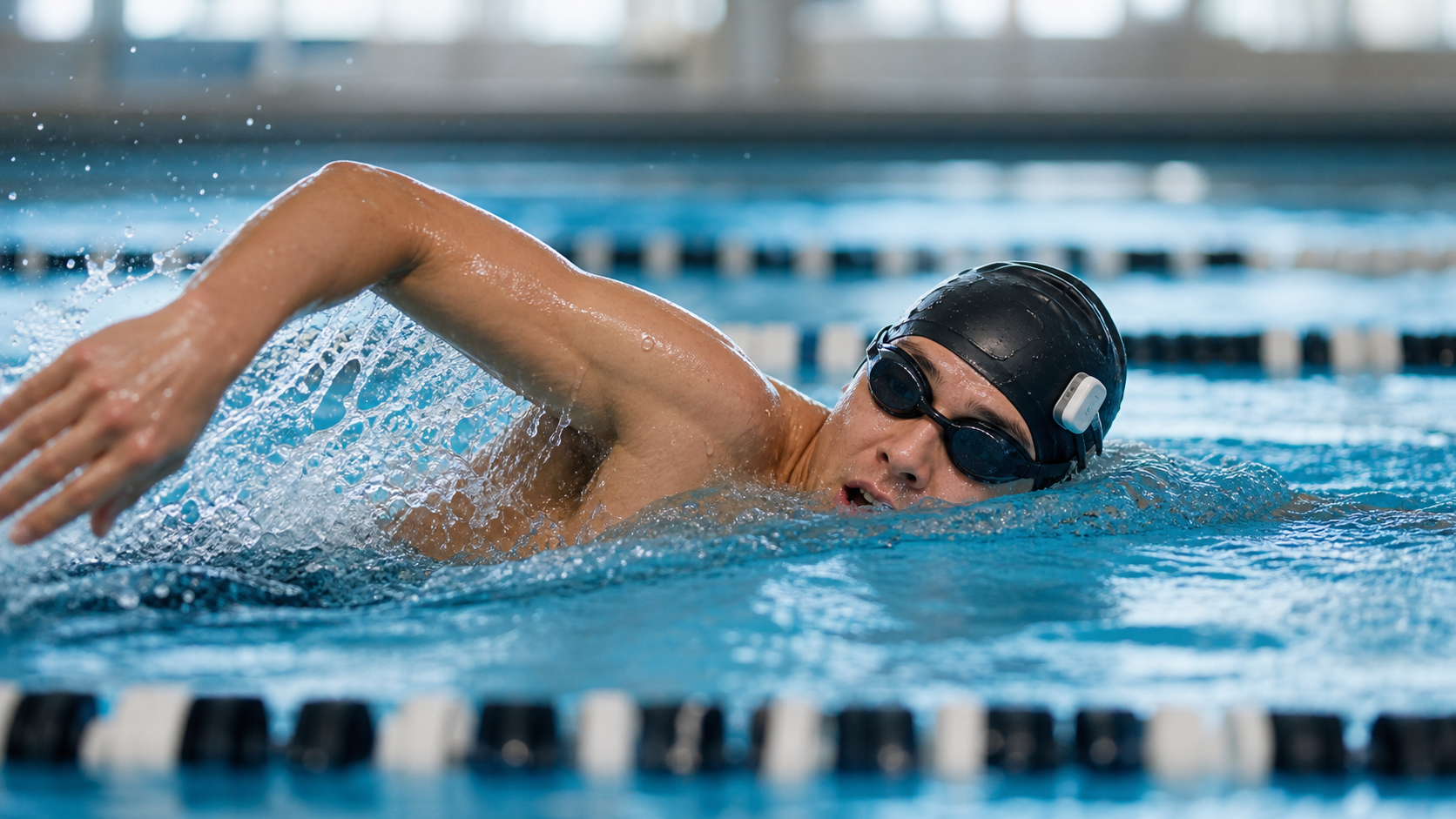
- Tempo Trainer Pro (FINIS brand): The most popular choice—waterproof, compact, and can be clipped under a swim cap or onto goggle straps, transmitting the beat to the swimmer via bone conduction
- Mobile apps with waterproof earphones: Some commercially available waterproof earphones can play metronome sounds; lower cost but with signal transmission latency
- Stroke Count Glove: A mechanical counting method—press to count with each stroke; suitable for counting strokes when no metronome is available
A Systematic Process for Metronome Stroke Rate Training
Step 1: Find Your Baseline Stroke Rate
Without a metronome, swim 100 meters at a comfortable pace. Have someone on deck count the number of stroke cycles completed within 10 seconds, then multiply by 6 to get your strokes per minute (SR). Repeat 3 times and take the average.
Step 2: Identify Your Optimal Stroke Rate Range
Swim 50 meters at each of 4 different tempo settings (baseline SR -4, -2, ±0, +2) and record your pace:
- If speed increases with a higher rate and technique remains acceptable: your optimal SR is above your current baseline
- If speed stays the same with a higher rate but technique breaks down: you need to improve stroke efficiency before increasing the rate
- If speed decreases with a higher rate: your current baseline is already near optimal, and the focus should be on improving DPS
Step 3: Progressive Stroke Rate Progression Workouts
Each training week, increase the metronome setting by 0.5–1 unit (cycles/min):
Weeks 1–2: Adaptation Phase
- Set tempo = baseline SR
- Workout: 8×100 meters, all swum to the metronome rhythm
- Goal: maintain technique under the tempo for more than 80% of the time
Weeks 3–4: Progression Phase
- Set tempo = baseline SR + 2
- Workout: 6×100 meters tempo swimming + 3×50 meters free pace (to feel the difference)
- Goal: maintain distance per stroke without dropping more than 10% under the tempo
Weeks 5–6: Consolidation Phase
- Set tempo = baseline SR + 4
- Workout: 4×200 meters tempo swimming (30 seconds rest between sets)
- Goal: maintain the tempo without errors over longer distances
Step 4: “Internalization” Training Without the Metronome
Once a swimmer can swim steadily at a given tempo, “off-tempo training” is needed—attempting to hold the same rate without the metronome:
- Swim 25 meters listening to the tempo, then swim 25 meters with the metronome off, and compare stroke counts
- If the two stroke counts differ by no more than 1–2 strokes, the rhythm has been internalized
Common Mistakes and Corrections
- Chasing stroke rate at the expense of technique: Setting the metronome too fast, shortening the stroke to match the beat. Correction: drop back to a rate where technique remains stable
- Metronome volume too low: Can’t hear the beat in a noisy pool. Correction: use a bone-conduction model or adjust the clip position
- Not tracking progress: Keep a training log, recording the tempo settings used and corresponding paces each week
Practical Advice
- Stroke rate training should make up 30–40% of each session; use the remaining time for technique or aerobic training
- Different strokes have different ideal stroke rates: butterfly is typically 10–15 units lower than freestyle
- Stroke rate tends to drop naturally when fatigued; continuing tempo training at this point strengthens fatigue resistance
Conclusion
Stroke rate metronome training is the best tool for turning “subjective rhythm” into “objective, quantifiable goals.” Through systematic baseline assessment, progressive increases, and internalization training, swimmers can raise their stroke rate by 4–8 units within 6–8 weeks without sacrificing distance per stroke, ultimately achieving a true breakthrough in speed.
Related Reading
- Swimming Rhythm Training: Using a Metronome to Set Stroke Rate
- Inconsistent Swimming Rhythm: How to Use a Metronome to Regain a Consistent Stroke Rate
- Swimming Rhythm Training: Stroke Rate Control and Technical Stability
- Calculating Swimming Stroke Efficiency: Optimizing Stroke Rate (SR) × Stroke Length (SL)
西進武嶺 免費訓練分析服務 Intervals | 練不夠還是練過頭?你哪一種類型選手?AI模型告訴你! | 備戰神器 | 公路車 訓練 | CT Yeh
4 年前
[教學] Premiere 影片 手震 修正 教學 防抖 單眼 影像 GoPro 穩定 Video Stabilization
8 年前
教學) 如何做出專業 慢動作 影片 Slow Motion 120fps GoPro 7 ActionCam AX700 A99II
7 年前
[教學] Dashware 教學 如何製作有 速度 功率 心律的 騎車影片 Guages Video
8 年前
如何把 GoPro 影片 翻轉 批次 轉正?
6 年前
風櫃嘴 衝刺慢動作回放!
8 年前
武嶺配速表最佳使用方式 #bike
1 年前
西進武嶺 自製新版AI配速表產生器 x 賽前攻略 抱佛腳! 沒有功率計也可以產生配速表嗎?有什麼其他眉角賽前要注意的呢? | 西進武嶺 / 東進武嶺 KOM 攻略 | 公路車 | CT Yeh
4 年前