Introduction
“You can run in any shoes” is technically true, but there’s a world of difference in comfort and injury rates between running in the right shoes and running in the wrong ones. Running shoes are the most important piece of gear for a runner because they are the only cushioning between you and the ground. Beginners don’t need to buy the most expensive model, but they absolutely need a pair that fits their foot type.
Basic Concepts to Understand Before Buying Shoes
Arch Type
Understanding your arch type is the first step in choosing shoes:
| Arch Type | Characteristics | Recommended Shoe Category |
|---|---|---|
| Normal Arch (Neutral) | Clear curve in the middle of the footprint | Neutral Cushioned Shoes |
| Low Arch (Flat Feet) | Footprint is nearly complete, almost no curve | Stability/Motion Control Shoes |
| High Arch | Very narrow or even broken middle section in the footprint | Cushioned Shoes |
How to test your arch: The “Wet Foot Test”—step on a piece of cardboard with wet feet and observe the shape of your footprint.
Foot Width
Taiwanese feet are generally wider than the standard lasts of Western brands. Pay special attention when choosing shoes:
- Whether the forefoot feels compressed
- Whether the little toe is squeezed by the upper
- Some brands offer wide versions (Wide, often labeled 2E or 4E)
Drop
The drop is the difference between the heel height and the forefoot height, measured in millimeters:
- High Drop (10-12mm): Traditional design, suitable for beginners who are used to heel striking
- Medium Drop (6-8mm): Currently the most mainstream, suitable for most people
- Low Drop (0-4mm): Closer to a barefoot running feel; recommended only for those with a running foundation
Beginners are advised to start with a medium to high drop to lower the barrier to entry.
The Right Way to Try On Running Shoes
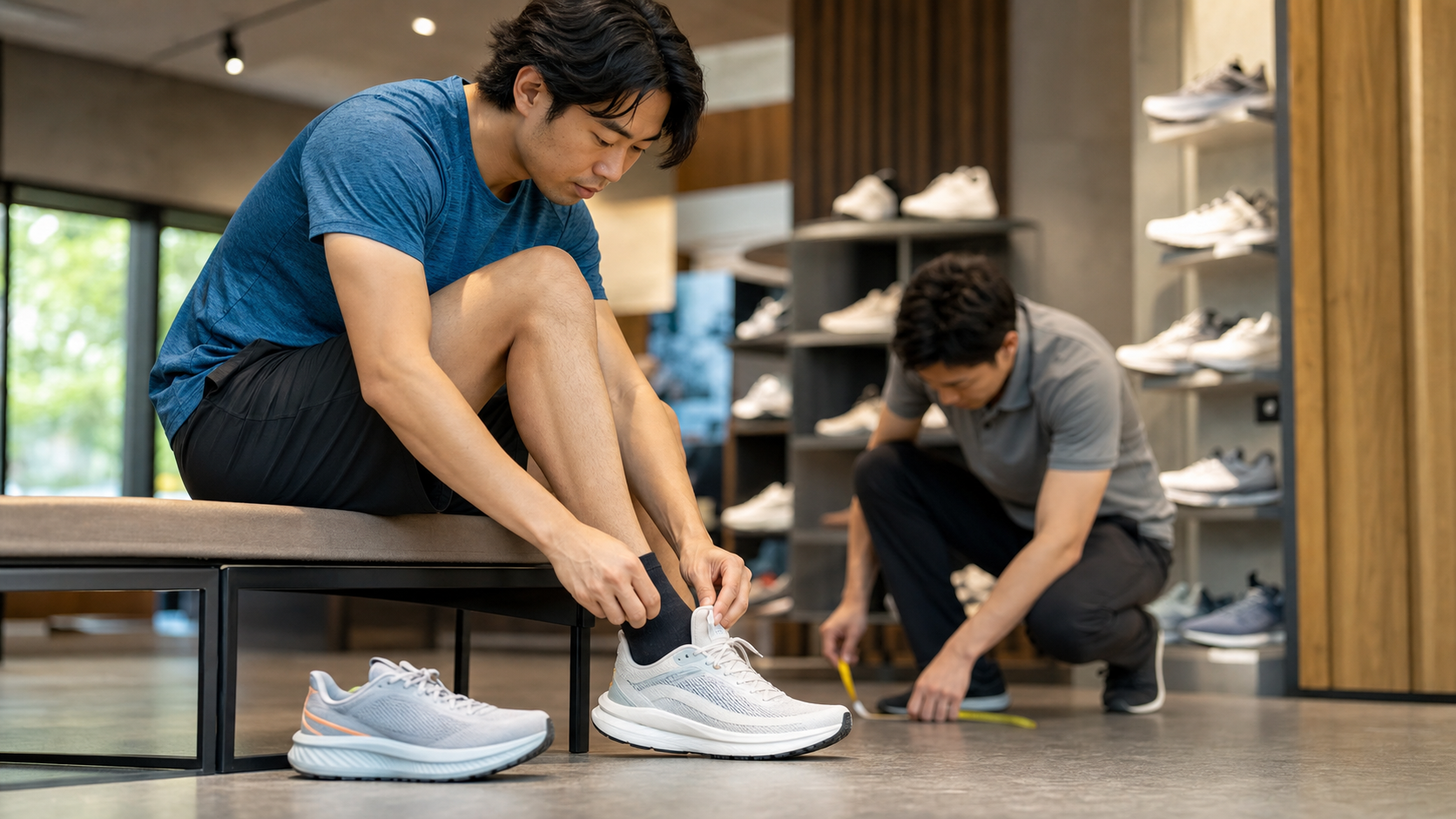
This is the most overlooked step, and also the most important. Here is the complete process for trying on shoes at a physical store:
7 Steps for Trying On
- Go in the afternoon or evening: Your feet swell slightly later in the day, and the size at that time is closest to how they’ll be during a run.
- Wear the same thickness of socks you run in: The difference between thin socks and thick cotton socks can be as much as half a size.
- Measure both feet: Most people have slightly different-sized feet; go with the larger one.
- Choose half to a full size larger than your everyday shoes: Your feet slide forward when running, and your toes need room to move (leave about one thumb’s width between your big toe and the front of the shoe).
- Test while standing: Stand up and feel whether the heel fits snugly and whether the forefoot feels compressed.
- Jog a few steps in the store: Let the staff observe your foot motion on landing; quality running shoe specialty stores will help analyze this.
- Test lacing methods: Try whether the “Runner’s Knot” can solve heel slippage.
Conditions That Must Be Ruled Out
- If anything feels tight or uncomfortable immediately after putting the shoes on: don’t buy them, no matter what the staff says
- Toes touching the front of the shoe: the size is too small
- Foot sliding back and forth more than 1cm inside the shoe: the size is too big or the laces need to be tighter
Common Beginner-Recommended Models in the Taiwan Market
The following are currently mainstream entry-level models (not sponsored; described by characteristics):
| Brand | Features | Suitable For |
|---|---|---|
| Nike Pegasus Series | Medium cushioning, slightly narrow fit, good for narrow feet | Beginners with normal to narrow feet |
| ASICS Gel-Nimbus / GT Series | Combines cushioning and stability, wider fit | Friendly for Taiwanese foot shapes |
| Brooks Ghost Series | Neutral cushioning, excellent durability | Suitable for most beginners |
| HOKA Clifton Series | Ultra-thick sole cushioning, comfortable on landing | Heavier runners or those with sensitive knees |
| Mizuno Wave Rider Series | Lightweight and stable, good energy return | Lightweight beginners with neutral feet |
Common Myth-Busting
- “The more expensive, the better”: Wrong. The most expensive carbon-plated racing shoes are not suitable for beginner daily training and may increase injury risk.
- “The lighter the running shoe, the better”: True for advanced runners, but for beginners, cushioning and support matter more than weight.
- “Buy it only if it looks good”: Running shoes are functional products; appearance is the last consideration.
Practical Advice
- Don’t buy your first pair of running shoes online: You must try them on at a physical running shoe specialty store (not a general sports goods store).
- Recommended running specialty stores in Taiwan: Cities have GARMIN experience stores, Running Innov8, or brand flagship stores, where trained staff can provide foot analysis.
- A pair of running shoes lasts about 500 to 800 km: Don’t keep using them after they’re worn out, as cushioning performance has significantly declined.
- You can rotate between two pairs of running shoes: Giving the foam cushioning 24 hours to recover can extend the life of the shoes.
Conclusion
Choosing the right pair of running shoes isn’t complicated—it just takes an afternoon of serious trying-on at a physical store. This investment will determine your running experience for the next several hundred hours, and it’s absolutely worth it.
Related Reading
- Beginner’s Guide to Choosing Running Shoes: Finding Your First Perfect Pair
- The Science of Running Shoe Selection: Foot Type Analysis, Cushioning Needs, and Who Should Use Carbon-Plated Shoes
- Road Running Shoe Buying Guide: Arch Type, Cushioning Needs, and Mileage Lifespan
- Road Running Shoe Buying Guide: Correct Matching of Foot Types (Flat, Normal, High Arch) with Shoe Models
單車 一日北高 ( 雙城 ) 肥宅雙人瘋狂行 紀錄片 REACTO
10 年前
一日北高常見問題大集合 | 攻略 | 路線 | 訓練 | 補給 | 自行車 單車 | 一日雙城 | 雙塔 | TWB北高360 | 屁股痛
6 年前
#公路車 #Fitting 靠人工智慧APP 幫你調整單車
6 年前
滑雪新手們慘摔學習全紀錄(請開字幕),滑雪好好玩 | Snowboard + Ski | 岩原 スキー場 | 滑雪APP使用 | GoPro Max
6 年前
一日北高前的高裝檢 | 北高 360 | 挑戰11小時的裝備 | 一日雙塔 | 補給
6 年前
白沙屯媽祖進香在家走!UREVO 坡度自調走步機 / 可連接訓練遊戲APP MyWhoosh / 邊看直播邊走起來 / CT Yeh
11 個月前
大家都在開箱的...單車用藍芽對講耳機真的有幫助嗎? SENA BiKom 20 長距離旅遊 & 海鷗繞圈賽 實際體驗心得 / 公路車 / CT Yeh
9 個月前
再快都跟的上!? 單車跟隨攝影機之王 HOVERAir X1 PROMAX 全面實測 / 唯一!8K畫質&自行車專用模式和跟蹤信標&前後避障 / DJI Neo 可參考/ 公路車 / CT Yeh
1 年前