Introduction
Every race-day morning, nearly all riders face the same anxiety: What should I eat? How much? When? Getting these three questions wrong can put you at a disadvantage before you even reach the starting line—either with gastrointestinal discomfort or a premature blood-sugar crash. Race-day breakfast isn’t complicated, but it requires systematic planning based on physiology, not a spur-of-the-moment decision made right before the event.
Why Is the Pre-Ride Breakfast So Important?
Glycogen Status After Overnight Fasting
After 7–9 hours of sleep, even if you completed carbohydrate loading the night before, liver glycogen—the primary source for maintaining blood sugar—will be depleted by about 30–40%. If you head to the race on an empty stomach, your brain may start “stealing” muscle glycogen within 30–45 minutes after the start, accelerating fatigue.
The Three Key Functions of Breakfast
- Replenish liver glycogen: Maintains stable blood sugar for the first 2 hours after the start
- Provide psychological reassurance: Research shows that athletes who eat before a race experience lower pre-race anxiety
- Prevent skeletal muscle breakdown: Prolonged fasting combined with high intensity can push the body to break down muscle protein for energy
Optimal Timing for Eating
Timing is closely tied to food choices:
| Time Before Race/Ride | Food Type | Recommended Portion |
|---|---|---|
| 3–4 hours before | Full meal (rice, noodles, bread + protein) | More substantial, 600–800 kcal |
| 2–3 hours before | Moderate carbohydrates (congee, toast, oatmeal) | Moderate, 400–600 kcal |
| 1–2 hours before | Easily digestible carbohydrates (banana, white toast) | Light, 200–300 kcal |
| 30–45 minutes before | Small amount of fast carbs (half an energy bar, sports drink) | 50–75 g carbs |
| Less than 30 minutes before | Solid food not recommended; sports drink only | — |
Golden rule: Eat your main meal at least 2–3 hours in advance, giving your digestive system enough time to process the food.
Best Breakfast Food Choices
Carbohydrate Selection
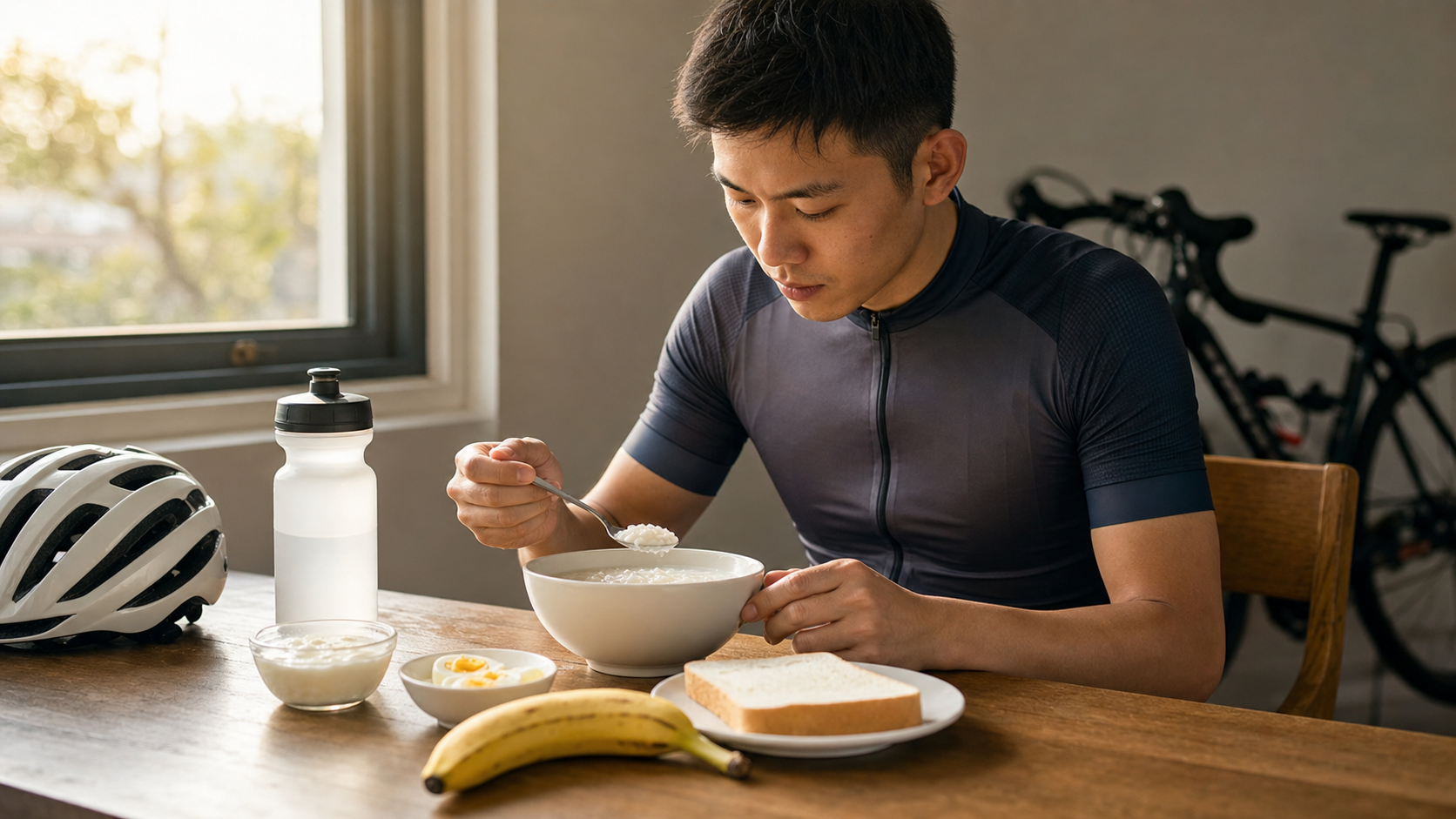
- Preferred: White rice, plain congee, white toast, oatmeal, bananas, white noodles
- Reason: Low in fiber, fat, and protein, they digest quickly without burdening the gut
- Avoid: High-fiber grains (such as whole wheat), legumes, cruciferous vegetables (broccoli, cabbage), spicy foods
Protein Selection and Portion
Pre-race breakfast doesn’t need much protein; its main role is to stave off hunger and slow carbohydrate digestion (preventing a sharp blood-sugar spike followed by a crash).
- Recommended portion: 15–25 g of protein
- Sources: Boiled eggs (1–2), low-fat yogurt, a small amount of chicken breast
- Avoid: High-fat proteins (such as ham and eggs, bacon), which take longer to digest
Fat Control
- Fat digests the slowest; consuming more than 15–20 g of fat at breakfast can cause a heavy stomach during the race
- Avoid fried foods, large amounts of nuts, and thick buttered toast
Practical Race-Day Breakfast Plans for Taiwan
Plan 1 (3–4 hours before)
One bowl of white rice (about 160 g cooked) + 2 boiled eggs + a small portion of stir-fried vegetables
→ Approximately 550 kcal, 70 g carbs, 18 g protein, 8 g fat
Plan 2 (2–3 hours before)
Oatmeal (60 g quick oats + 250 ml milk) + 1 banana
→ Approximately 450 kcal, 75 g carbs, 14 g protein, 6 g fat
Plan 3 (1–2 hours before)
2 slices of white toast + honey + 1 banana
→ Approximately 350 kcal, 70 g carbs, 7 g protein, 4 g fat
Plan 4 (Out-of-town races, hotel breakfast)
2 white rice balls + 1 bottle of low-sugar soy milk (350 ml)
→ Approximately 480 kcal, 80 g carbs, 15 g protein, 7 g fat
Pre-Race Hydration
- Upon waking: 400–600 ml of water (to replenish fluid lost during sleep)
- With breakfast: avoid excessive coffee (it’s diuretic); pair with diluted sports drink or water
- 30 minutes before the start: 250–350 ml of sports drink (to top up sugar and electrolytes)
Practical Tips
- Rehearse your breakfast during training days in the week before the race to confirm compatibility with your stomach; never try new foods on race day.
- Log your breakfast and performance for each event to build a personalized optimal breakfast formula.
- Sensitive stomachs should choose a more conservative plan: banana + energy bar + sports drink is the lowest-risk option.
- Don’t skip breakfast out of nervousness: riding on an empty stomach will almost certainly lead to energy depletion in longer distances.
- Prepare a backup breakfast: for out-of-town races, pack white toast, bananas, and instant oatmeal the night before in case the hotel breakfast isn’t suitable.
Conclusion
Part of your race-day performance is decided before you even start. A well-designed pre-race breakfast isn’t just about filling your stomach—it’s about building the energy foundation for the hours of high-intensity output ahead. Starting today, make breakfast planning part of your pre-race checklist, and let every bite do its job.
Related Reading
- Runner’s Breakfast Design: Ideal Carb-to-Fat Ratio 3 Hours Before the Race
- Road Runner’s Breakfast Design: Best Eating Timing on Race Morning
- Breakfast vs. Fasted Training: How to Schedule Meals Around Different Workouts
- Trail Race Day Breakfast: What to Eat 3 Hours Before the Start So Your Stomach Doesn’t Rebel at 10K
CT暗黑廚房) 車友必備 宇宙無敵鮮蚵湯 幫助訓練恢復 天然食補 好市多 超肥鮮蚵 破PR
7 年前
一日北高前的高裝檢 | 北高 360 | 挑戰11小時的裝備 | 一日雙塔 | 補給
6 年前
一日北高/長距離團騎 常見問題補充篇 / 組團或跟團的眉角 / 壯車友容易被瘦車友慢性拉爆 / 原來屁股痛可能是這個原因...? / 風場配速法 / 公路車 / CT Yeh
2 年前
西進武嶺 自製新版AI配速表產生器 x 賽前攻略 抱佛腳! 沒有功率計也可以產生配速表嗎?有什麼其他眉角賽前要注意的呢? | 西進武嶺 / 東進武嶺 KOM 攻略 | 公路車 | CT Yeh
4 年前
#公路車 #Fitting 靠人工智慧APP 幫你調整單車
6 年前
FTL 與 SYB 車隊專訪 西進武嶺 實用攻略分享! 2小時 如何練?!你不知道的眉角!新手準備武嶺必看 EP1 | 實力派女車友 | 精華版 | 公路車 | CTYeh
4 年前
CT 喇低賽) 武嶺牽車 才是王道 西進牽車四小時內秘訣 攝手位置 如何判斷 防抽筋小秘訣
7 年前
西進武嶺 免費訓練分析服務 Intervals | 練不夠還是練過頭?你哪一種類型選手?AI模型告訴你! | 備戰神器 | 公路車 訓練 | CT Yeh
4 年前