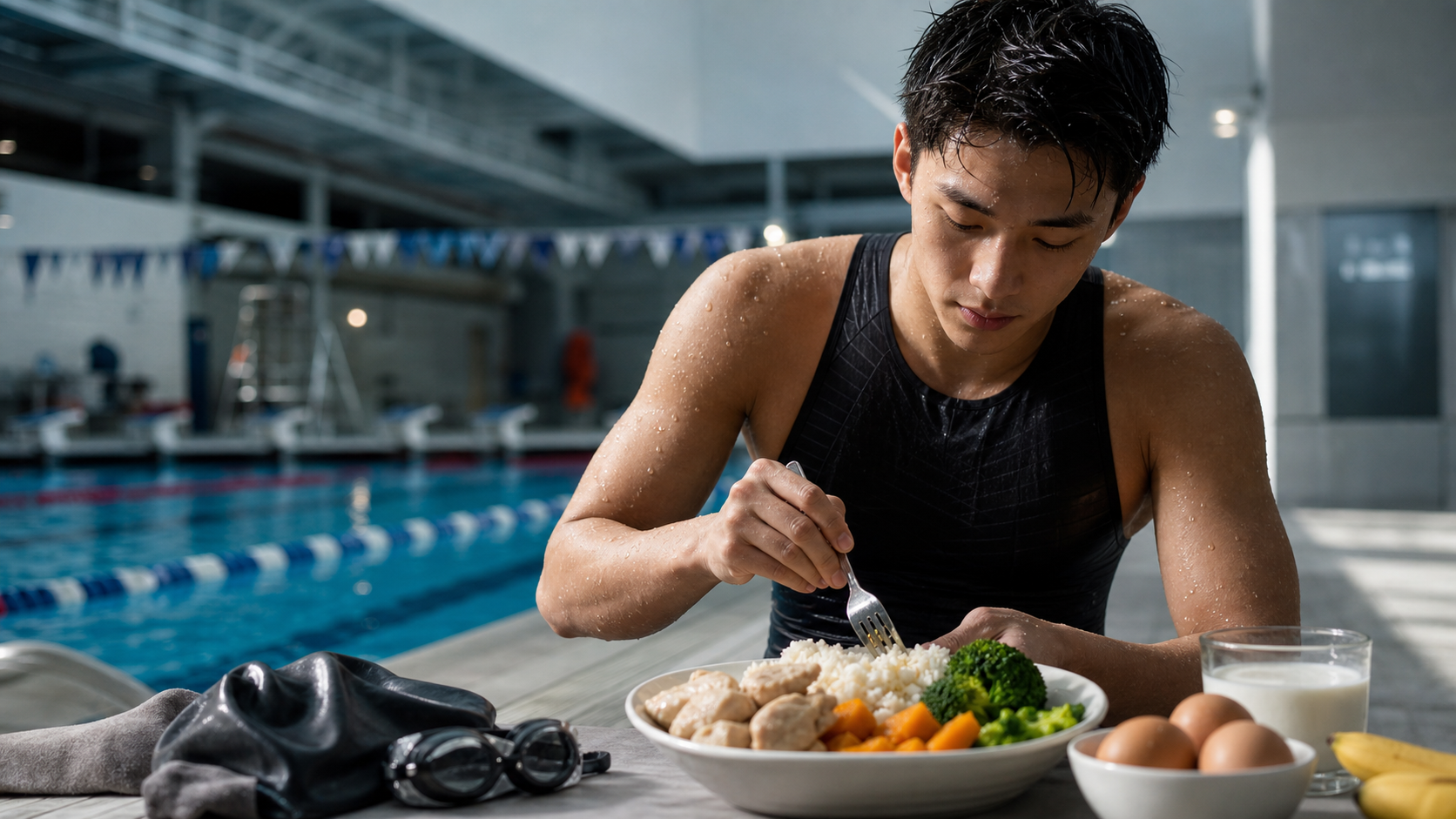
Introduction
Swimming is a full-body aerobic exercise that can burn 400–800 calories per hour, far higher than many people imagine. Surprisingly, swimmers often feel less hungry after swimming than after running—the cold water environment suppresses appetite, leading athletes to mistakenly believe they don’t need to replenish as much energy. Long-term hidden energy deficits can affect recovery or lead to “Relative Energy Deficiency in Sport” (RED-S), damaging bone density, immune function, and hormonal balance.
Basic Caloric Calculation
A swimmer’s daily caloric needs = Basal Metabolic Rate (BMR) × Activity Factor
Step One: Calculate Basal Metabolic Rate (Mifflin-St Jeor Formula)
- Men: BMR = (10 × weight kg) + (6.25 × height cm) − (5 × age) + 5
- Women: BMR = (10 × weight kg) + (6.25 × height cm) − (5 × age) − 161
For example, a 22-year-old male athlete weighing 70 kg and standing 178 cm tall:
BMR = (10 × 70) + (6.25 × 178) − (5 × 22) + 5 = 700 + 1112.5 − 110 + 5 = 1707.5 kcal
Step Two: Multiply by Activity Factor
| Training Intensity | Activity Factor | Description |
|---|---|---|
| Light Activity | 1.375 | 1–3 light swim sessions or technique drills per week |
| Moderate Activity | 1.55 | 4–5 training sessions per week, each 60–90 minutes |
| Heavy Activity | 1.725 | Daily training, with double sessions on some days |
| Very Heavy Activity | 1.9 | Daily double sessions, peak season |
If the above example athlete trains daily (1.725):
Daily caloric needs ≈ 1707.5 × 1.725 ≈ 2945 kcal
Step Three: Add Extra Training Expenditure
Caloric expenditure in swimming varies greatly by stroke and intensity:
| Stroke | Intensity | Caloric Burn per Hour (70 kg Athlete) |
|---|---|---|
| Freestyle | Moderate | About 500–600 kcal |
| Freestyle | High | About 700–800 kcal |
| Butterfly | Moderate-High | About 650–750 kcal |
| Backstroke | Moderate | About 400–500 kcal |
| Breaststroke | Moderate | About 450–550 kcal |
Understanding Relative Energy Deficiency in Sport (RED-S)
RED-S was formerly known as “Female Athlete Triad,” but it is now confirmed that both men and women can be affected. When long-term energy intake is insufficient to support training expenditure, the body “shuts down” non-essential functions:
Early Symptoms:
- Persistent fatigue, declining training performance
- Mood swings, reduced concentration
- Frequent colds or injuries
- Poor sleep quality
Long-term Consequences:
- Decreased bone density (increased risk of stress fractures)
- Menstrual cessation or irregularity in female athletes
- Decreased testosterone and muscle loss in male athletes
- Weakened immune function, compromised gut health
In Taiwan, swimmers face RED-S risks due to cultural myths that “thin equals fast” and suppressed appetite after training.
Weight Management: Adjusting Without Compromising Performance
Safety Principles for Weight Loss
- Maximum weekly weight loss of 0.5 kg: Faster rates mean losing muscle rather than fat
- Daily caloric deficit not exceeding 500 kcal: Larger deficits impair training quality and recovery
- Protein cannot be reduced: During weight loss, maintain 1.8–2.2 g of protein per kg of body weight to prevent muscle loss
- Avoid weight loss during peak season: Prioritize maintaining weight in the 4 weeks before competition
Caloric Strategies for Different Phases
| Training Phase | Caloric Recommendation | Focus |
|---|---|---|
| Base Phase (Low Training Volume) | Maintain or slight deficit | Moderate adjustment of body composition |
| Build Phase (High Training Volume) | Adequate calories or slight surplus | Ensure recovery and adaptation |
| Pre-competition Phase | Adequate calories + increased carbs | Glycogen supercompensation |
| Post-competition Recovery Phase | Slight surplus | Repair tissues, reduce inflammation |
Macronutrient Distribution Recommendations
For swimmers training daily, recommended macronutrient ratios are as follows:
- Carbohydrates: 50–60% of total calories (up to 65% on endurance training days)
- Protein: 20–25% of total calories (1.6–2.0 g per kg of body weight)
- Fat: 20–30% of total calories (should not drop below 20%, or hormonal function is affected)
Practical Recommendations
- Use a dietary tracking app: Record intake for 2–3 weeks with MyFitnessPal or Cronometer to understand actual consumption before adjusting.
- Differentiate training and rest days: Increase carbs on training days, moderately reduce on rest days; do not follow the same diet every day.
- Don’t be overly anxious about weight numbers: Weight may rise temporarily after training due to increased muscle water, which is a normal adaptation response.
- Seek help from a sports nutritionist: If you have weight goals or health concerns, consult a certified sports nutritionist for a personalized plan.
Conclusion
Swimmers’ caloric needs are far higher than average and fluctuate with training phases. Understanding actual needs, avoiding long-term energy deficits, and adhering to safety principles during weight management will allow training results to fully translate into competitive performance. Remember: being fast in the water isn’t about starving, but eating right.
Related Reading
- Daily Caloric Needs for Swimmers: Differences Between High-Volume and General Training
- Swimmers’ Dietary Strategies: In-season Weight Management and Carb Loading Plans
- The Truth About Swimmer Weight Management: Complete Analysis of Caloric Expenditure Calculation and Appetite Compensation Effect
- Swimmer Weight Control: Dietary Compensation Issues for High-Volume Swimmers
CT暗黑廚房) 車友必備 宇宙無敵鮮蚵湯 幫助訓練恢復 天然食補 好市多 超肥鮮蚵 破PR
7 年前
靠單車減肥35公斤 心得分享與整理
7 年前
西進武嶺 免費訓練分析服務 Intervals | 練不夠還是練過頭?你哪一種類型選手?AI模型告訴你! | 備戰神器 | 公路車 訓練 | CT Yeh
4 年前
#公路車 #Vo2Max #最大攝氧量 測驗 體驗 | 心肺測試
6 年前
16/02/16 - 夜訪中社路 緩慢進步中
10 年前
2016/4/20 - 中社路 夜騎 半年甩肉14KG 後測
10 年前
一日北高常見問題大集合 | 攻略 | 路線 | 訓練 | 補給 | 自行車 單車 | 一日雙城 | 雙塔 | TWB北高360 | 屁股痛
6 年前
一日北高/長距離團騎 常見問題補充篇 / 組團或跟團的眉角 / 壯車友容易被瘦車友慢性拉爆 / 原來屁股痛可能是這個原因...? / 風場配速法 / 公路車 / CT Yeh
2 年前